The 1851 Religious Census was a unique survey of all identified places of religious worship then in existence, including Nonconformist and Catholic chapels and Jewish synagogues as well as Church of England churches. It took place on March 30th, 1851. The objectives were to:-
1. identify the number or seats available in relation to the population, and
2. measure religious attendance on that day.
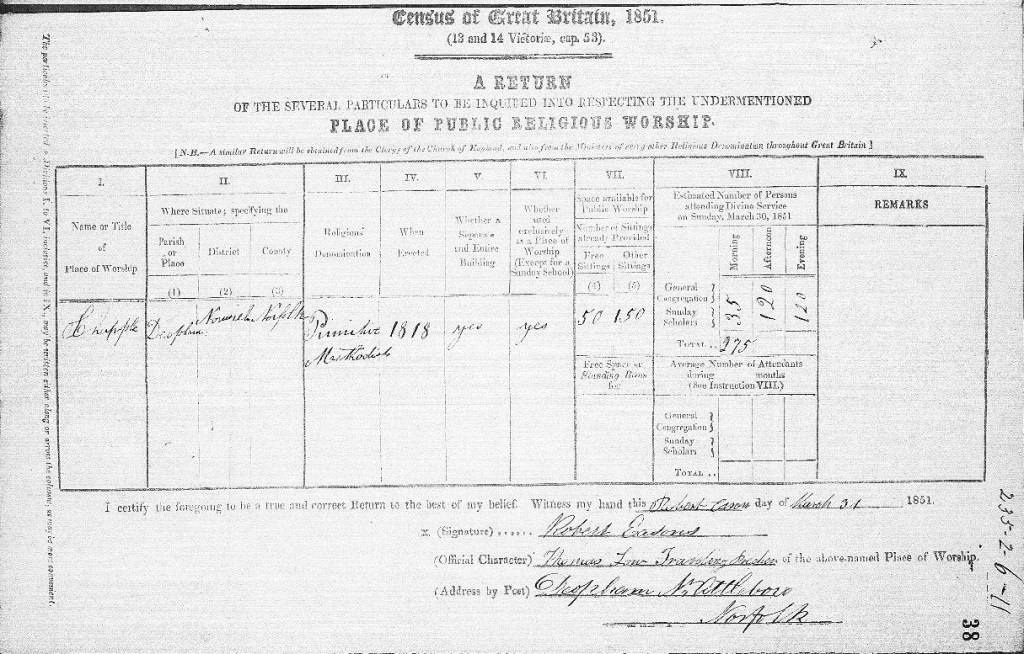
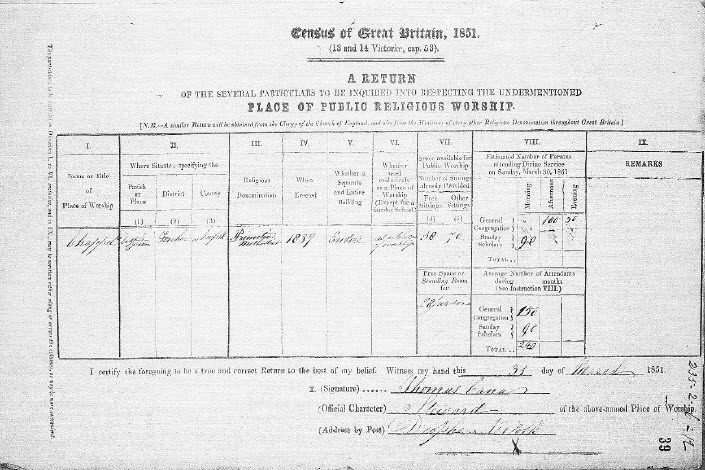
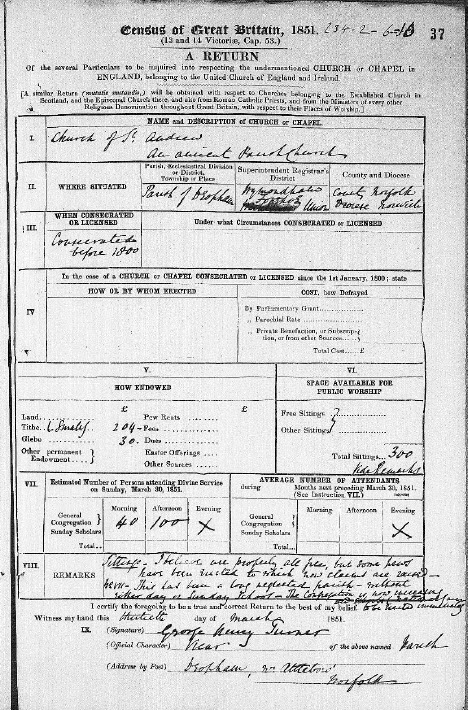
The results were published in 1853 in a consolidated form. However, the individual returns were published in 1998 by the Norfolk Records Society, Volume LXII, ‘Religious Worship in Norfolk: The 1851 Census of Accommodation and Attendance at Worship’, edited by Janet Ede and Norma Virgoe. The figures for Deopham (pages 150-151) were:-
| Free Seats | Other Seats | Standing | Morning attendance | Afternoon attendance | Evening attendance | Signatories | |
| Deopham Common | 50 | 150 | 35 | 120 | 120 | Robert Eason Thomas Low | |
| Deopham Green | 58 | 70 | 28 | 90 “Sunday scholars” | 100 | 50 | Thomas Cana |
| Parish Church | 300 | 40 | 100 | George Henry Turner, Vicar |
The population of the village at this time was 494.
It is impossible to tell how many worshippers attended more than one service. One wonders too how genuine these figures would have been since it was known in advance that this was a significant day. The Low Common chapel brought in the circuit’s star preacher (see here).
The Parish Church figures look remarkably good considering that the vicar was complaining at the time that “this has been a long neglected church”.
The census notes on free sittings contain the following comments:
… how much of the accommodation proved to be existing is available for the use of that great part of the community most needing spiritual education, and least able, by pecuniary outlay, to procure it? What proportion of our present provision is at the service of the poorer classes, without price? For the purpose of ascertaining this, inquiry was made, as to every place of worship, how many of the sittings were ” free”; the meaning of the term being “free to any persons wishing, without payment, to occupy them.”1
The Parish Church shows all seats to be “free” – i.e. not appropriated to specific worshippers. The vicar notes however on his return that “I believe [sittings] are properly all free, but some pews have been erected to which now claims are raised”.
It has also been identified that seats were declared as “free” where no “pew rent” was being charged. However, it could still mean that pews were appropriated either by custom or the authority of the church officers to particular persons.2
The following images of the source documents are not too clear. However the Low Common document is important to emphasise that the year of construction, 1818, has been correctly transcribed.
© National Archives, Kew Ref HO 129/235
Footnotes
- Census of Great Britain, 1851 Horace Mann Horace, Lincoln’s Inn ↩︎
- There is a detailed discussion of this problem in Rival Jerusalems by K.D.M. Snell & Paul S. Ell pp 343ff ↩︎
| Date | Change |
|---|---|
| 5/11/23 | Comments on “free” seats |
| 4/11/22 | Published |
 Deopham History