Other name: Camp Land
Contents
Introduction
There is a field near Deopham church that is called Camp Lands or Camping Lands. This has nothing to do with tents, but refers to the ancient game of Camp-Ball. This game has medieval origins, although the oldest reference in Deopham is in 1807.
Whilst camp-ball is often linked to football, the use of hands in camp-ball links it more directly with rugby. The camping lands on which the game was played were often situated near the church since the matches; Robert Forby has written1 that there was a time “when the lads of the village regularly repaired thither, after evening service on Sundays, to play foot-ball and other games”.
The game was a particularly East Anglian phenomenon.
Location of the field
The 1807 Survey and Valuation of the Manor & Parsonage of Deopham on Page 3 shows 3½ acres called Camp Lands being used for the growing of oats. There is no accompanying map for this survey.
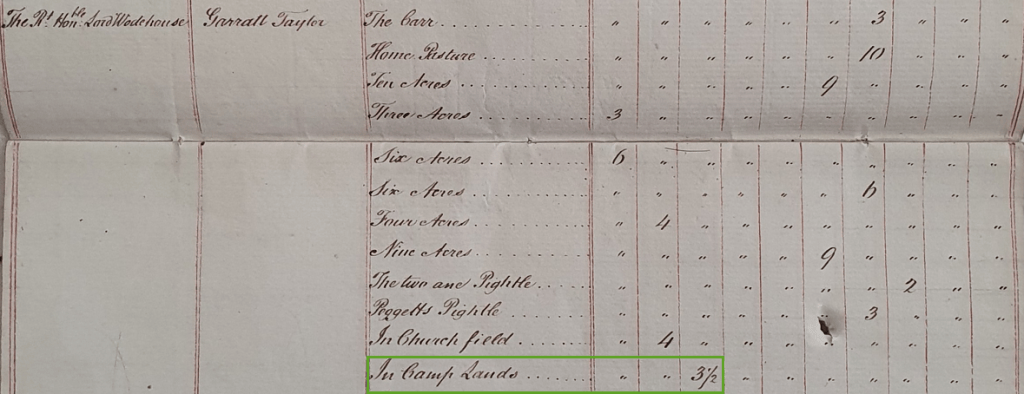
Reproduced courtesy of the Chapter of Canterbury; their ref CCA/U63/70380
The following extract from a plan of Church Farm after the completion of the inclosure process (i.e. sometime shortly after 1814) shows the Camping Lands as piece no 8:
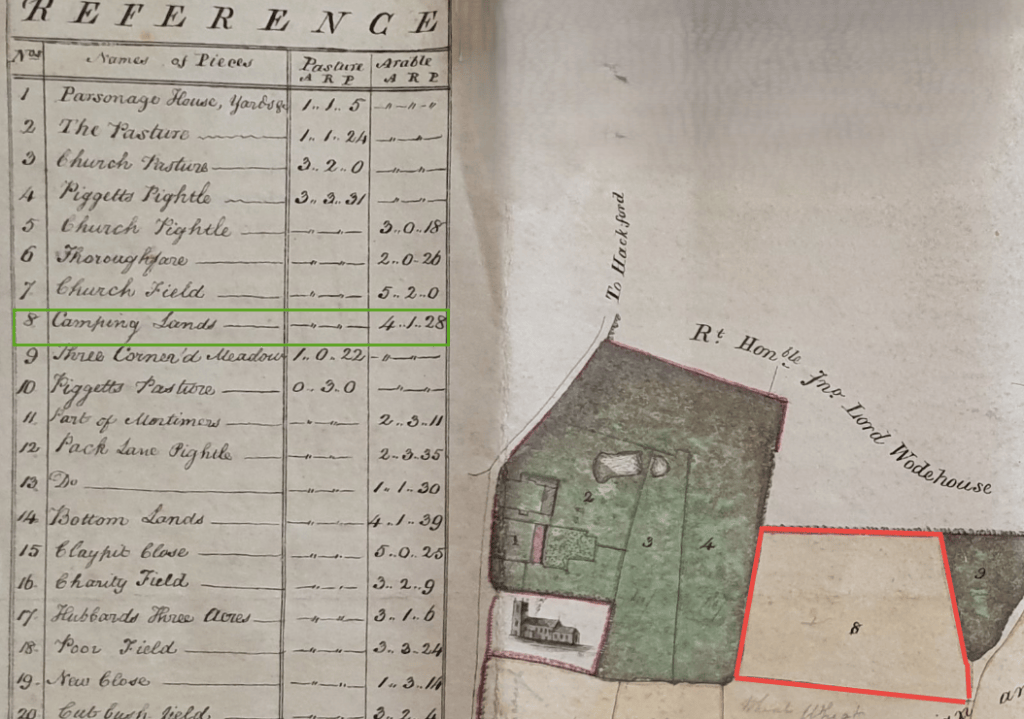
Reproduced courtesy of the Chapter of Canterbury; their ref: CCA/U63/70380
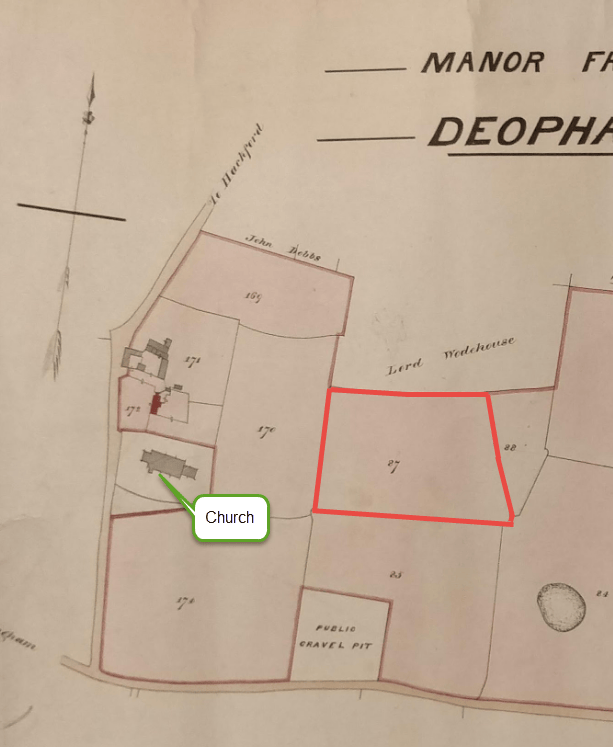
The Camp Lands are identified as piece no 87 and clearly identifiable on the attached plan:
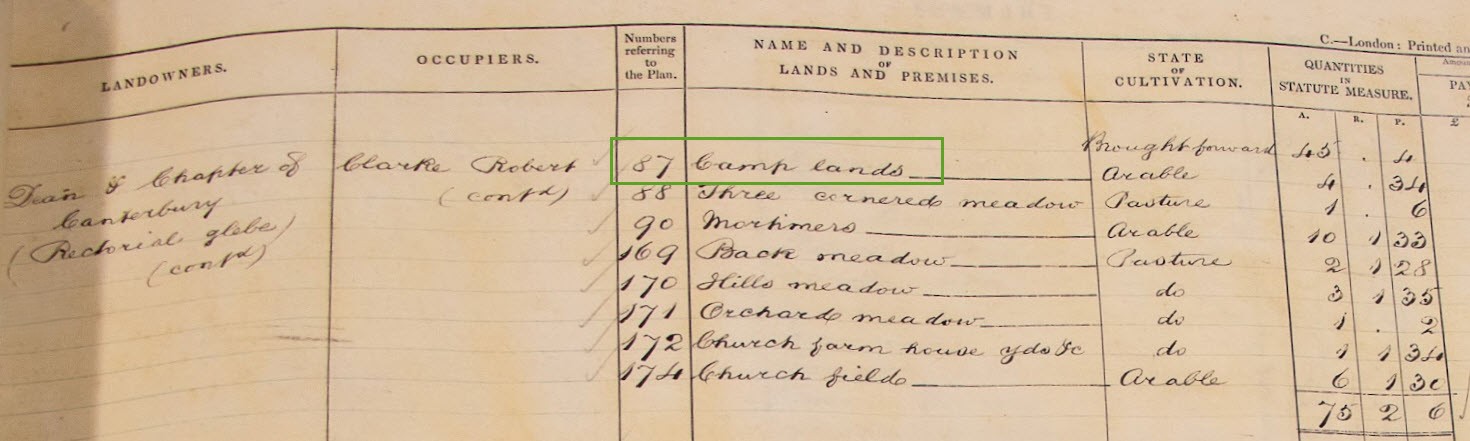
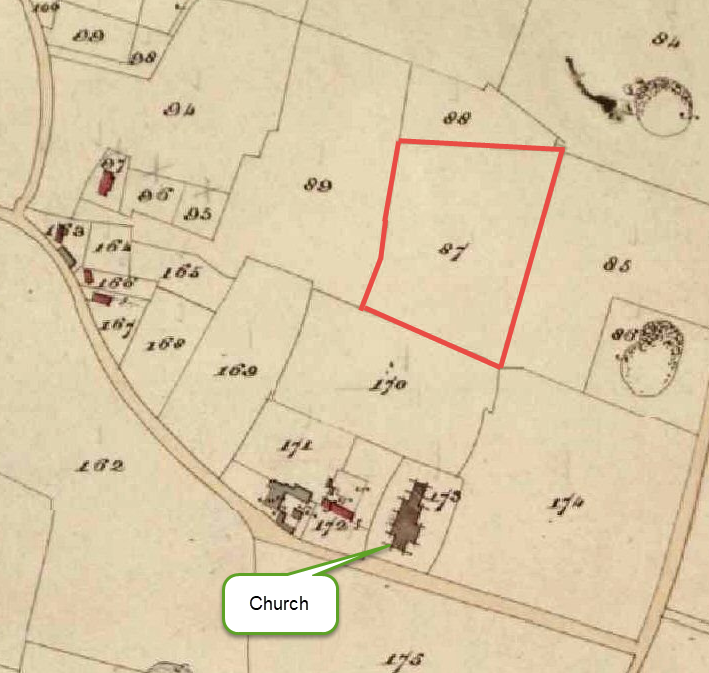
All rights reserved by Norfolk Record Office who hold the original; their ref is NRO DN/TA 743
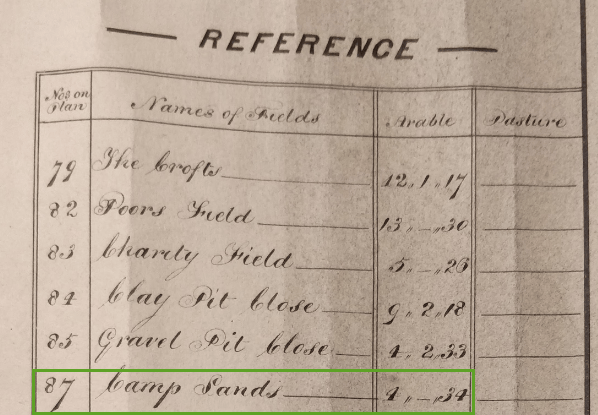
The following analysis of the lands of Manor Farm (laer called Church Farm) shows piece no 87 called Camp Lands:-
Description of the Game
The following description of the game of Camp by Edward Moore was published in 18232:
CAMP. A game formerly much is use among schoolboys, and occasionally played by men … sometimes school against school, or parish against parish. It was played thus:
Goals were pitched at the distance of 150 or 200 yards from each other — these were generally formed of the thrown off clothes of the competitors. Each party has two goals, ten or fifteen yards apart. The parties, ten or fifteen on a side, stand in line, facing their own goals and each other, at about 10 yards distance, midway between the goals, and nearest that of their adversaries. An indifferent spectator, agreed on by the parties, throws up a ball, of the size of a common cricket ball, midway between the confronted players, and makes, his escape. It is the object of the players to seize and convey the ball between their own goals. The rush Is therefore very great; as is sometimes the shock of the first onset, to catch the falling ball : — he who first can catch or seize it speeds therefore home pursued by his opponents (thro’ whom he has to make his way) aided by the jostlings and various assistances of his own sidesmen. If caught and held, or in imminent danger of being caught, he throws the ball — but must in no case give it — to a less beleagured friend, who, if it be not arrested in its course or he jostled away by the eager and watchful adversaries, catches it; and he hastens homeward, in like manner pursued, annoyed, and aided — winning the notch (or snotch) if he contrive to carry — not throw — it between his goals. But this in a well matched game, is no easy achievement, and often requires much time, many doublings, detours and exertions. I should have noticed that if the holder of the ball be caught with the ball in his possession, he loses a snotch, if, therefore, he be hard pressed, he throws it to a convenient friend, more free and in breath than himself. At the loss (or gain) of a snotch, a recommence takes place, arranging which gives the parties time to take breath. Seven or nine notches are the game — and these it will sometimes take two or three hours to win.
…
Sometimes a large foot-ball was used — and the game was then called “kicking camp” — and if played with the shoes on, “savage camp”.
The Right honourable William Wyndham of Felbrigg has been quoted3 as saying
it combined all athletic excellence ; that to excel in it, a man must be a good boxer, runner, and wrestler; in short, a sort of pancratiast. Certainly, no kind of manly exercise can display to so much advantage the powers, proportions, and attitudes of a fine muscular frame.
The following description was recorded by Robert Forby in 18304
Of the sport itself, however, two varieties are at present expressly recognized; rough-play, and civil-play. In the latter, there is no boxing.
…
The number on each side is equal ; not always the same, but very commonly twelve.
…
The contest for the ball begins, and never ends without black eyes and bloody noses, broken heads or shins, and some serious mischiefs.
Footnotes
- Robert Forby: The vocabulary of East Anglia, published 1830, pg 53. ↩︎
- Edward Moor: Suffolk words and phrases; or, An attempt to collect the lingual localisms of that county, published 1823, pp 63ff. ↩︎
- Robert Forby: The vocabulary of East Anglia, published 1830, pp 50ff. ↩︎
- Ibid ↩︎
Acknowledgment
Thanks are due to Anna Allison for pointing out the significance of Deopham’s Camp Lands.
Navigation
| Date | Change |
|---|---|
| 10/10/26 | Published |

