Contents
- Beginnings in France
- 1146
- 1177
- 1181
- 1227
- 1254
- 1291
- 1541
- A translation of Wace’s medieval account of the escape of William aided by Hubert de Ryes
- Footnotes
Beginnings in France
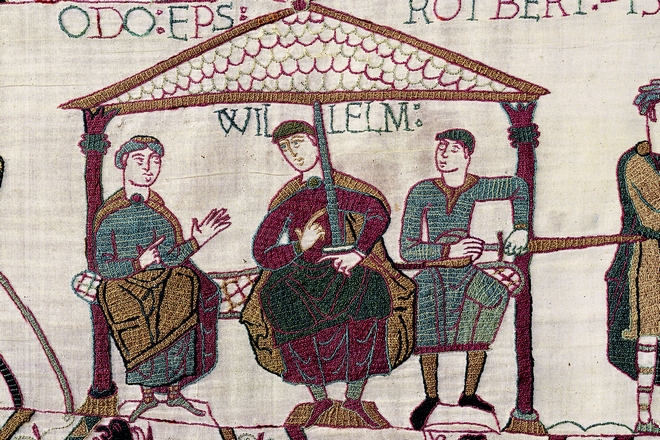
The story starts in France:
The man we know as William the Conqueror became under obligation to the de Ryes1 family, because in his youth, shortly after succeeding to the Duchy of Normandy, a conspiracy was formed against him, and his opponents would have captured him and put him to death, if he had not been woken from his bed and made his escape, half dressed, on horseback. Reaching the Castle of Ryes, in northern France, Hubert its lord, recognised him, and learning the emergency, not only placed William on a fresh horse, but misled his pursuers who were following at his heels. In gratitude for this service, William, when he became King of England, entrusted Hubert with high office in Normandy; made his first son, Ralph, Castellan of Nottingham, and Hubert, the second son the Castellan of Norwich; he also gave to Eudo, the youngest, possession of many lordships in England, as described in the Domesday book.2
As the Castellan of Norwich, the son would have been governor both of the castle and the surrounding territory. It can reasonably be assumed therefore that William’s saviour Hubert died a wealthy man, and his son Hubert likewise.
When Hubert de Ryes, the former Castellan of Norwich, died in 1126, his will stated that his estates in Mulbarton should be passed to the monks of Canterbury so that they would pray for the souls of himself and his wife in the afterlife. For whatever reason, this property transfer did not happen. The monks made various attempts to take control, but were unsuccessful. They therefore involved the archbishop of Canterbury who instructed Hubert de Rye’s son, Henry, to sort things out. The archbishop excommunicated Henry because the monks’ expectations of the additional income had not been respected. In due course, Henry reported back to archbishop Theobald that the situation at Mulbarton could not be resolved, but that he would let the monks have his inheritance in Deopham instead of his father’s promised Mulbarton. This offer was accepted, with the additional peace offering that Henry could join the monks of Canterbury should he so wish in due course.
Having initially obtained these assets to support prayers for the deceased Hubert, the monks subsequently arranged for the income to be redirected towards providing hospitality to pilgrims arriving in Canterbury to venerate Saint Thomas Becket. this change took place seven years after Henry’s death.
When Henry VIII closed the monasteries, he suppressed the Thomas Becket cult, burning Thomas’ bones and banning all mention of him. He passed the Deopham assets (amongst others) to the Dean and Chapter of Canterbury.
In 1814, there was some consolidation of the church lands as a result of the implementation of the Enclosures Act.
By 1860 the assets of the Dean and Chapter of Canterbury had passed to the Ecclesiastical Commissioners who were then rebranded as the Church Commissioners in 1948.
This state of affairs continued until 1963 when the Deopham lands (apart from the church and churchyard) were sold off.
The following extracts are from documents created at the time of the various steps in this process. I have done my best to make these medieval Latin legal texts as readable as possible; I’ve kept all mentions of “aforesaid” and equivalent words to retain the legal tone.
1146
The initial transfer of ownership to the monks of Canterbury
Henry de Ryes granted the manor of Deopham to Christ Church, Canterbury, in 1146 in exchange for the manor of Mulbarton, which his father Hubert had given to the monks and of which they had been despoiled.3
Translated from the Latin:
How the church of Christ Canterbury holds the manor of Deepeham.4
Hubert de Rye gave to the church of Christ in Canterbury his certain manor called Mulbarton, and Goldwin, a monk of the same church, held it after the death of Hubert until the church of that manor was abandoned by violence.
Later, in the time of Ralph, the archbishops were sent by the same archbishop, Hugh, a monk who afterwards became abbot of St. Augustine, and Richard de Beanfulk and abbot of St. Alban, to claim the aforesaid manor for the work of the monks of the church of Christ, but it remained as it was for a great while.
Then, in the time of king Stephen, Lord Theobald, archbishop and chief minister of England, hearing that the aforesaid manor had thus been given to his church and forcibly taken away, he sent to Henry the son of Hubert de Rye, asking him to restore the taken manor to his church, or to do justice therefrom, but Henry was unwilling to do either of these things.
From then on Henry, when he was again and again required to do this by the archbishop, completely disdained to do so, and therefore, as was the custom of the canons, he refused to come, having been called more than once and many times to do justice, whereupon he was excommunicated by the lord archbishop, and in the same excommunication for some time he continued until, repenting himself of the guilt of his penance, he came to the lord archbishop Theobald on the feast of Great Holy Martyr of Canterbury.
There, in the archbishop’s chamber, after many conversations about the matter, he asserted at last that the manor was so alienated from him that he could in no way recall it to the work of the church. He asked, however, that instead of that manor he might give free land from his inheritance worth ten marks of silver every year to the church of Christ.
When this was done, the same Henry de Rye swore upon the four gospels that on the day set for him by the archbishop he would deliver that land worth ten marks to the monks of the church of Christ for perpetual possession.
When these things were done, he immediately went to the church, and in the presence of the archbishop and many others from the aforesaid land, he stood at the altar of Christ with a certain knife, and there he received the full fraternity of the same church from the archbishop in that manner that could, if he wished, become a monk there towards the end of his life.
On the same day of the meeting in the chapter he renewed the donation in perpetuity of the manor of Deepeham in Norfolk, which he had made for the souls of his father and his mother and for the salvation of his own soul.
- Those present were:-
- Walter the Prior,
- Wybert the monk,
- Hugh the celerer,
- Felix the monk,
- Dunstan the monk,
- the clergy,
- Walter the archdeacon of Canterbury,
- John de Pageham,
- Roger de Ponte, Bishop,
- Thomas de London,
- Alanus de Welles,
- William Cumin and
- Jordanus Fantasma;
- Laymen:-
- Goffridus de Ros,
- Robertus son of Goffridus,
- Bernerius dapifer,
- Williamus the porter,
- Rogerus the porter,
- William the porter of the church,
- and many others.
- Dated 1146 – soon after August 19th.
1177
Confirmation of the rights of the monks of Canterbury
Confirmation for the monks of Christ Church of the grant by bishop William of Norwich of the church of Deopham.5
Translated from the the Latin:
Richard, by the grace of God, archbishop of Canterbury. To the children of the holy mother church, to whom the present letter has reached, may you receive eternal salvation in the Lord. They are known to have been reasonably made by our brothers and fellow-bishops: they must rejoice in their stability and in order that they may desire a firmer strength of peace, our interest is to provide diligently. Accordingly, to our brother monks in the Lord at the holy church of Canterbury, who have been freed for divine service, the church of Diepeham with its free lands and tithes and offerings and all that pertains to the right of the same church: as it was granted and confirmed to them by the pious memory of William, formerly bishop of Norwich, we also grant and by the present charter we confirm the decrees and protect them under penalty of anathema. Let no man infringe this page of our confirmation or presume to contradict it in any manner.
By the witnesses:
William the Archdeacon of Gloucester,
Henry of Bayocen,
master Roger Norwicensi
William de Sotindon
and many others. …
This agreement is dated May 1177, ratified Dec 1177.
1181
Ratification of the 1177 declaration
The charter of bishop William which confirmed the churches of Deopham and Tofts to Christ Church … was confirmed by bishop John I in 1181.6
1227
A declaration by the bishop of Norwich.
Thomas, Bishop of Norwich, by the grace of God, greets all in the name of the Lord who study these letters. We want to bring to the notice of all men for the sake of God and for the goodwill of religion and because of the veneration of the blessed Thomas the martyr, and in memory of our death.
The church of Dypeham, with all things belonging to it, is granted and given to the prior and monks of the church of Christ of Canterbury for the support of guests and pilgrims on the feasts of the said martyr, the donations to the aforesaid monastery to be permanently possessed for their own use, supported by the honourable vicar who will minister for the time being in the aforesaid church.
He will be presented with our counsel by the aforesaid prior and monks and our successors and instituted by us.
And so that it may not be called into doubt by anyone, the vicar serving at the present time should have an allowance.
We have ordered by the present letters to establish the portions relating to the vicarage.
The vicar at the time of the aforesaid church shall have all the offerings of the altar of this church with tithes coming from the fields called Tweyt and Sumercroft in the parish of Dypeham, saving the tithes of the monks of Norwich which they have in the aforesaid field, namely, two garbis of seven acres from Tweyt. Also the said vicar shall have two acres on the east side of the cemetery of the church of Dyeph, in which site is the old messuage which belonged to the said prior and monks of Canterbury, and three acres of the free land of this church that extends from the southern part of the church toward the south, and sixteen shillings and four pence every year from the steward of the monks to be paid moreover, in the same town, on the feast of St. Michael [Michaelmas – Sept 29th].
If these payments should cease, the said monks agree that through us and our successors the said payment should be enforced by remote appeal for the money.
The vicar at this time will also accept the usual episcopal and archdeaconry burdens, and keep safe all things in obedience to us and to our successors and to the holy church of Norwich on the due or customary debts and tithes which the monks of Norwich have in the same parish.
Concerning our provision, and the consent of the monks, for the repair and improvement of the ornaments and utensils of the said church, we want that two parts should be found by the monks, and a third part by the vicar, so that the church is competently and honourably served.
As this is our concession and confirmation ratified and constant to continue forever, by the consent of our chapter, the present document is authorised under the protection of our seal.
By these witnesses:
Master Alan de Beccles,
archdeacon Suthb’, then official to the lord of Norwich,
master Robert de Bilneh,
master Nicholas de Framingham,
Henry the chaplain,
John Terry,
Dionisio de Cotton,
Roberto de Ponte Tegle,
William de Fordeham.
June 1227, ratified October 12277
[Robert is said by Francis Blomefield to have finished his priesthood at Deopham and Ralph to have taken over in this year.]
Summary of the 1227 declaration
- The vicar [vicarage] gets:
- all the offerings of the altar of this church;
- tithes coming from the fields called Tweyt and Sumercroft in the parish of Dypeham, except for the tithes from two garbis of seven acres from the Tweyt field which the monks of Norwich receive;
- two acres on the east side of the cemetery of the church of Dyeph
- three acres of the free land of this church that extends from the southern part of the church toward the south;
- sixteen shillings and four pence every year from the steward of the monks to be paid annually on Sept 29th;
- The vicar gives:
- the usual episcopal and archdeaconry burdens;
- loyalty to the monks of Canterbury and of Norwich;
- Payment of one third of the cost of repair and improvement of the ornaments and utensils of the church;
- The monks of Norwich get:
- Part (two garbis) of the tithes from the seven acre Tweyt field;
- The monks of Canterbury get:
- The church of Dypeham, with all things belonging to it;
- The right to choose the vicar of Deopham;
- The monks of Canterbury give:
- Payments for two thirds of the cost of repair and improvement of the ornaments and utensils of the said church;
1254
Survey of taxes
The pension to Christ Church is recorded in 1254 in The valuation of Norwich, ed. W. E. Lunt (1926) 407.
1291
Survey of taxes due
The assessment of the temporalities and spiritualities of the church in England and Wales, is called the taxation of Pope Nicholas of 1291.8
This shows that both Canterbury and Norwich had a responsibility to pay tax on Deopham.

1541
The group of assets owned by the monks of Christchurch Canterbury which were transferred by Henry VIII to the Dean and Chapter of Canterbury Cathedral after the dissolution of the monasteries included the following9:-
“The rectories and advowsons of vicarages of Eastrye, Monketon, Byrchyngton, Meopham, Sesalter, and Fayrefeld, Kent; Westclyeff near Dover, Fernyngham, Eastpekham, and Halstowe, Kent; Deopham, Norf.; Pageham, Barsted, Mondeham, and Warneham, Sussex; which belonged to Christchurch.”
Rectory in this context is a “body corporate” – i.e. the whole package of buildings, lands, tithes etc. Advowson is the right to select a vicar, albeit subject to the bishop’s final approval.
A translation of Wace’s medieval account of the escape of William aided by Hubert de Ryes
by Edgar Taylor, published 1837
[William] was at that time sojourning at Valognes, for his pleasure as well as on business; and had been engaged for several days hunting and shooting in the woods. One evening late his train had left his court, and all had gone to rest at the hostels where they lodged, except those who were of his household; and he himself was laid down. Whether he or not I do not know, but in the season of the first sleep, a fool named Golets came, with a staff slung at his neck, crying out at the chamber door, and beating the wall with the staff; “Ovrez!” said he, “Ovrez! ovrez! ye are dead men: levez. levez! Where art thou laid, William? Wherefore dost thou sleep? If thou art found here thou wilt die; thy enemies are arming around; if they find thee here, thou wilt never quit the Cotentin, nor live till the morning!”
Then William was greatly alarmed; he rose up and stood as a man sorely dismayed. He asked no further news, for it seemed unlikely to bring him any good. He was in his breeches and shirt, and putting a cloak around his neck, he seized his horse quickly, and was soon on the road. I know not whether he even stopped to seek for his spurs, or whether he took any companion of his flight, but he hasted on till he came to the fords nearest at hand, which were those of Vire, and crossed them by night in great fear and anger. From thence he bent his way to the church of St. Clement, and prayed God heartily, if it were his will, to be his safe conduct, and let him pass in safety. He dared not turn towards Bayeux, for he knew not whom to trust, so he took the way which passes between Bayeux and the sea. And as he rode through Rie before the sun rose, Hubert de Rie stood at his gate, between the church and his castle, and saw William pass in disorder, and that his horse was all in a sweat. “How is that you travel so, fair sire?” cried he. “Hubert,” said William, “dare I tell you?” Then Hubert said, “Of a truth, most surely! say on boldly!” “I will have no secrets with you; my enemies follow seeking me, and menace my life. I know that they have sworn my death.” Then Hubert led him into his hostel, and gave him his good horse, and called forth his three sons. “Fair sons,” said he, “muntez! muntez! Behold your lord, conduct him till ye have lodged him in Falaise. This way ye shall pass, and that; it will be ill for you to touch upon any town.” So Hubert taught them well the ways and turnings; and his sons understood all rightly, and followed his instructions exactly. They crossed all the country, passed Folpendant at the ford, and lodged William in Falaise. If he were in bad plight, what matters so that he got safe?
Hubert remained standing on his bridge; he looked out over valley, and over hill, and listened anxiously for news, when they who were pursuing William came spurring by. They called him on one side, and conjured him with fair words to tell if he had seen the bastard, and whither and by what road he was gone. And he said to them, “He passed this way, and is not far off; you will have him soon; but wait, I will lead you myself, for I should like to give him the first blow. By my faith, I pledge you my word, that if I find him, I will strike him the first if I can.” But Hubert only led them out of their way till he had no fear for William, who was gone by another route. So when he had talked to them enough of this thing and that, he returned back to his hostel.
The French quotations in this passage are in Medieval French!
Footnotes
- The family name de Rhys is taken from name of the village in Normandy. I have endeavoured to use this spelling, but where quoting directly from other documents I have left the author’s spellings. These include Rhye, Rie and Ria. ↩︎
- English Episcopal Acta II Published for the British Academy by Oxford University Press, 1980, Pg 59
https://archive.org/details/englishepiscopal0000unse/ ↩︎ - English Episcopal Acta II Published for the British Academy by Oxford University Press, 1980, Pg 60
https://archive.org/details/englishepiscopal0000unse/ ↩︎ - Saltman, Avrom Theobald, Archbishop of Canterbury, 1956 University of London, Athlone Press, pp 536-538
https://archive.org/details/theobaldarchbish0000salt_o6p1/ ↩︎ - English Episcopal Acta II Published for the British Academy by Oxford University Press, 1980, Pg 58
https://archive.org/details/englishepiscopal0000unse/ ↩︎ - Ibid, Pg 71 (footnote) ↩︎
- English Episcopal Acta, Volume 21, page 34
https://archive.org/details/englishepiscopal0021unse/ ↩︎ - This extract is from Sheffield digital humanities: https://www.dhi.ac.uk/taxatio/benkey?benkey=NW.NF.HI.05 ↩︎
- https://www.british-history.ac.uk/letters-papers-hen8/vol16/pp409-429 ↩︎
| Date | Change |
|---|---|
| 4/1/24 | Revised footnotes & added table of contents |
| 5/1/23 | Published |
 Deopham History