This is how “Deopham” is written in the Domesday Book:
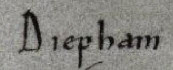
The following is a translation from the Latin section of the Domesday book concerning Deopham. References to “then” mean the year of Edward the Confessor’s death -1066; “now” is 1086.
Leofwine, a free man1, held T.R.E.2: 1 carucate3 and 80 acres. Now the same man holds [it]. [There have] always [been] 9 villans4. Then [there were] 10 bordars5; now 9. Then and afterwards [there were] 2 slaves6; now none. [There have] always [been] 3 ploughs7 in demesne8 and 1½ [ploughs] belonging to the men. [There is] woodland for 12 pigs. And [there are] 10 acres of meadow. [There has] always [been] 1 horse and 10 head of cattle and 17 pigs, 32 goats. To this manor13 have always belonged 25 sokemen9 and 1 carucate3 and 26 acres. [There have] always [been] 6½ ploughs7. And after this 6 free men1 were added to this manor T.R.W.10 whom Euda held. And it has 120 acres of land 20 bordars5 and 5 ploughs7 and 6 acres of meadow. Then the head manor13 was worth £4. And Ralph gave the whole to farm for £12 but now, however, it has not rendered anything except for £6. And 6 free men are worth 55s. The Hundred11 testifies to this. Of these, 3 were sokemen9 of Stigand’s15 and the soke12 is in Hingham, [a manor] belonging to the king. And it is 10 furlongs14 in length and 6 in breadth. And [it renders] 17¾d.
This extract of the Domesday Book was taken from the National Archives website which credits Editions Alecto Ltd for the translation.
Notes:
- Freeman: A man who was free and might hold land but who owed some services to his lord. This is a status that became more widespread in King William’s time – a sign of increasing “manorialism”. Payments that might previously have been payable to the monarch were now, by royal grants, due to the local lord. See Rural England, 1086-1135; A Study of Social and Agrarian Conditions by Lennard, Reginald Vivian, pp 231, 374.
- T.R.E. is an acronym in the Domesday Book for the three Latin words tempore Regis Edwardi, ‘in the time of King Edward’ with the implied meaning ‘on the last day of King Edward the Confessor’ – i.e. January 5th 1066.
- Carucate: A standard unit for measuring land sometimes used for tax purposes in northern England, where Danish law prevailed. Elsewhere land was measured in hides. Both were intended to represent the amount of land that could support a household, roughly 120 acres.
- Villan: An unfree peasant who owed his lord labour services (two or three days per week) but who also farmed land for himself. Villans were the wealthiest and most numerous of unfree peasants. Also called villains or villeins.
- Bordar: Unfree peasant with less land than villans.
- Slave: A man or woman who was the property of his or her lord and had no lands.
- Plough: When Domesday refers to the number of ploughs it is referring to the taxable amount of land that can be ploughed by a team of eight oxen. Thus, land ‘for half a plough’ (or ‘for four oxen’) means half a plough land.
- Demesne: Part of the manor either kept by the lord in his own hands or farmed for his own profit.
- Sokeman: Freeman who nevertheless had to attend their lord’s court.
- T.R.W. : an acronym for Tempore Regis Willielmi, generally the date of Domesday Book i.e. 1086.
- Hundred: A sub-division of the shire (or county) used for administrative purposes. Deopham was in the Forehoe Hundred.
- Soke: generally denoted “jurisdiction”, but its vague usage means it lacks a single, precise definition.
- Manor: An estate or unit of lordship, varying in size. The Domesday survey was based on the manor and not the parish.
- Furlong: A furlong is just over 200 metres, so these dimensions would make the size of the village about 2km x 1.2km.
- Stigand: Archbishop Stigand (see the image below from the Bayeux tapestry) was taken to Normandy after the conquest of England by William the Conqueror, probably as a hostage. Having been a supporter of Edward the Confessor, Stigand’s loyalty to the new king was very much in question.

Published: 24/9/22
Last revision: 24/2/23
 Deopham History