- Raphael and J. Arthur Brandon, 1858
- Arthur Mee, 1940
- Nicolaus Pevsner, 2000
- Andrew Swift, 2015
- Mortlick & Roberts, 2017
- Notes
Raphael and J. Arthur Brandon, 1858
in their book Parish Churches1
Although published in 1858, their account of the poor condition of the church is at odds with the church’s own propaganda of 1851 which sang the praises of all the repairs that had been completed.
The noble tower of this Church is perhaps not excelled by any in Norfolk. It is of pure Perpendicular, with good base mouldings,* well graduated buttresses, and excellent window tracery. The turrets which terminate the buttresses are hexagonal, and with the crocheted gables surmounted by crosses that rise out of the parapet, form a rather unusual and very beautiful arrangement.
The west and south doorways are richly carved ; the latter has an embattled label over the doorway, with spandrels filled with tracery.
Both within and without, this Church is in a sad state of decay : most of the windows of the tower are blocked up, also those in the porch, and the east window of the Chancel, a fine piece of Perpendicular tracery.
There were formerly Chapels at the east end of the aisles; parts of the screens remain, retaining some of their ancient colouring. The Chapel in the south aisle was that of the Assumption, and in the north that of St. John the Baptist. There is a piscina in each.
There is a good plain roof over the nave, and many of the old benches (for they have no backs) still remain. A very remarkable monument occurs in the north aisle ; the foot of it is partly buried in the east wall. It is of Purbeck marble, and the upper part, instead of being coped, is raised in gradations, probably with a view to gain more room for an inscription which covers the whole surface.
The Church affords accommodation for about 430 worshippers.
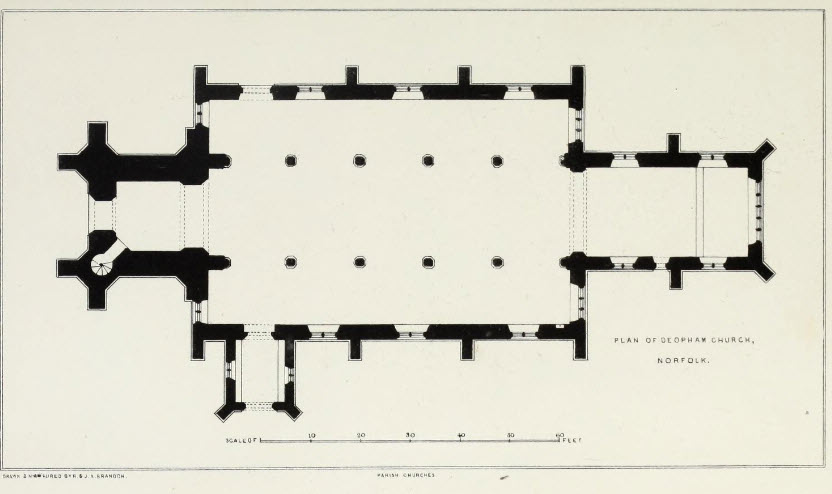
The Brandons give the following dimensions; I have placed their measurements for Deopham and Hingham alongside each other for ease of comparison.
| Deopham | Hingham | |||
| Ft | In | Ft | In | |
| Length of Chancel | 32 | 4 | 60 | 0 |
| Length of Nave | 72 | 1 | 97 | 6 |
| Width of Chancel | 18 | 0 | 27 | 6 |
| Width of Nave | 17 | 5 | 27 | 6 |
| Width of South Aisle | 11 | 0 | 14 | 1 |
| Width of North Aisle | 11 | 0 | 14 | 1 |
The following is their plan of the church:
Arthur Mee, 1940
in his book Norfolk2
Here is a surprisingly big church for this lonely countryside, and its noble tower, rising like a beacon a hundred feet above the fields, is worth coming far to see. Built in the middle of the 15th century, it is one of Norfolk’s highest towers and has an individuality all its own. Sets of three windows with lovely tracery are in three sides of the church, splendid buttresses climb in six steps to end in turrets above the parapet, and between these are leafy gables, surmounted by a cross. Some 18 feet from the ground runs a band adorned with fruit and flowers. The great east window and the splendid doorway framing the old door are both 15th century; the rest of the church is 16th. The best view inside is from the sanctuary steps, where we see the simple charm of the tall arcades and the soaring arch of the tower with the font standing below. Old relics are the sedilia and the piscina, a coffin stone carved with a cross, and fragments of the medieval screen.
Nicolaus Pevsner, 2000
in his book Norfolk 2: North-West and South3
A big church with a big Perpendicular west tower. The tower has set-back buttresses connected diagonally across the corner in the manner of nearby Hingham. The south east buttress impinges slightly on the aisle on that side. The buttresses have chequered flushwork right up to the top. Hexagonal turret pinnacles with flushwork panelling. West doorway, west window with stepped embattled transom, blocked window above, and tall bell-openings with steep gables reaching up into the flushwork-panelled battlements.
The bells were being hung in 1473. Moreover there is a quatrefoil base frieze and a pretty vine frieze above the doorway level, these features also present at Hingham: so to the fifteenth century mason there was nothing wrong with motifs of a century earlier. The tall tower arch has three orders of double wave mouldings.
Decorative south aisle and south arcade. The arcade is of five bays and has octagonal piers and double-chamfered arches on low stepped bases. The south doorway has traceried spandrels and a crenellated top, and the windows are clearly Decorative. They have cusped mouchettes flanking coarse reticulation units. Only the aisle east window is Perpendicular. The north arcade is Perpendicular too, though the aisle windows favour the Decorative style. The arcade piers are odd, consisting of square piers set diagonally with the corners slightly chamfered – i.e. essentially a lozenge plan reduced to the simplest form. High moulded bases.
Two-light clerestory windows. Good nave roof of low pitch with cambered tie-beams on arched braces with traceried spandrels. Bosses at intersections of the roll-moulded purlins and ridge-piece. Roll-moulded also the boarded ashlaring. The head-corbels of the former roof below, only on the south side; on the north side they were no doubt removed when the arcade was rebuilt. Decorative chancel, but with a restored five-light east window and a hammerbeam roof installed during the 1864 chancel restoration.
FONT. Octagonal, with small punched tracery motifs.
SCREEN. Part of the base in the south aisle at the east end. Painted brocade as decoration of the inner panels of the dado; late C15, the loose paint fixed 1978, by Anna Hulbert. Further fragments against the south aisle wall.
DOORS. Fine traceried s door with a pattern of quatrefoils, minor west door arcaded only in the arch.
STAINED GLASS. In the tracery of the north aisle east window assembled fragments.
MONUMENT. Coffin-lid with foliated cross (south aisle).
Andrew Swift, 2015
In his book on medieval churches4 comments on the wonders of the tower, but the dilapidated state of the interior:
Here at Deopham is one of Norfolk’s grandest Perpendicular towers, often compared to (or based on, according to some sources) the one at nearby Hingham, but worthy of admiration on its own account. Everywhere there is adornment and decoration, from the quatrefoil panelling at the base, to the vine- leaf frieze at the top of the first stage, the powerful if rather overwrought buttresses and busy top stage with turrets at the corners and tightly-angled gables topped with large crosses protruding above the battlements, which themselves are enriched with ornament. The rest of the building is also impressive, but is somewhat overshadowed by the tower. There are both Decorated and Perpendicular features, the south doorway and porch are particularly fine, the C15th door embellished with tracery, as is the west door. The east window is a Perpendicular tour-de-force.
With two generous aisles, the interior has the feeling of a barn, more so because of the sparse furnishings and general untidiness and dilapidation. The church has not been lucky with regard to theft and the north aisle lost its lead in recent times. A bleakness oppresses the interior, and it is to be hoped that better times will arrive soon. But even under these conditions, the ?C16th nave roof still impresses and has a crew of personable wooden gentlemen supporting the wall plates and holding shields, except one who appears to be holding a bleeding heart. Below these corbels on the south side only is another, equally singular set, in stone, now marooned since the clerestory was added. At one time a mighty medieval screen stretched across the church, but all that remains now are two short stretches of dado, in poor shape, one still dividing off what used to be the south chapel, the other against the south wall at the west end. The chancel, and especially the sanctuary, is thinly furnished but an excellent Decorated piscina survives, with elaborate head. Two other noble piscinas grace the church, one in the east respond of the north arcade (for a north chapel) and the other in the south wall where a south chapel used to be. Here also are the steps to the old rood loft. Fragments of old canopy glass and other salvaged pieces are gathered in the north aisle east window. The lightly carved font may be late C15th.
Mortlick & Roberts, 2017
in their book Guide to Norfolk Churches5:
Deopham, St Andrew: This must be one of the most distinctive towers in Norfolk, not only because it is so rich and splendid, but because it does not really seem to belong to the eastern counties, but rather to the West Country. It is pure Perpendicular of about 1450, at its most confident, in four thrusting stages divided by string courses. It has enormous right-angled buttresses, chequerworked down the faces and reaching right up to the opulent parapet with its octagonal, embattled corner turrets, and battlements intersected by triangular ‘gables’ crowned by luxuriantly carved crosses. Nobly traceried and transomed windows at three levels complete this sparkling piece of architecture. The body of the church is generally earlier, of the Decorated period, as indicated by the aisle windows two-light, with big quatrefoils in the heads of the ogee arches and by the n. door. The rest of the windows, including the fine e. window, are all Perpendicular, that in the s.e. corner of the chancel being the latest of the group. The Perpendicular porch, which inside has shallow arcades recessed into the wall on each side, shelters a splendid s. doorway of similar vintage, with a square, embattled hood mould over its arch, and cusped arcading in the spandrels. The doors themselves should be noticed – they are C15, with excellent carved traceries.
The interior of the church is spacious and lofty, albeit rather bare, with a plain tie-beamed roof which has moulded wall plates and deep wall posts with wooden angel corbels, immediately below. which on the s. side are six large stone corbels, individually carved with human and animal heads – were these for the earlier, lower roof before the Perpendicular clerestory was added? Notice high above the soaring Perpendicular tower arch the sanctus bell window, giving a clear view of the high altar, The tall five-bay arcades are possibly separated in date by about a century: the s. pillars are octagonal and early-C14, those on the n. side square, with chamfered corners at the angles, are C15. On one of the n. arcade pillars is a small stone footing possibly an effigy pedestal. Set into the e. end pillar is a very beautiful piscina, with a trefoil arch and protruding base; beside it, as also in the pillar immediately to the w., can be seen slots in the stonework where the parclose screen was fitted, when there was a chapel in this corner. Opposite, in the s. aisle, where there was another chapel (it is recorded that there were chapels here to the Assumption of the Blessed Virgin and to St John the Baptist) a remnant of the old screen remains, with more pieces leaning against the wall. The steps to the old rood loft are here also, set into the base of a window; and a large traceried piscina under a square hood, with leaf shapes in the spandrels. Even grander is the piscina in the chancel, with a richly cusped, ogee arch and with shields in the spandrels. Adjoining are plain dropped sill sedilia on two levels. Notice again the grand five-light e. window; and above, the hammer-beamed and arch-braced roof, with its open-carved and battlemented wall plates. The font is plain, octagonal C16 work, with little quatrefoil motifs around the bowl.
Notes
- Raphael & Joshua Brandon, Parish churches; being perspective views of English ecclesiastical structures: accompanied by plans drawn to a uniform scale, and letter-press descriptions, 1858, pages 51-53.
- Arthur Mee, Norfolk, 1940, Page 97
- Nicolaus Pevsner, The Buildings of England Norfolk 2: North-West and South, Revised 2000, pages 281f.
- Andrew Smith, 100 Norfolk Churches of Village and Countryside, published by Velox Books in 2015
- D.P. Mortlick & C.V. Roberts The Guide to Norfolk Churches, third edition published by Lutterworth in 2017.
| Date | Change |
|---|---|
| 8/6/23 | Published |
 Deopham History