Contents
- Preface
- Chapter 1
- Chapter 2
- Chapter 3
- Chapter 4
- Chapter 5
- Chapter 6
- Appendix A: Maps and Documents
- Appendix B: Analysis of Owners and Occupiers
- Appendix C
- Notes
- Bibliography
- Navigation
Preface

Common land pre-enclosure

Land comprising Deopham

Chapter 1
Introduction and Background
The Parliamentary Enclosure of the parish of Deopham took place following the passing of a Private Act of Parliament in 1812. This study is an examination of the activities in the thirty four years prior to the Bill being introduced into Parliament attempting, preventing and finally settling terms for enclosure; a discussion of the activities of the Enclosure Commissioners; a commentary on their award and an evaluation of the effects of the enclosure in the next fifty years.
Deopham is a parish of rather over sixteen hundred acres, about twelve miles South East of Norwich on the edge of what is generally known as the ‘Wood Pasture Region’ of mixed agriculture on boulder clay soil with the lighter Breckland soils to the West.
This particular parish has been chosen, partly to demonstrate the widely varied influences at work which led to the enclosure process being long and complex, partly because of the writer’s connections with and access to some privately owned material about the village and partly because it presents a picture and some conclusions which are perhaps at some variance with the pictures painted and conclusions drawn by many authors on the subject of Parliamentary enclosure in Norfolk.
The principal sources utilised for this study include the Acts, Minutes, Awards, Maps and Clerk’s Accounts of the Enclosures of Deopham, Hingham, Hackford and Wicklewood held by the Norfolk Record Office.
The Wodehouse archive was in the midst of being sorted and catalogued in the Norfolk Record Office but a limited number of relevant papers were located and used. The parish document collection for Deopham for the period is sparse apart from a descriptive survey in 1815 and the Tithe survey of 1842. Both of these have been analysed and summarised and reference has been made to other parish collections to gain an insight into the work of Churchwardens, Overseers, Constables etc.
The decennial population censuses from 1841 to 1881 have been analysed and reference has been made to privately owned maps, deeds and other documents of the period. The Gilman collection in the Norfolk Record Office has been consulted but, although extensive, little of relevance to his work as Clerk to the Deopham Commissioners or to his family landholdings in the parish was located. The archive of the Dean and Chapter of Canterbury at Canterbury contains a considerable amount of material and has been used extensively.
The diaries of Randall Burroughes of Wymondham and Thomas Howes of Morningthorpe have been used to provide background information of farming in the area in the period under consideration.
Parliamentary enclosure between about 1720 and 1850 is perhaps almost the final chapter in the process of enclosure in Norfolk that had been taking place progressively through the centuries. Since about 1950 the trend has been to remove fences and ditches and recreate once more larger open areas.
By the sixteenth century the enclosure of open fields was well advanced. A tithe survey of Wacton in 1541 describes a number of parcels of land as ‘enclosed’, ‘recently enclosed or annotated at a later date as ‘now enclosed’.1
Blomefield writing in 1736 and referring to open fields records that the Hundred of Forehoe, which included Deopham as “… the whole enclosed lands and abounds with a good quantity of wood and timber…”2 and he reports that the adjacent Hundred of Wayland was “… chiefly enclosed…”3
Much of the enclosure had taken place through exchanges of land and engrossment. Nathaniel Kent in 1796 wrote:-
“…There is a considerable deal of common field in Norfolk though a much smaller proportion than in other counties; for notwithstanding common rights for great cattle exist in them all and even sheep walk privileges in many yet the natural industry of the people is such that whenever a person can get four or five acres together he plants a white thorn hedge round it and sets an oak at every rod distance…”4
The open arable fields in Deopham had all been enclosed well before the beginning of our period although some of the old names such as ‘part of the hundred acre field’ and ‘bullswood’, ‘bloodlands’, ‘breeds’ etc which may refer to the woodland that had preceded the open fields, still occur. There remained about five hundred acres of commons and wastes (as Faden’s Map shows). The largest ‘Low Common’ by the Hackford boundary to the North; The Stalland’ and ‘South Hill or Hookwood’ Commons to the South on higher open ground, both at one time forming parts of much larger commons jointly with neighbouring parishes, and ‘The Green’ in the midst of the parish.
The enclosure of common land and wastes was a complex business as many varied and sometimes conflicting interests had to be taken into account. These included not just rights to graze cattle, horses, sheep and geese but also the right to take timber for building, dig turves and take topwood for fuel etc.
In some places enclosure had been made possible by one person buying out the other interests. William Windham completed the enclosure of Felbrigg by buying the scattered lands of a young yeoman and establishing him as his tenant on a newly consolidated farm5 and at Timworth in Suffolk the Cornwallis family completed the reorganisation of that parish after buying out the last small owner.6
More formal arrangements were resorted to by means of Act of Parliament and Deopham was one of about four hundred Norfolk parishes involved in enclosure by this means.
Some of the Acts covered the enclosure of common field as well as commons and waste, some commons and waste only and some including Deopham covered the enclosure of the common and waste as well as the redistribution of the old meadows and arable enclosures into more convenient holdings.
There was a substantial shift in the pattern of farming on the Norfolk claylands in the second half of the eighteenth century with the introduction of fodder crops to feed the cattle and increased demand for wheat and barley. This was in part made possible by the advances in agricultural practices particularly the introduction of bush underdraining to enable the heavy soils to be cultivated more effectively and by ploughing up former grassland.7
In 1768 the farmers of Deopham grew wheat, barley, oats, turnips and cabbages in the old enclosures and kept livestock, mainly cattle but also some sheep, horses, pigs and geese in the meadows and on the common. There was pressure to plough up the common and ‘improve’ the parish and the first moves towards enclosure were made but there were many different interests and influences at work and it was thirty four years before the work of Enclosure Commissions even commenced.
Chapter 2
Dramatis Personae
This chapter introduces some of the participants in the enclosure of Deopham. Featured are the Wodehouses, the Dean and Chapter of Canterbury, the Amyas family and John Browne of Tacolnestone (major landowners); Rowing Brasnett and the Easons (farmers who owned their land); Charles Allen (a cottager), Charles John Chapman (the owner of a small parcel of land); Garrett Oddin Taylor (a substantial tenant farmer); Aaron and John Lane (millers); Lord Walsingham (who had some interests in the parish), Richard Adams (Vicar); John Dugmore, John Mitchell and William Unthank (the Commissioners) and Samuel Heyhoe Lelieve Gilman (their clerk).
There were many others affected especially all those who did not own property or land including the agricultural workers, village craftsmen, the unemployed, the old and the poor.
The Wodehouses
The Wodehouse family acquired an estate in Kimberley, three miles from Deopham through marriage in the fifteenth century.
John Wodehouse, who became first Baron Wodehouse, was born in 1741 and succeeded to the Kimberley estate on the death of his father Sir Ermine Wodehouse, fifth Baronet in 1777. He held the estate for fifty seven years until his death in 1834.1
The ‘Kimberley Estate’ eventually totalled eleven thousand acres of land in Norfolk, including the Manor of Deopham Hall and a number of other manors.2 John’s brother Philip was Rector of the parish of Hingham and kept an eye on the family interests in that and the adjoining parishes of Deopham, Hackford and Wicklewood. Prior to enclosure he owned one hundred and forty one acres in Deopham as well as the Manor of Deopham Hall. He also owned some sixteen hundred acres in Hingham, Hackford and Wicklewood.3
The Dean and Chapter of Canterbury
King Henry the Eighth granted the Dean and Chapter of Canterbury a Manor in and the Rectory of Deopham at the Reformation. The Manor had been given to the Prior and Monks of Canterbury in 1146 and the Rectory in 1227. 4
The Dean and Chapter of Canterbury were a body of considerable importance and influence in the late eighteenth and early nineteenth centuries. The Dean and nine of the twelve Prebends were Crown Appointments in theory but in practice in the gift of the Prime Minister or Lord Chancellor. The remaining three Prebands stalls were filled by the Archbishop of Canterbury.5
Through the ages the Priors and Deans had used their estates not only as a source of revenue but also as a means of building up support in local society through contented tenants enjoying reasonable rents and moderate fines. The Dean and Chapter had various property interests in Canterbury, Sandwich, London, Southwark and Oxford but their major source of income was from thirty seven manors (of which the manor in Deopham was one of the smallest) and thirty seven Rectories many of them situated near their Manors.6
The Dean and Chapter had leased the Manor and Rectory of Deopham to the Amyas family (q.v.) since the sixteenth century7 but reserved the Advowson or Patronage of the living and appointed Vicars of Deopham. Their practice was to grant a lease of the Rectory and Manor for twenty one years but at the end of seven years to grant a new lease for twenty one years from that date on payment of a fine.8 The detailed negotiations were conducted by the auditor to the Dean and Chapter with the terms of the lease and amount of the fine being finally confirmed by the Deans and Chapter at the Chapter Audit.
The auditor until 1800 was Edward Benson who seems to have been somewhat incompetent. He was asked to give evidence to a Select Committee of the House of Commons about The Chapter Archives and it was reported “… After having been several days examining them finds himself not competent to the execution of a task of so much difficulty…”9 His successor Thomas Starr when referred to previous correspondence replied “… my late friend was not in the habit of preserving letters received or keeping copies of letters sent”10
Many of the Prebendaries spend only a limited amount of time in Canterbury with little involvement in the business of the Chapter but Prebendary Lynford Caryl was “… a person to whom the body is much indebted for his indefatigable care and industry in the regulation and improvement of their estates … “11
The Deans of Canterbury in many cases went on to become Bishops including James Cornwallis Dean from 1775 to 1781; already noted for his involvement at Timworth; who became Bishop of Lichfield and Coventry.12 The Prebendaries were also often well connected, for example Matthew Surtees was the brother in law of Lord Chancellor Eldon13 and William Nelson was the brother of Admiral Nelson and succeeded to his title Earl Nelson of the Nile.14
Prior to enclosure the Dean and Chapter owned fifty one acres of land in Deopham in addition to their manor.
The Amyas Family
The Amyas family came from Godmersham in Kent15 but by 1553 had moved to Deopham as farmers or lessees of the Rectory.16 They paid a subsidy of four pounds in 1621 (compared with thirty pounds paid by Sir Philype Wodehouse Knight Barronett of Kimberley).17
The family were influential in Hingham as landowners, Solicitors and Stewards of Manors in the seventeenth and eighteenth centuries. John Amyas an attorney of Hingham died unmarried in 1763 and left a substantial estate to cousins and others.18 The Deopham properties eventually went to two daughters and a son of the late Reverend John Amyas of Beccles. At the time of enclosure their affairs were looked after by the Reverend Bence Bence Rector of Beccles. Anne Elizabeth and Frances held the lease of the Manor and Rectory and Bevil owned Elm Farm with one hundred and forty nine acres of land.
John Browne of Tacolneston
John was the last of a long line of Brownes in Tacolneston where the family had been since at least 1500.19 He died unmarried on the seventh of June 1814 at the age of seventy eight. Some of his affairs had been looked after by his nephew George Denny Graver of Wymondham and his son, John Thomas Graver was left his great uncle’s estates in Tacolneston, Morley St Peter and Deopham. Prior to enclosure one hundred and seventy acres were owned by John Browne in Deopham.
Rowing Brasnett
Rowing Brasnett came from long lines of farmers in the parish with both the Rowings and the Brasnetts living there for several generations. He was one of a small number of owner occupiers farming about forty acres of his own and some twenty four acres owned by other members of the family before enclosure. He was also Pindar of the common.20 His duties are not described in the record of the Leet Court of the Manor of Deopham Hall but in the neighbouring parish of Wicklewood the Pinder was instructed that he
“… shall take care for cattle not belonging to the parish: neat beasts and horse beasts six pence a head: sheep and hogs two pence a head to the number ten and if above, only a penny a head: geese three pence a score … … which he shall impound by virtue of his office…”21
Isaac and Robert Eason
The Easons are of interest not only as farmers who farmed thirteen acres of their own land and further land hired from, among others, Charles Chapman (q.v.); but also because they were supporters of the Primitive Methodists and almost certainly were prime movers in the introduction of this active non-conformist fellowship to the parish.
Charles Allen
Charles Allen was the son of a shopkeeper in Deopham who died in 1777 leaving him his property.22 Charles lived by ‘The Stalland’ common and claimed right of common in respect of his house and garden.
Charles John Chapman
Charles John Chapman was a clerk in holy orders. He owned a piece of land called ‘Breeds’ about three and a quarter acres in extent held Copyhold of the Manor of Shadwells otherwise Cockerills in Morley. He had bought it for one hundred and five pounds in 179923 and it was farmed by Isaac Eason.
Garrett Oddin Taylor
Garrett Oddin Taylor was Lord Wodehouse’s tenant at the one hundred and forty one acre Bayfield Hall Farm adjoining the low common at the time of enclosure. Garrett Oddin Taylor and his father Samuel were influential figures in the parish acting as Churchwardens, Constables and Overseers of the Poor.24
Aaron and John Lane
Aaron Lane owned a new house on the site of a water mill in a small enclave on Deopham Low Common by the Hackford border. John owned the water mill just into the parish of Hingham and he and Aaron also owned some more small pieces of land in the vicinity.
Lord Walsingham
The Walsingham estates in Norfolk extended to about twelve thousand acres including many Manors 25 mostly in Breckland but including a large part of the neighbouring parish of Great Ellingham and the Manor of Burys Hall Great Ellingham which extended into the Stalland area of Deopham. Lord Walsingham claimed the sole and exclusive right of feeding and depasturing sheep ‘levant and couchant’ on part of the common of Deopham as well as common of pasture for great cattle by reason of the sixteen acres of land he owned.
Richard Adams
The Reverend Richard Adams was presented to the Vicarage of Deopham by the Dean and Chapter of Canterbury on twenty third of June 179026, the vacancy arising on the death of the Reverend Buck. He also held the Rectory of Edingthorpe near North Walsham where he is recorded as having lived. He was entitled to the small tithes of Deopham, the vicarial glebe of about six acres in Deopham and the rent from a property and about twenty one acres in the parish of Shipdham.
The Enclosure Commissioners of Deopham
Until about 1800 the Commissioners were usually prominent landowners but after that date it became customary to nominate professional men invariably surveyors or solicitors. John Dugmore, John Mitchell and William Unthank were appointed by the Deopham Act.
John Dugmore was working as a surveyor on the Holkham estate from about 1777 and is believed to have come from Tamworth in Staffordshire. John Dugmore rose to a unique position in Norfolk as a result of his Holkham work and Thomas Coke’s patronage. He continued to be employed for surveying and mapping the Holkham estate for some twenty years but as time went on he became increasingly involved as an Enclosure Commissioner.27 He was the Sole Commissioner at Hackford28 enclosure and his many other enclosure appointments included Wicklewood.29
John Mitchell and William Unthank were both solicitors. John Mitchell came from London and practised in Wymondham.30 William Unthank practised in Norwich: he was the son of a corn merchant and peruke maker [i.e. a wig-maker] who had come from Newcastle.31
Samuel Heyhoe LeNeve Gilman
Samuel was born in Hingham in 1773 in the house that his four times great grandfather had bought in 1658.32 The Gilman family had been influential in Hingham as solicitors and landowners and many of the memorial tablets in the chancel of Hingham church are to members of the family. The Gilmans were connected by marriage to the Amyas’s and when John Amyas died in 1763 he left property to Samuel Gilman, Samuel’s brother and two sisters.33
Samuel Gilman was steward to several Manors including both the Deopham Manors, acted as solicitor and clerk to the Enclosure Commissioners several times, and practiced in Hingham and Norwich. He and his father owned property in Deopham as well as about two hundred and seventy acres of land and several properties in Hingham.
Chapter 3
Prelude and Preparations
The first reference to any proposal for the enclosure of Deophans is in a letter from Edward Hare from Caston near Peterborough to the Reverend Dr Dewing in Canterbury dated the first of October 1778 in which he states that he has made enquiries of Mr Gilman agent for Miss Amyas and the Reverend Buck Vicar of Deopham but neither of them was able to give any information except that a Bill was being prepared by Sir John Wodehouse’s Attorney and that Notices of Intent had been put on the church door about the ninth of September. He reported that no meetings of proprietors had been called nor had Miss Amyas who possessed a considerable property of her own in Deopham in addition to the lease held of the Dean and Chapter, been consulted. “… all I could do was to take a survey and measurement of the commons and such an account of the circumstances as might enable me to judge the propriety of the Bill when its contents are disclosed…”1
A meeting of proprietors of Deopham and Hingham was held in early November 1778 and on the eighth the Reverend Philip Wodehouse wrote to his brother John Lord Wodehouse:-
“… Our meeting upon the whole went off better than I expected though whenever your interest was concerned I was obliged to dispute the points inch by inch against a whole room full of attorneys…” and he notes that “… some little owners of Deepham came to the meeting and were very noisy but a kind of Protest which they had signed was so absurd and they seemed so ignorant that it was not thought necessary to take any notice of the opposition …”2
The Dean of Canterbury James Cornwallis wrote to Edward Benson the auditor to the Dean and Chapter on the twenty ninth of December that year referring to correspondence with Lord Wodehouse saying that he thought it in the interests of the Church to have Deopham enclosed and “… perhaps it will be better to relax a little in our demand, if Miss Amyas demurs we [The Dean and Chapter] should take some of the expense…” On the subject of the appointment of Commissioners he comments
“… you can easily find out the character of the Commissioners at Cambridge. If Deopham only had been the subject of the bill we should have insisted on the nomination of one commissioner but as Hingham has a larger common perhaps we should not …”3
At the same time the Reverend Philip Wodehouse was writing to his brother’s Attorney suggesting that Hingham should go it alone if they are unable to obtain the Dean and Chapter’s agreement.4 The Dean again writes to Edward Benson thanking him for his attention to the Deopham business and commenting that it is “… certainly fortunate for us that the application to Parliament is postponed …”5
Just when Hingham reached the decision to go ahead on their own is not clear but in October 1780 Anne Amyas writes to the Dean and Chapter to tell them that she had been asked to sign the Hingham bill as a small landowner there.6 The Hingham Act was passed in 1781 and the Commissioners Henry Partridge, Robert Quinne and William Rogerson commenced their work. On fifteenth of November 1781 we find that:-
“… The Commissioners went this day to the water called the Seamere and were met by many owners and inhabitants of Hingham and Deopham according to appointment and viewed the said water and the common called Deopham Common adjoining there when it appeared to them that a considerable amount of that common was claimed and taken into the bounds of both parishes for many years and that Deopham parish takes in a small part of the said Seamere into their bounds and each Parish having several witnesses the Commissioners agreed to examine them at Hingham tomorrow afternoon. They afterwards viewed the other commons and observed that part of the common called the Stalland or Warren being about twenty acres is claimed by both the said parishes of Deopham and Hingham..”7
The commissioners settled the boundary as part of their award made in 1783 (see this Map ).
It was thirteen years before further steps were taken to endeavour to arrange for the enclosure of Deopham. Gilman in his bill of costs records that he had had several applications from proprietors in Deopham who wished to unite with the proprietors of Hackford to enclose the commons of both parishes under a single Act. He charges ten guineas for:-
“… a great number of attendances and very long correspondence with some of the non resident proprietors and journies to Kimberley, Beccles, Deopham etc to advise and to endeavour to remove difficulties and accomplish the object in view…”8
Gilman October 1796
Gilman sets the scene in a letter to Thomas Hardwick, agent for the Dean and Chapter, dated sixth October 1796 in answer to Hardwick’s enquiries about the intended enclosure:-
“… I should first inform you that I am not regularly appointed solicitor, there having been no meeting of the proprietors but as I am favoured with the interest of those resident in this neighbourhood and having by their desire written to those who live at a distance I may venture to suppose that I shall have the honour of transacting this Business. I should have written to the Dean and Chapter of Canterbury had not Mrs Amyas and the Rev’d Buck undertaken to procure their answer. It is for that we wait and if you send us a favourable one we shall immediately call a meeting to settle the terms upon which an act is to be procured…”
Gilman states that there are about five hundred acres of commons and waste and about eleven hundred acres of old enclosed land and that the Manor of the Dean and Chapter of Canterbury and Sir John Wodehouse’s Manor of Deopham Hall had both immemorialy exercised the rights of soil of the commons. He notes that there are a few small proprietors who object but their interest in the property is comparatively small but
“… Mrs Amyas will not support the measure until she and the Dean and Chapter have settled their own private terms, for she says she will not submit to a certain expense without securing for herself a proportionate recompense and the latter she thinks she cannot receive unless the Dean and Chapter bind themselves to renew the lease upon terms previously agreed on…” 9
He goes on to record that in Norfolk in similar circumstances the interests have been settled by requiring the lessees to renew once on the same terms as the last lease granted. This did not find favour with the Dean and Chapter and Thomas Hardwick replied:-
“… The Dean and Chapter have come to a Resolution not to be at any expense in the enclosing of Deopham Common Lands nor will they bind themselves from raising their next fine if it should be proper so to do. They are of opinion their interest is so trifling and so distant that tis not worth notice…” 10
Thus attempts at enclosure in 1796 were abandoned.
In December 1800, Gilman spent eight days going to Canterbury to attend the Chapter audit to try to arrange terms for enclosure at the renewal of the lease of the Manor and Rectory11 and the Chapter Act book records that a new lease was granted adding:-
“…And it is agreed that if an Inclosure of the Commons takes place, at the end of Seven Years from the date of the lease now granted to grant a new lease for twenty one years including all advantages to be derived from such Inclosure the lessees paying a fine of £215 for such further renewal and also paying the expense of fencing ditching draining and improving the land allotted to the Dean and Chapter…” 12
Gilman records that in August and September 1801 attempts were again made to put together a joint scheme with Hackford but this proved impossible13 so in 1805 Hackford decided to obtain a separate14 Act.
Further attempts to arrange enclosure of Deopham were made in 1806 this time jointly with Wicklewood but were also abandoned as
“… Inclosure [of Deopham] was prevented at this time solely by the decided opposition of Mr John Browne of Tacolnestone and some small proprietors…” 15
The Dean and Chapter renewed their lease of the Manor and Rectory again in 1807 but without specific terms for a further renewal at the same time if enclosure takes place.”16
There are no further references to enclosure until the twenty third of August 1811 when Gilman writes to Thomas Starr submitting a further proposal
“… A general wish to inclose seems now to prevail amongst the Deopham Proprietors… so far as Mr Bence [as trustee for the Amyas’s] is concerned he only wishes to have from the Dean and Chapter one Renewal at the time upon payment of the same fine as he paid in 1807 according to the Spirit of the Agreement made in 1800 and which was thought by Mr Kent in 1807 to be reasonable. The principal value of the leasehold arises from the Corn tithes… [on] 930 acres exclusive of Glebes. The commons amount to about 480 acres which in their present state do not produce a farthing to the Rector, though the greatest part might upon an Inclosure be broken up and become tithable to the Rectory. Besides the Corn Tithes the Dean and Chapter have only a very small manor and a small farm of glebe lands but I may venture to say that their interest is not of that uncertain, or trifling nature which it was considered to be in 1796 [see above] because of the increased quantity of land which will be brought into a tithable state … “17
Thomas Starr having received a draft of the enclosed bill responded on twenty sixth of November 1811 about the nomination of Commissioners, possible allotment in lieu of tithes, the Vicar’s claim to a part of the corn tithes on one field, the expenses of enclosure and the terms of renewal of the lease.18
Gilman replied on thirtieth of November
“… Your letter of the 26th reached Hingham on Tuesday but it was utterly impossible for me to answer it fully by return of that nights post and some important engagements at Kimberley Hall yesterday previously to the marriage of Lord Wodehouses Daughter this morning rendered it equally impossible for me to compleat my answer in time for last nights post … … … I will endeavour to give you the fullest information (in my power) 1st As the Nomination of Commissioners is almost always made here by the largest Proprietors, it is impossible for me to answer that the Nomination for one at Deopham would be left to the Chapter when there are four other proprietors who have each of them three times as large a property in the Parish as the Dean and Chapter if we except the Tithes which are neither touched or intended to be mentioned in the Bill … …… 2nd An Allotment in lieu of Tithes is very unusual in this county and the desire to preserve and increase the extent of occupation is so entirely the principal object that there is no probability of any arrangement of this kind proposed at each of the former attempts to enclose but rejected by every proprietor except one. It has not been mentioned upon the present occasion… [but] it may be proposed if the Dean and Chapter desire it…”
Gilman dismisses the point about the Vicar’s claim to part of the corn tithes as not relevant if the bill does not cover tithe and then deals at length with the question of the expenses of enclosure and terms of the lease. He points out that the Dean and Chapter’s holding is “… fifty acres and is scattered in half that number of places, detached from each other and not contiguous to the Parsonage House and that the intention is to bring each property within one ring fence…” and goes on to conclude:-
” … This in my opinion is almost always one of the greatest benefits to be derived from Inclosure though it is attended with considerable expense in making new sub division fences to old lands as well as common land beside the draining, claying and improving the latter which situated as Deopham Parsonage is near the Low Common is likely to be a heavy expense upon The Chapter’s Property in proportion to its extent…”19
Bence, on behalf of the Misses Amyas, had indicated his approval of the Bill to the Dean and Chapter
“… provided that the Dean and Chapter will accede to my proposal of renewing their lease once at the usual time paying the same fine as last renewal…”20
Thomas Starr responded to Gilman on the twelfth of December to the effect that the Dean and Chapter were satisfied on the first two points, that the third should be settled with the Vicar by the lessees but on the final and main point he states “… In regard to the fine the Dean and Chapter desire me to state in express terms that it shall be estimated in their usual and regular mode except as to the new allotments but any expense incurred by the leasee beyond that provided by the sale of land shall have their consideration…” He also states “… I believe your style, The Dean and Chapter Lords of the Manor of Deopham of the Dean and Chapter of Canterbury the words scored under should be omitted as by the original grant from King Henry the 8th the Manor is called only ‘Deopham alias Depeham’.”21
Starr writes again to Gilman on the twenty fourth of December:-
“… their [The Dean’s and Chapter’s] customary mode is when 7 years of the term is expired to grant an additional 7 years to the then existing 14 years upon payment of a fine estimated at a year and a half of the annual rental of the estate deducting the reserved rent only… … … any new lease must commence on the festival of St Luke [and] … they will not consent to any enactment imposing on them expense …”22
Gilman responds on the eleventh of January saying that he had been asked by Bence to go to Canterbury to give the Dean and Chapter a further explanation and to come to a definite arrangement with them
“… By a convenient arrangement I only mean the certainty of a renewal at a fixed sum according to the spirit of the former agreements by which the present income and future prospects of these young ladies (The Misses Amyas) will be brought into the greatest certainty that the nature of their property will admit of, but their trustee will be better authorised to lay out money in improving that property of which their tenure is so limited and uncertain …”23
Starr replies to Gilman on the fourteenth of December hoping that the letter arrived before Gilman leaves as the Dean and Chapter will not agree to a fixed fine. 24
Gilman did go to Canterbury and terms were agreed without a fixed fine but excluding from the calculation the fine at the next renewal the additional income arising from the Act. Gilman’s costs for his eight days away included twenty one pounds six shillings for coach hire and expenses twenty four guineas for his fees and eight guineas for the Chapter seal on the bill.
Thus the Dean and Chapter came on board but Mr Browne continued to be difficult and Gilman records in his bill of costs
“… 1812 Jan 12 Mr Browne continuing to express a most decided hostility to any Inclosure and Mr Bence and others having consented to waive their pretensions about the appointment of Commissioners if Mr Browne could be conciliated by making such appointment. Writing letters to Mr Browne and his solicitor at Wymondham to inform them of this concession … “25
Gilman then spent the next two days rallying the other main proprietors and attending a meeting of small proprietors at Deopham. Then on sixteenth of January a General Meeting of Proprietors was held at the White Hart Hingham:-
“…. When the application to Parliament was finally determined upon and the heads of the intended Bill were settled, and it was also settled that Mr Dugmore and Mr Unthank should be two of the three Commr’s whom it was agreed should be appointed and that Mr John Mitchell should be the third in case Mr Browne should in writing to be delivered to Mr Gilman upon or before the 23rd January signifying his consent to the meeting and in default thereof that Mr Sewell of Norwich should be the 3rd Commissioner…” 26
Mr Browne signed but all did not proceed smoothly for on the first of February Gilman went to Norwich to a meeting
“… to obviate the difficulties which had arisen. Mr Adam, the Vicar ‘having occasioned an unpleasant understanding about the appointment of the 3rd Commissioner’…”
The bill proceeded to Parliament with Starr and Gilman doing all they could to ensure it had a smooth passage. On Nineteenth of February Starr writes to Gilman:-
“… When the days appointed certainly be good enough to drop me a line and I will write to Lord Nelson and request his attendance on the Committee. I will beg the Archdeacon of Canterbury to trouble the Bishop of Bath and Wells if in London to attend and if you can prevail upon Lord Wodehouse to bring a peer or two and the Bishop of Norwich we may venture to hope that the bill will be reported favourably…”27
Thus the Bill became ‘An Act for Inclosing Lands in the Parish of Deopham in the County of Norfolk’. The contents of which and the subsequent events are discussed the next chapter.
Chapter 4
The Deopham Act and its execution
See note 1 concerning sources.
The preamble to the Deopham Act states ‘The Lands lie intermixed and dispersed in small parcels and the commons and wastes yield little profit and it would be beneficial to inclose it.’ It sets out the powers of the Commissioners and the detailed regulations as to how they are to carry out their task. The Act states that encroachments on the common within the previous thirty years shall be deemed to be part of the commons or waste to be allotted but confirms encroachments beyond thirty years. It provides that all owners of messuages or cottages in Deopham built within the previous forty years (or built in the past forty years on the site of an earlier messuage or cottage) and the owners of all arable lands, meadow and pasture grounds that have not been part of the commons in the past sixty years are to receive an allotment of the commons in proportion to the value of their messuages, cottages and land.
The Act provided for:-
- allotments to the poor,
- the allotment of gravel pits to maintain the roads,
- it enables the Commissioners to sell land to defray expenses,
- to construct new roads and stop up old ones,
- to make regulations about fences and ditches and
- to decide the course of husbandry while the activities of the Commissioners are in progress.
- It provides for the costs of ring fencing of the land allotted to the Rectory, Vicar, Poor and Highway Surveyors to be borne by the other proprietors.
- It cancels all leases except the lease by the Dean and Chapter of Canterbury.
- It maintains the various different types of tenure with the allotments copyhold where appropriate.
- It also maintains both great and small tithes and provides for allotments to the Dean and Chapter and Lord Wodehouse as Lords of Manors in respect of their right to the soil of the common.
- It also specifically states that the Dean and Chapter’s costs are to be defrayed by their lessee,
- provides for the payment of costs, preparation of accounts,
- sets out what notices have to be placed where and when,
- how the award is to be enrolled and finally
- grants a right of appeal to Quarter Sessions.
The Commissions held the first of their ten meetings on seventeenth of April 1812 and the final one on the sixteenth of February 1814.
The minutes of all these meetings are recorded in a minute book, formal in style and running to one hundred and twelve pages. Much of the space is taken up setting out in full the various notices of meetings, advertisements for claims etc.
John Dugmore, William Unthank and John Mitchell were sworn in at the first meeting. John Brown was appointed Surveyor (no connection with John Browne one of the principal landowners) and Samuel Heyhoe LeNeve Gilman was appointed clerk. The first nineteen claims were received at this meeting and thirty seven more at the next. They are recorded very briefly in the minutes; for example:-
“… Claim 4 Brasnett Rowing messuages occupied by Elizabeth Holly 41 acres in own occ …”
The claims include Aaron Lake for a right to flood, Lord Walsingham for a sole and exclusive right to feed sheep levant and couchant on part of the common and Lord Wodehouse and the Dean and Chapter for the right to part of the soil of the commons as Lords of Manors.
The third meeting over two days was largely taken up with the perambulation and agreement of the boundaries of the parish.
The Commissioners next met to hear eighteen objections to claims. All but one of these objections were made by Gilman and all the objections were sustained in whole or in part. In several cases claims for two messuages were reduced to one. Charles Allen’s claim for a messuage was reduced to a moiety of a messuage. Aaron Lake’s claim to a right to flood part of the common was turned down (as had his claim for a similar right on land on the Hackford side of the boundary a few years earlier when that common was enclosed). William Lock’s claim for a double cottage was reduced to a single cottage, it had been built within the past thirty years but on the site of an earlier one. George Hubbard’s claim for a messuage however was rejected as this had been built within the past thirty years on a new site. Robert Gathergood’s claim was also rejected as his messuage had been built within sixty years on part of the common enclosed within thirty years.
All the objections and the Commissioners’ decisions are recorded in one line entries in the minutes except for the claim by Lord Walsingham. The detailed evidence presented on his behalf is recorded including particulars of indentures and leases back to 1707 describing “… a sheeps course or liberty of fold course of and for two hundred and a half of sheep upon the common pasture of Great Ellingham and other towns thereto near and adjoining…” This too was rejected. (Lord Walsingham had made a similar claim at the time of the Great Ellingham enclosure in 17992.) The only claim to be withdrawn was the claim by Gilman’s father to a double messuage and this he revised to a claim for a single messuage.
The layout of the public and private roads was decided, many of the new stretches were across the former commons but some gave access to new allotments of ‘old’ lands. Baylam Lane was stopped up. [See here for a map showing the lane’s location.] The precise position of all roads is set out in the minutes for example the description of the Upper Hackford Road (Number 3) reads:-
“… Branching out of Wymondham Road at a distance of thirty three yards from the corner of the nine acres (Wodehouse/Oddin Taylor) north and in a straight line across the said inclosure to the South West corner of the churchyard thence proceeding … … … to the bounds of Hackford… “
Forty acres of land were sold at public auction and these with a small piece of land sold privately realised £2,980-10s-0d.
Various agreed exchanges of land were approved by the Commissioners. They then produced a draft award and, after some minor amendments, a final award.
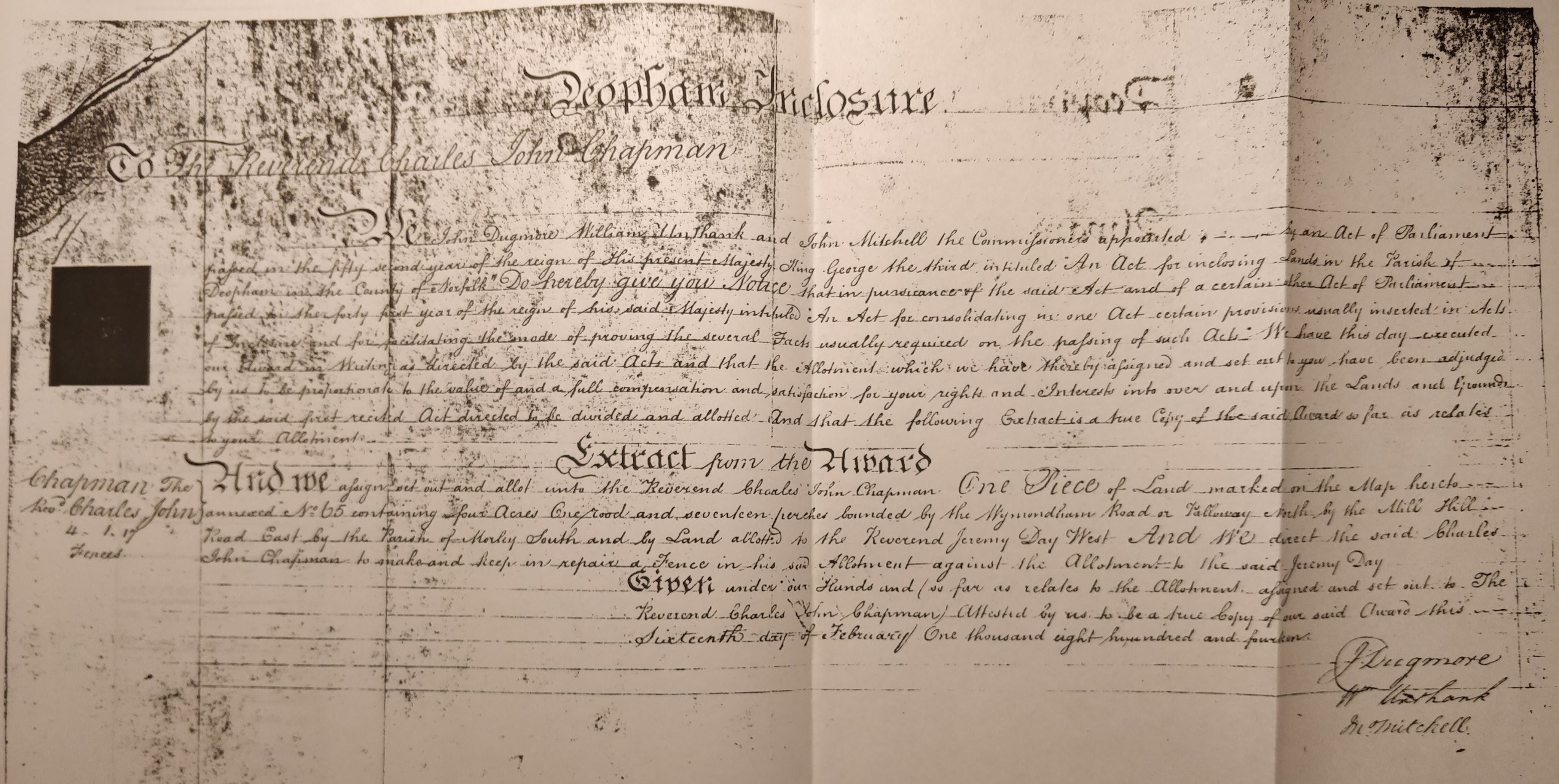
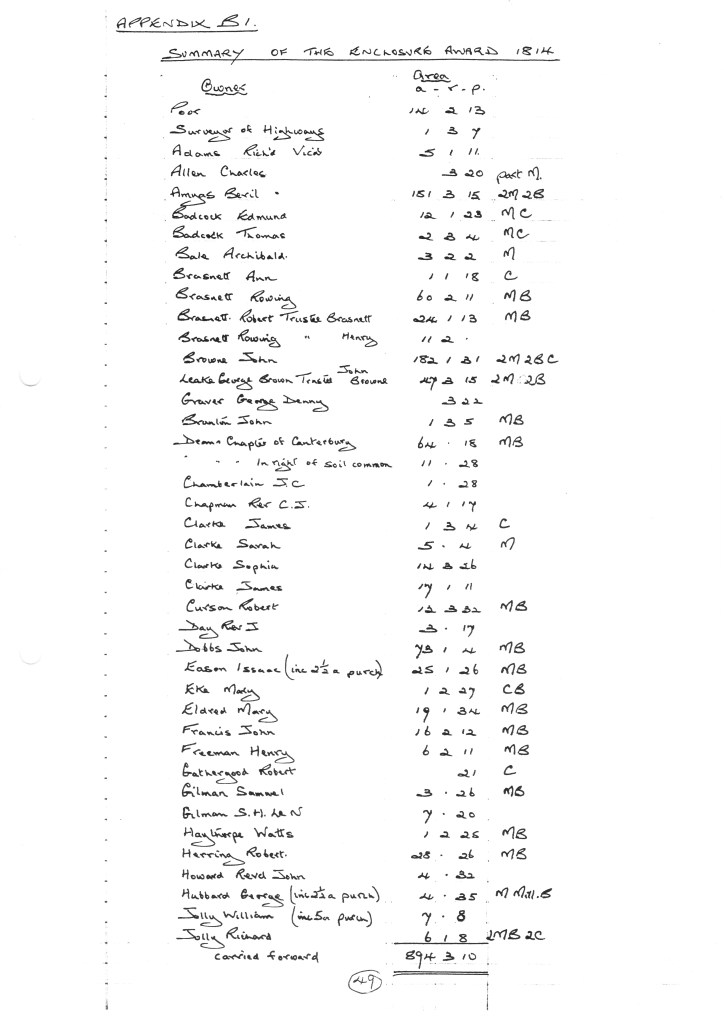
The award set out the boundaries of the parish and all roads before describing each allotment in detail specifying if it is copyhold and if copyhold of which manor, the abbutals are denominated with the responsibility for fencing and ditching defined. The award, which fills over one hundred pages of the Commissioners minute book is referenced to a detailed map. (For a summary of the award see Appendix B1, for part of the enclosure map see Appendix A1 and for a copy of an actual award see Appendix A4).
The total costs of enclosure amounted to £4,307-9s-8d, equivalent to £2-12s-0d an acre. Part of the cost was raised from the sale of land and the remainder of £1,326-19s-88 levied on the properties.
The award made in 1814 at least ended a very long period of uncertainty. How it affected the people involved is considered in the next Chapter.
Chapter 5
The Award and the aftermath
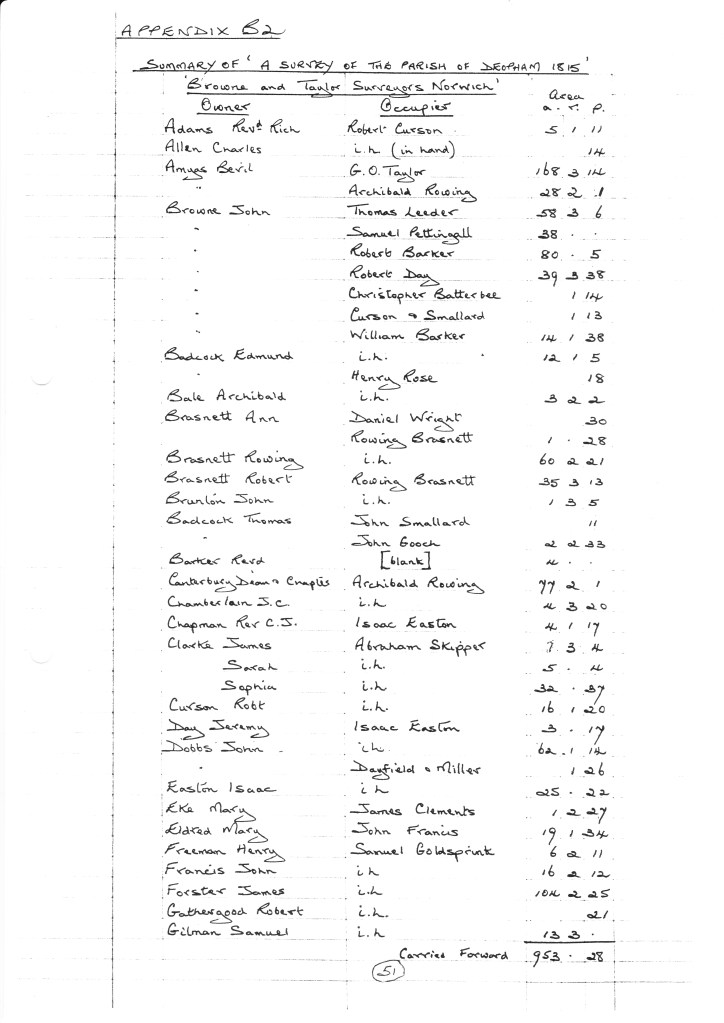
In the year following the enclosure award a detailed survey was prepared of the parish showing each holding and describing each piece of land distinguishing between arable and pasture.1 (A map was prepared but unfortunately does not survive). The total arable acreage recorded was 1361 acres and while it is not possible to say precisely how much of this was former common the descriptions and locations enable this to be identified in many cases and it is estimated that between three hundred and three hundred and fifty of the four hundred and eighty or acres of common were ploughed up immediately after enclosure. There were a number of changes in land ownership between the award and the survey: the estate of Thomas Kett was split between seven different owners, the Phoenix family reorganised their holdings, Lord Wodehouse bought about four acres from John Vassar and several sales and exchanges of small pieces took place before the new ditches were dug and new hedges planted.
There was a further survey in 1842 which also details every piece of land and distinguishes between arable or pasture and is accompanied by a map showing the precise location of each piece.2
It shows that there had been very little change in the total arable acreage, 1374 acres against 1361 acres twenty seven years earlier. There are a number of variations in the lists of owners and occupiers but overall there was very little change in the pattern of ownership or farm size.3 (See Appendix B)
The 1842 survey identified 534 pieces of land:-
| Percentage of total area | ||
| 151 | under one acre | 4.6 |
| 105 | 1 acre but less than 2 acres | 9.6 |
| 125 | 2 acres but less than 4 acres | 22.6 |
| 75 | 4 acres but less than 6 acres | 22.3 |
| 41 | 6 acres but less than 8 acres | 17.3 |
| 18 | 8 acres but less than 10 acres | 9.8 |
| 19 | 10 acres and over | 13.8 |
| 534 | 100.0 |
The evidence indicates that a high proportion of these pieces had been separately fenced by 1842.
The population increased from 392 in 1811 to 494 by 18514 three quarters of them had been born in Deopham (58.9%) or its adjoining parishes (15.4%).
The enclosure award identifies sixty messuages and cottages but many of these were subdivided. The 1851 census records 120 dwellings while a direct comparison cannot be made inspection of the enclosure map and the 1842 map suggests that there was little overall change.
The 1851 census records thirty one farmers living in Deopham farming 1502 acres and employing forty nine men and lads. This contrasts sharply with ninety five men and lads living in the parish who describe themselves in the same census as agricultural labourers, farm servants etc. The most probable explanation is that the farmers recorded full time permanent farm staff and this took no account of casual or day workers or indeed the unemployed.
One of the most interesting points to emerge is the position of the Church. Richard Adams was Vicar from 5 1799 for about fifty years but it does not appear that he ever lived in the parish or indeed visited it very often. It was not until November 1850 that Deopham had the first of a line of resident Vicars, the Reverend G.H. Turner. His comments in 1851 are illuminating “… This has been a long neglected parish without day or Sunday school – the congregation is now increasing and schools (National) are to be erected immediately…”6
Richard Adams had also been Rector of Edingthorpe since 1789 and although he is recorded as resident there in White’s Directory of 18477 the comments of the newly appointed Rector there in 1851 are no more favourable
“… I have only lately been presented to the Rectory of Edingthorpe and from the dilipidated condition of the Glebe House am not yet in residence. The parish has been for the last 60 years cruely neglected…” 8
There had been an active Baptist Congregation in Great Ellingham since about 1700 and James Sparkhall who farmed in Deopham was Pastor there for twenty one years from 17679 but in the early nineteenth century Methodism arrived in Deopham. A Primitive Methodist Chapel was erected in 181810 on land that had formed part of the low common sold to Isaac Eason and it was his son Robert who signed the Ecclesiastical Census return. Robert’s wife Mary is described as ‘Primitive Methodist Local Preacher’ in the 1861 population census. 11 A second Primitive Methodist Chapel was established in 1837 on part of the former Deopham Green.12 On the thirtieth of March 1851 220 people were recorded as attending afternoon worship in the two chapels as against 100 present at the parish church.13
[See here for further details of the 1851 figures.]
The records of the churchwardens, constables and overseers of the poor do not survive. Deopham was one of twenty three parishes in the Forehoe Poor Law Administration incorporated in 1776 with a ‘House of Industry’ at Wicklewood.14 In the first half of the nineteenth century the number of Deopham people resident there averaged five or six at one time but several more were supported by outdoor relief. In this period there was considerable migration from Norfolk villages to towns, from Norfolk to London, the Midlands and the North and emigration from this country to the New World. In 1836 Shipdham sent forty four people to a new life in Leeds while Edgefield bade farewell to one hundred and twenty three who emigrated to North America.15 Carleton Rode paid for ten of its inhabitants to sail from Great Yarmouth to Quebec in May 184216 the cost of seventy pounds being raised by way of a loan with the repayments being met out of the poor rates according to a calculation of the weekly maintenance of that number of the poor. 17
Lord Wodehouse was one of the main beneficiaries of the enclosure. He added much of the common between Bayfield Hall Farm and the Hackford boundary to that farm which he fenced and ditched and consolidated his holdings between the Wymondham Road and Morley as shown on the map (Appendix A2). He carried out extensive drainage of most of his farm between 1853 and 1858 involving digging and laying clay drains sometimes six feet below the surface (Appendix A3). This work it is reputed was carried out by Irish labour.18 The Wodehouse family continued to own the land in Deopham until 1922.
The Dean and Chapter of Canterbury were also major beneficiaries consolidating their glebe which had been spread throughout the parish which with their share of the commons enabled them to obtain a compact farm of about seventy five acres. This passed to the Ecclesiastical Commissioners in about 1862 but continued to be held by them and their successors until 1963. The Dean and Chapter of Canterbury still retain the right of presentation of the Vicarage now jointly with others to the benefice of ‘High Oak’ of which Deopham is now part.
The Amyas family did well from enclosure despite their pleadings to the Dean and Chapter that the Misses Amyas
“… have every claim to a convenient arrangement which can be made for two young ladies born and brought up with considerable expectations and now reduced by the imprudence of their Father and the lunacy of their Brother, to this leasehold only or nearly so and whose family were lessees of this very property more than three hundred years ago…” 19
They leased a compact farm, were able to collect corn tithes on a much larger acreage of corn from the common land ploughed up and sown with wheat and barley.
Bevil Amyas who owned Elm Farm increased his acreage by taking in former common land.
The Amyas interest in Deopham came to an end with Bevil’s death in 187620 – his two unmarried sisters having died a few years earlier. Bevil left no heirs and no will so his estate passed to the Crown.
Rowing Brasnett farmed almost one hundred acres after enclosure and having obtained more land benefited by having a larger more compact farm. He ceased farming in Deopham before 1841 but his descendants continued to live in the village until about 1950. His uncle Archibald Rowing also farmed in Deopham and that family continued in Morley and Deopham until about 1910.
Robert Eason took over the land farmed by his father and by 1851 was farming some sixty five acres dispersed in several different places. He was, as has already been noted, a key worker for the Primitive Methodist Chapel.
Charles Allen was allotted three rods and six perches of land on the former Stalland Common in addition to his semi detached dwelling (half a messuage). His allotment was sandwiched between ‘Browne’ lands and he sold it to them immediately after the award was made rather than incur the relatively high cost of fencing and ditching his small piece of land. Charles was already an old man in 1814 but continued to live in Deopham until he died at the age of eighty four in 1830. His sons lived in Great Ellingham and Attleborough but the family involvement in Deopham recommenced in 1875 when his grandson William took a tenancy of Hall Farm from the Earl of Kimberley (formerly Lord Wodehouse) and which William’s son Walter bought in 1922. The Allen involvement as land owners and farmers continues in Deopham to this day.
The Oddin Taylors who farmed Bayfield Hall Farm at the time of enclosure as tenants of Lord Wodehouse moved from the village. The family accumulated considerable wealth from farming, landowning and the law and John Oddin Taylor of Hardingham Grove became Lord Mayor of Norwich in 1861.21
The Lanes left Deopham shortly after enclosure. Lord Walsingham’s interest was in more than one sense peripheral, his large estate straying over the edge of Breckland just into Deopham. Richard Adams continued as Vicar until his death in 1850. John Dugmore, John Mitchell and William Unthank collected their fees and went their separate ways and Samuel Heyhoe LeNeve Gilman prospered from his fees and his Legal Practice.
Chapter 6
An Evaluation
A great deal has been written about the benefits and disadvantages of Parliamentary Enclosure in Norfolk. Three of the best known writers of the time acclaimed the agricultural advances they observed. Arthur Young devoted one hundred and twelve pages of his ‘General View of the Agriculture of the County of Norfolk’ to support his opinion of “… the remarkable improvements which are known to have flowed from Parliamentary Enclosure…”1; William Marshall produced detailed calculations to prove the increased profits that could be obtained by enclosure of open fields and grass lands2 and Nathanial Kent supporting enclosure concluded “… the markets will ever regulate the proportion of arable and grass land better than any fixed plan that can be suggested…” 3 Their writings were no doubt influenced by the enthusiastic agriculturalists who sought them out and with whom they corresponded. About sixty farmers of substance are quoted by Arthur Young in ‘General View of Norfolk’ referred to above and both Marshall and Kent were land agents and so again were more familiar with the large improving tenants of great estates than they were of the typical farmer.
The Hammonds in their study ‘The Village Labourer 1760-1832’, while acknowledging the economic benefits saw enclosure as one of the stages in the breaking up of the structure of the old village and the way it was carried out as very damaging to the poor commented “… The greater the stress laid on the progress of Agriculture, the greater appears the perversity and injustice of the arrangements of society under which the labourer became impoverished…”4 Arthur Young was a great supporter of enclosure but wanted the Enclosure Acts to be fairer to the poor. He was the author of a pamphlet ‘Inquiry into the Proprietory of applying wastes to the better maintenance of the poor’ in 1801 to which he refers in his autobiography five years later
“… of all the essays and papers I have produced none I think so pardonable as this, so convincing by the facts, and so satisfactory to any candid reader. Thank God I wrote it, for though it never had the smallest effect except in exciting opposition and ridicule, it will I trust remain a proof of what ought to have been done; and had it been executed would have diffused more comfort among the poor than any proposition that ever was made…”5
The loss of common rights everywhere had an effect on the life of the village and while it may be argued that the actual monetary value of these common rights was small, to those on the margins it could have made the difference between independent survival and resort to the poor house. There was also the loss of small privileges and customs by consent rather than legal right for which there was no compensation. The loss of these rights and privileges was a marker post indicating a change to the way of life towards one of complete dependence on employment from one with a small element of independence. The loss of the commons together with such things as the centralisation of care of the poor in Unions, marked the loss of a sense of parochial community and responsibility for all under the paternal eyes of the elected elders the village pindars, overseers, haywards and constables.
The enclosure of Deopham was set up by the Amyas’s, Wodehouses, Brownes and the Church of England after a thirty four year argument between them on how the spoils should be shared. The desires of the Wodehouses and the Amyas’s in particular were orchestrated by Gilman. The bill was eventually passed in 1812 and two years later the award was made by the Commissioners, professional men of integrity but their decisions no doubt made against the awareness of those to whom they relied on for the appointments, position and prosperity.
The evidence suggests that the effects of the eventual Enclosure of Deopham were modest. It provided the means to reorganise the land holdings of the village and to promote a more productive and profitable agriculture. The population of Deopham grew in the period between 1801 and 1851 and then fell back again to its 1801 level by the end of the century, but this pattern of change is repeated in almost every other Norfolk rural parish whether you take for example Carleton Rode enclosed in 1777 or Wacton where the commons have never been enclosed.
In some areas of Norfolk massive changes took place in the late seventeenth and early eighteenth centuries under the auspices of the Cokes, the Townshends and others in large modern farms and this was publicized as ‘the Norfolk Agricultural Revolution’. In other areas the changes were quieter and slower and Deopham can be included in this category.
The enclosure of Deopham helped to increase the quantity of agricultural goods produced, helped to improve the quality of those goods and helped to increase the return to the farmer not just from quantity and quality but because it increased the flexibility to move production into the most profitable segment of the market at the time but the major factors at work were external. The first half of the nineteenth century witnessed a fundamental change from an agricultural society to an industrial one. The population of the country doubled and people moved from the country villages to new jobs and opportunities in the towns and cities as the demand for labour on the farms decreased and the cottage industries became no longer viable. The advent of steam for threshing and deep ploughing, the advent of the railways in the county, the introduction of artificial fertilisers all had an impact on each farm whether the parish in which it was situated was enclosed or not.
The place of the common can be exaggerated. The major rights were often in the control of a few as at Wacton6 where the rights to graze were held by nineteen owners. The populace no doubt grumbled as they did at Ashill in 18167 and there is no doubt that the more powerful members of society fared best in Deopham as elsewhere. The enclosure of Deopham can be viewed as a device used by the major land owners not just to enhance the value of the land in the parish but also to secure a larger share of that value. This was really what the thirty four years of arguing was about before Parliament ever saw an Enclosure Bill for Deopham. In practical terms it was nearly all decided by that point leaving the Commissioners to arrange the details to put the award into place.
What seems remarkable is not how much change took place in Deopham in the fifty years following the award in 1814 but how much remained relatively unaltered with a similar pattern of land ownership and farm size throughout that period. Enclosure changed the landscape with new roads, new hedges, new ditches and some new buildings, but in the context of the dramatic social and economic changes of the time the specific effects of the Parliamentary Enclosure itself were modest.
Appendix A: Maps and Documents
Appendix A1 – Part of map of Deopham showing enclosure award 1814
Cp DeH = Copyhold of Manor of Deopham Hall
Cp DCh = Copyhold of Dean and Chapter of Canterbury
Cp Sh in M = Copyhold of Shadwells in Morley

[The whole of the original of this map can be seen at here.]
Appendix A2 – Part of map of Wodehouse estate showing pre and post enclosure boundaries
Part of a Map of the Wodehouse Estate in Deopham after Enclosure in 1814 (this shows the pre-enclosure boundaries of the land in allotments 67 and 69 – see Map 1 above – and includes part of Baylam Lane – marked in green – stopped up).
[See here for a newspaper cutting concerning this closure.]
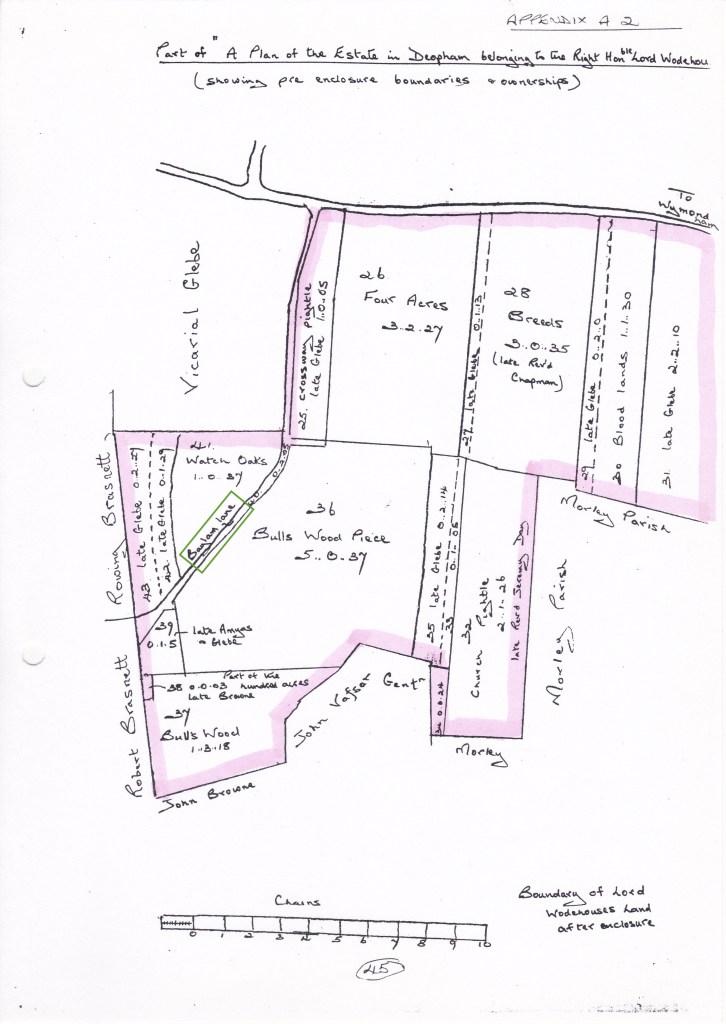
[This plan was copied from a document in the possession of Michael Allen which is reproduced in full here.]
Appendix A3 – Map of Wodehouse Estate in Deopham and Morley in 1860
Copy of Map of Wodehouse Estate in Deopham and Morley in 1860 showing land drainage schemes.

Note North is at the foot of this map.
Appendix A4 – Copy of Award to Charles John Chapman
Award No 65 (shown on Map 1 above) which he received in substitution for ‘Breeds’ (number 28 on Map 2 above).
Appendix B: Analysis of Owners and Occupiers
Analysis of Owners and Occupiers of Land in Deopham

Appendix B1 – Summary of the Enclosure Award 1814

Appendix B2 – Summary of ‘A Survey of the Parish of Deopham, 1815‘

Appendix B3 – Survey of the Tithe Award 1842
Richard Allen’s original transcripts can be seen here.
| Landowner | Occupied by | Acres | Roods | Perches | ||
|---|---|---|---|---|---|---|
| Amyas | Bevil | Clarke | Robert | 28 | 2 | 9 |
| Rowing | Archibald | 166 | 3 | 26 | ||
| Pearce | Stephen and | |||||
| Codling | Fielding | 2 | 17 | |||
| Badcock | Edward | Daines | Thomas | 2 | 1 | 37 |
| George | John | 36 | ||||
| George | James | 14 | ||||
| unocc. | 4 | |||||
| Badcock | William | Knights | William | 7 | 0 | 18 |
| Baker | John | Reeve | Reuben | 24 | 1 | 24 |
| Shickle | William | 6 | 2 | 30 | ||
| Barker | Elizabeth | 22 | ||||
| Barnard | Eliza | Kimm | Thomas | 33 | ||
| Brasnett | Bridget | Turner | Frederick | 23 | 1 | 8 |
| Brasnett | Rowing (executors) | Phoenix | John | 23 | 0 | 8 |
| Shickle | Jas Jnr | 37 | 3 | 17 | ||
| Garner | Berry & | |||||
| Minns | Thos | 1 | 15 | |||
| Boodle | William | Richardson | James | 4 | 1 | 35 |
| Wingfield | John & others | 1 | 39 | |||
| Browne | John Turner Graver | Barker | Mary | 14 | 2 | 39 |
| Brunton | William | Knott | William | 1 | 0 | 25 |
| Himself | 3 | 5 | ||||
| Brunton | James | Himself | 2 | 0 | 10 | |
| Chamberlin | John C | Raven | William | 4 | 3 | 1 |
| Himself & | ||||||
| Raven | William | 23 | ||||
| Chapman | Rev J C | Eason | Robert | 4 | 1 | 12 |
| Churchwardens & | ||||||
| Overseers of Deopham | Wright | William | 1 | 1 | 15 | |
| Clarke | Sophia | Clarke | Henry | 32 | 1 | 23 |
| Clarke | James | Flint | Jarmany & | |||
| Deck | Fras | 9 | ||||
| Deck | Francis | 3 | 15 | |||
| Flint | Jarmany | 3 | 30 | |||
| Clements | Francis | George | Jeremiah | 1 | 1 | |
| Cooper | Rev C B | Rowing | Archibald | 4 | 1 | 24 |
| Curzon | John | Curzon | Jno Jnr | 16 | 0 | 11 |
| Smith | Thomas | 17 | ||||
| Colman | Richard & | |||||
| Baker | Jno | 30 | ||||
| Darby | Rev | Barnard | Francis | 12 | 0 | 34 |
| Day | Rev J | Eason | Robert | 3 | 0 | 14 |
| Dobbs | John | London | Henry | 6 | 1 | 5 |
| Himself | 1 | 2 | 32 | |||
| Himself & Phoenix | 1 | 7 | ||||
| Durrant | William | Shickle | James Snr | 30 | 0 | 11 |
| Eason | Robert | Himself | 22 | 0 | 14 | |
| Goward | Wright & Others | 2 | 9 | |||
| Poll | Esther | 34 | ||||
| Poll | Esther & Others | 2 | 34 | |||
| Everett | Archibald & Others | 2 | 10 | |||
| Eldred | Henry | Cowles | Robert | 19 | 3 | 5 |
| Fenix | Taylor | Rippir | William | 20 | 3 | 2 |
| [Phoenix] | ||||||
| Fenix | Taylor Jnr | Himself | 1 | 0 | ||
| Fenix | John | Himself | 7 | 0 | 16 | |
| Francis | John | Wade | Robert | 15 | 3 | 21 |
| Gapp | James | Coldham | James | 2 | 2 | 36 |
| Greaves | Revd | Wrigglesworth | William | 3 | 2 | 29 |
| Haythorpe | Watts | Flint | Jarmany & | |||
| Garner | W. | 38 | ||||
| Hewitt | Robert & | |||||
| Flint | Jno | 30 | ||||
| Bales | Archibald & | |||||
| Gooch | Biros | 31 | ||||
| Flint | Elinga & | |||||
| Summers | Jno | 1 | 15 | |||
| Flint | Francis & | |||||
| Flint | William | 38 | ||||
| Clements | Charles & Jas | 2 | 6 | |||
| Hewitt | Revds John & George | Wrigglesworth | William | 14 | 0 | 1 |
| Hubbard | George | Himself | 9 | 0 | 26 | |
| Iverson | Revd | Wrigglesworth | William | 3 | 2 | 0 |
| Jessup | William | Himself | 6 | 2 | 27 | |
| Johnson | James | Stone | John | 47 | 1 | 27 |
| Jolly | William | Wade | John | 5 | 0 | 28 |
| Coldham | James | 7 | 2 | 30 | ||
| Gooch | Barnabas & | |||||
| Page | Wm | 1 | 14 | |||
| Knight | George Browne Leake | Matthew | Turner | 57 | 1 | 22 |
| Barker | Robert | 78 | 3 | 11 | ||
| Leader | Thomas | 80 | 3 | 12 | ||
| Cana | Thomas | 3 | 29 | |||
| Knights | Robert | Gathergood | Robert | 1 | 29 | |
| Barker | Robert & | |||||
| Seaman | James | 2 | 1 | |||
| Lane | Andrew | Himself | 40 | 0 | 22 | |
| Last | Philip | Barker | David | 31 | 0 | 22 |
| Labell | Edward | Wilby | James | 3 | 0 | 30 |
| Liddelow | William | Lincoln | Geo & | |||
| Whitehand | 1 | 16 | ||||
| Lock | Ezekiel | Liddelow | William | 84 | 0 | 5 |
| Mann | William | Ward | John | 38 | ||
| Curle | William | 1 | 29 | |||
| Mason | Rev C | Barnard | Francis | 4 | 0 | 4 |
| Pitts | Phineas | Goward | John | 8 | 2 | 34 |
| Pitts | Philip | Driver | Samuel | 104 | 1 | 24 |
| Primitive Methodist | (Trustees) | Themselves | 5 | |||
| Pond | (Widow) | Lebbell | Edward | 1 | 19 | |
| Wright | William | 1 | 1 | 26 | ||
| Poor Trustees | Eason | Robert | 14 | 0 | 33 | |
| Rix | Robert | Himself | 40 | 1 | 25 | |
| Rix | Henry (Charity) | Curson | John | 4 | 1 | 24 |
| Shaw | Henry | Himself | 27 | 1 | 9 | |
| Simpson | Katherine | Wright | William | 13 | 0 | 33 |
| Surveyors of Highways | Themselves | 1 | 32 | |||
| Love | George | 1 | 1 | 37 | ||
| Taylor Garrett Oddin | Himself | 23 | ||||
| Richardson | James | 3 | 2 | 3 | ||
| Clarke | Thomas | 3 | 1 | 9 | ||
| Taylor | Thomas | Ward | James & Others | 23 | ||
| Taylor | Francis Oddin | Taylor | Samuel | 4 | 2 | 16 |
| Taylor | William & Holman James | Taylor | Samuel | 33 | 0 | 7 |
| Walsingham | Lord | Colman | James | 24 | 0 | 12 |
| Watson | James | London | Henry | 3 | 37 | |
| Wodehouse | Lord | Taylor Garrett Oddin | 166 | 2 | 36 | |
| Curle | Mary | 1 | 0 | |||
| Mason | Edward | 1 | 2 | |||
| Mason | Edward & Curle Mary | 1 | 4 | |||
| London | Henry | 11 | 2 | 6 | ||
| Himself | 14 | 1 | 10 | |||
| Wright | Murrell | Wright | William | 19 | 2 | 12 |
| Wood | Rev Benj | Barnard | Thomas | 3 | 3 | 13 |
| Dean & Chapter of Canterbury | (Rectorial Glebe) | Clarke | Robert | 75 | 2 | 6 |
| Vicarial Glebe | Curson | John Jnr | 5 | 1 | 25 | |
| Clarke | Robert | 1 | 0 | 10 | ||
| Totals | 1622 | 2 | 11 |
Appendix C
Summary of the main terms of the lease of the Manor and Rectory or Parsonage of Deopham
Dated Ninth December 1807
Lease Twenty fifth November 1800 surrendered.
“… Farm, let, Manor, Rectory or Parsonage of Deopham Norfolk also rents, services, lands, meadows, pastures and feedings together with tythes, pensions, portions, ways, wastes, profits, commons and commodities and hereditaments to the said manor and parsonage, together with all court leets, views of frank pledge and the profits thereto belonging with all waifs, strays, escheats, deodands, felons goods, fugitives goods and all chattels goods of outlawed and condemned persons, fines, issues and amerciaments and all other things whatsoever… except… the Advowson gift and patronage of the Vicarage of Deopham…” To Revd. Bence Bence devisee in trust for Ann Amyas deceased from feast of St Luke the Evangelist last past [eighteenth of October] for twenty one years.
Paying sixteen pounds a year to the Dean and Chapter plus eight pounds sixteen shillings a year in lieu of land tax which had been redeemed by the Dean and Chapter and six pounds a year to the Vicar.
The tenant to repair, uphold and maintain all the houses, barns, stables, edifices, buildings and all inclosures of land of the manor and parsonage and the chancel of the Parish Church of Deopham.
The tenant to cause to be made up two terriers or books showing the demesne and glebe and two rentals showing all free and copyhold tenants.
The tenant to pay the Dean forty shillings a year and the Receiver twenty shillings a year “… at the election or choice of the said Dean or Receiver whether to take their entertainment in kind or so much money in lieu thereof whether they visit that parsonage or not…”
The Lessee to find and pay “… a sufficient honest and learned Steward.”
Detailed provisions on how rents are to be paid, what happens if there are arrears or default and how a new lease can be granted in certain circumstances etc etc.
Source: DCC U63/68973
Notes
DCC refers to the archive of the Dean and Chapter at Canterbury
NRO Norfolk Record Office Office
PRO Public Record Office
Chapter 1
- NRO PD 496/105
- Blomefield Francis History of Norfolk 1739 (1805/10 Edn), Vol II 532
- Blomefield Vol II 373
- Kent Nathaniel General View of Agriculture of the County of Norfolk 1794 p82
- Marshall William The Rural Economy of Norfolk 1783 Vol II 365
- Paine Clive (Ed) The Culford Estate 1780-1935 1993 pp 21-26
The purchase of the property of James and Mary Houghton, who had lost an expensive legal action about gleaning, cleared the way for Marquis Cornwallis to enclose and reorganise the whole of the parish of Timworth. The Marquis spent many years in India and Ireland and his interests at home were looked after by his brother James (Dean of Canterbury from 1775 to 1781). - For a description of farming at the time see:-
The Farming Journals of Randall Burroughes (1794 – 1799) (Norfolk Record Society Vol LVIII (1995); edited by Susanna Wade-Martins and Tom Williamson)
The unpublished diaries of Thomas Howes of Morningthorpe 1803-1806
(NRO MC 150/52)
Landscape and Landscape Change in the Norfolk Claylands 1700-1870 (NAHRG Annual No 40 (1995) pp 44-58 Tom Williamson)
Chapter 2
- Burke’s Peerage and Baronetage (1927 Edn) p 1327
- Return of Owners of Land Norfolk 1873 (London 1875) Kimberley Earl of, 10800 acres with a gross estimate rental of £15,185 per annum.
- Hackford Inclosure Award 1806 250 acres NRO Rye MS 111
Wicklewood Inclosure Award 1808 240 acres NRO Rye MS 113
Hingham Survey 1811/12 approx 1000 acres NRO Rye MS 107 - Collinson Patrick & others (eds) A History of Canterbury Cathedral Oxford 1995 pp 568/9
- Collinson p 215
- Collinson p 566
- Blomefield Vol II p 495
- For a summary of the terms of the lease see Appendix C
- Collinson p 391 quoting from ‘Reports from the Select Committee Appointed to Inquire into the State of the Public Records of the Kingdom’ (London 1800) p 332
- DCC LB2 p 86 extract from letter dated the twentieth December 1812 from Thomas Starr to Gilman about a long running dispute with the Vicar who considered that he was entitled to a portion of the great tithes on land called Hawfield and referring to previous correspondence that Gilman had quoted.
- Collinson p 246 quoting from Hasted’s ‘Kent’ Vol XI p 528
- Collinson p 253 and 565
- Collinson p 253 and Burke’s Landed Gentry 15th Edn. p 2183
- Collinson p 213
- Norfolk Genealogy Vol 13 (1981) pp 10-12 Patrick Palgrave-Moore Pedigree and Arms of Amyas of Deopham and Hingham.
- Blomefield Vol II p 495
- Norfolk Archaeology Vol XXI (1922) pp 295-296 William Hudson Assessment of the hundred of Forehoe 1621 Document 2
- Will dated 7 June 1763 Proved PCC 1763
- Norfolk Record Society Vol XIII p 30
- NRO MC 639/3 795×9 p 90
- NRO MC 639/8 796X I Lord Wodehouse’s Leets
- Will NRO AF 1774/8 W60 351 [see here for a copy of the will of Charles Allen]
- Deeds of Lease and Release 1799
- See Note 20 above
- Return of Owners of Land Norfolk 1873
- DCC CA/11 p 88
- Norfolk Archaeology Vol XXXVI p 134 Peter Eden
Land Surveyors in Norfolk 1550-1850 - NRO Rye MS 111
- NRO Rye MS 113
- Williams Neal The Oldest Law Firm in Norfolk (Wymondham 1993)
- Burkes Landed Gentry 15th Edition
- NRO Rye MS 138 Gilman Papers
- See Note 18 above.
Chapter 3
The main sources from the archive of the Dean and Chapter of Canterbury at Canterbury are:-
- The Canterbury Letters DCC Cant Let
- The Chapter Act Books DCC CA
- The Auditors Letters DCC AL and DCC LB
- Box 50 in the Basement Box Series DCC BB50
The main sources from the Norfolk Record Office are the Enclosure Commissioners’ Minutes and Accounts of their clerk for Deopham, Hingham, Hackford and Wicklewood (Rye MS).
The Kimberley Papers have yet to be catalogued.
- DCC BB50 100
- NRO KIM 39 15 (4)
- DCC Cant Let 232
- NRO KIM 39 15 (2)
- DCC Cant Let 238
- DCC AL 155
- NRO Rye MS 105
- NRO Rye MS 109
- DCC AL209
- DCC BB50 102 (1) (quoted in)
- NRO Rye MS 109
- DCC CA 11 p84
- NRO Rye MS 109
- NRO Rye MS 111
- NRO Rye MS 109
- DCC U63 68973 (for a summary of this lease see Appendix C)
- DCC BB 50 102 (1)
- DCC LB2 p86
- DCC BB50 104
- DCC BB50 105
- DCC LB2 p86
- DCC LB2 p90
- DCC AL 548
- DCC LB2 p95
- NRO Rye MS 109
- NRO Rye MS 109
- DCC LB2 p 100
Chapter 4
- Unless otherwise stated, the source of the information is the bound book of the proceedings of the Deopham Enclosure Commissioners which includes a copy of the Deopham Act, the minutes of the Commissioners’ meetings and a copy of the award:- NRO Rye MS 108
- NRO WLS XL 33 5
Chapter 5
- NRO PD 485/19
(for summary see Appendix B2) - NRO PD 485/28
(for summary see Appendix B3) - For a summary of the land ownership and occupation see Appendix B
- 1811 and 1851 Population Censuses HO 107 1817 259-176
- DCC CA11 p 68
- PRO HO 129 235.37 (see below*)
- White’s Norfolk Directory 1845 p 478
- PRO HO 129 230.64 (see below*)
- Norfolk Genealogy Vol 13 163
- PRO HO 129 235.38 (see below*)
- 1861 Population Census
- PRO HO 129 235.39 (see below*)
- PRO HO 129 235.37-39 (see below*)
- White’s Norfolk Directory 1845 p 431
- Dymond David The Norfolk Landscape p 246 (Bury St Edmunds 1985 1990 Edn)
- NRO PD 254/64
- NRO PD 254/74
- Maps of drainage scheme Appendix A3
- DCC Al 548 letter from Gilman to Thomas Starr dated 11 January 1811 (should be 11 January 1812)
- Norfolk Genealogy Vol 13 10-12
- Norfolk Genealogy Vol 8 150-151
* The 1851 Census of Accommodation and Attendance at Worship is reproduced in Norfolk Record Society Vol LX11 (1998) edited by Janet Ede and Norma Virgoe (see page 150 Deopham and page 66 Edingthorpe).
[See extract here for the Deopham data.]
Chapter 6
- Young Arthur General View of Agriculture of the County of Norfolk London 1804 (1969 Edn) pp 75-186
- Marshall William The Rural Economy of Norfolk London 1783 p 371
- Kent Nathaniel General View of Agriculture of the County of Norfolk London 1796 p 73
- Hammond J L and B The Village Labourer 1760-1832 London 1911 (1987 Edn)
- Quoted in the preface to Hammond (above)
- Agreement on the Common rights of Wacton 1745 between the various “… Owners or proprietors of certain messuages lands and tenements situated, lying and being in Wacton in the County of Norfolk to which… there doth of right belong common of pasture for all commonable cattle …” on Wacton common. This sets out regulations for the use of the common. The common rights for one hundred and fifty seven cattle to graze the common belonged at that time to nineteen people.
NRO PD 496/74. - Quoted by A.W. Reid The Process of the Parliamentary Enclosure of Ashill Norfolk Archaeology XXXVI (1979) pp 169-177
Bibliography
Atherton lan and others (Eds) Norwich Cathedral: Church, City and Diocese 1096 - 1996 London 1996

Barringer J.C. (Ed) Faden's Map of Norfolk 1797 First published 1797 (1989 Edn)

Blomefield Francis An Essay towards a Topographical History of the Country of Norfolk Fersfield 1739 (1803/10 Edn)

Collinson Patrick and others (Eds) A History of Canterbury Cathedral Oxford 1995

Dymond David The Norfolk Landscape Bury St Edmunds 1990

Ede Janet and Virgoe Norma (Eds) The 1851 Census of Accommodation and Attendance at Worship Norfolk Record Society Vol LXIII 1996

Hammond J.L. and B The Village Labourer 1760-1832 London 1911 (1987 Edn)

Hoskins W.G. The Making of the English Landscape London 1955 (1985 Edn)

Kent Nathaniel General View of Agriculture of the County of Norfolk London 1794

Marshall William The Rural Economy of Norfolk London 1783

Paine Clive (Ed) The Culford Estate 1780-1935 Bury St Edmunds 1993

Palgrave-Moore Patrick (Ed) Norfolk Pedigrees Part Two Norfolk Genealogy Vol 8 1976

Palgrave Moore Patrick (Ed) Norfolk Pedigrees Part Three Norfolk Genealogy Vol 13 1981

Rackham Oliver The Illustrated History of the Countryside London 1937 (1967 Edn)

Riches Naomi The Agricultural Revolution in Norfolk London 1937 (1967 Edn)

Wade-Martins Peter (Ed) An Historical Atlas of Norfolk Norwich 1993

Wade-Martins Susanna Norfolk a Changing Countryside 1780-1914 Chichester 1988

Wade-Martins Susanna and Tom Williamson (Eds) The Farming Journals of Randall Burroughes 1794 - 1799
Norfolk Record Society Vol LVIII (1995)

Williams Neal The Oldest Law Firm in Norfolk Wymondham 1993

Young Arthur General View of the Agriculture of the County of Norfolk London 1804 (1969 Edn)

Barringer J.C. An Introduction to Commons Commons in Norfolk (1987) pp 3-8

Dodd J. Philip Norfolk Agriculture 1853-1854 Norfolk Archaeology XXXVI (1976) pp 253-264

Eden Peter Land Surveyors in Norfolk 1550-1850 Norfolk Archaeology XXXVI (1975) pp 119-148

Hudson William Assessment of the Hundred of Forehoe 1621 Norfolk Archaeology XXII (1923) pp 285-308

Reid A.W. The Process of the Parliamentary Enclosure in Ashill
Norfolk Archaeology XXXVII (1979) pp 169 177

Williamson Tom Land Use and Landscape Change in the Norfolk Claylands 1700-1870 NAHRG Annual No 4 (1995) pp 44-58
Navigation
| Date | Change |
|---|---|
| 12/3/25 | Link to Charles Allen’s Will |
| 15/4/24 | Note on source of Appendix A2 |
| 10/1/24 | Sub heading to Gilman 1796 |
| 7/1/24 | Linked to Gilman letter of 11/1/1812 |
| 8/9/23 | Linked to 1815 Survey of Deopham |
| 4/8/23 | Correction of Bragnett to Brasnett in App B3 |
| 31/10/22 | Published |
 Deopham History