Contents
- Introduction
- September 22nd 1636: Construction of a windmill
- September 24th 1638
- Adjacent land refers to the water mill
- September 22nd 1724: Indenture for sale to Michael Hardy
- January 21st – 22nd 1731: Lease and Release
- September 26th – 28th 1732 Lease, Release and Mortgage
- March 8th 1734: Hannah Thurrold advanced a mortgage
- October 29th 1739: Assignment of Mortgage by Hannah Thurrold
- August 22nd 1757: Court of the Manor of Deopham Hall
- 1797 Map
- December 13th – 14th 1798: Lease and Release
- April 2nd 1800: Court of the Manor Deopham Hall
- October 4th 1800: Transfer of Mortgage to John Smith
- July 28th 1804: Transfer of Mortgage to William Lane
- April 26th 1806: Transfer of Mortgage to John Smith
- December 5th-6th 1808: Lease and Release to Aaron Lane
- 1812 – Pre-Inclosure Statement of Claims
- 1813 – earliest plan
- The 1814 Inclosures
- April 7th 1814: Court of the Manor of Deopham Hall
- 1815 Survey of Deopham
- November 4th 1837: Disposal of Aaron Lane’s assets
- November 4th 1837
- 1843 Tithe Apportionment
- June 30th 1847: Mortgage on Copyhold Land redeemed
- 1881/2 Ordnance Survey Map
- 2024
- Footnotes
- Navigation
Introduction
This is possibly one of the most interesting plots in the village on account of the detailed documentary history that is still extant. There were two closely related plots of land in Low Common, Deopham. The one was Freehold and covered by a series of indentures, from which the relevant sections are transcribed below. In these, the descriptions of the property are highlighted in yellow.
The second, but closely related plot, was Copyhold of the Manor of Deopham Hall. The relevant parts of the court proceedings for that Manor are included on this page, with links to the full court proceedings on the Manor pages. Passages relating to the manorial copyhold plot are highlighted in orange.
There is a summary before each group of documents which indicates their key purpose and points of interest. Parts of the documents that relate back to these summaries are highlighted in green.
As elsewhere on this site, square brackets indicate insertions not in the original text; a row of stops indicate a chunk of text that has been omitted.
September 22nd 1636: Construction of a windmill
At the Court of the Dean & Chapter of Canterbury held on September 22nd 1638 reference was made in the Court Roll to a windmill having been built by Thomas Smythe in Low Common. It appears that this was built without the consent of the Lord of the Manor. No further identification of the location or size of the plot at Low Common was recorded
September 24th 1638
At the Court of the Dean & Chapter of Canterbury held on September 24th 1638 reference was made in the Court Roll to a water mill and a defunct windmill in Low Common next to a piece of land 60ft by 60ft.
Adjacent land refers to the water mill
October 19th 1718
The Court Roll of the Court of the Manor of Deopham Hall held on October 19th 1718 recorded that John Raven surrendered a piece of copyhold land in Low Common which measured 60ft by 60ft. This piece of land was said to be next to a water mill lately of Richard Raven, and next to the water course, South & West.
This description of the Deopham Hall piece of land is repeated in several further transactions referenced below.
December 1st 1719
The same plot of land 60 ft x 60 ft copyhold of the Manor of Deopham Hall appeared again at the Court held on December 1st 1719 when the owner was recorded as being Henry Osborn of Deopham, Miller. He used his property to secure a loan from William Cooper of Hingham, Butcher.
November 20th 1724
The Deopham Hall plot changed hands again at the Court of November 20th 1724 when it passed from Henry Osborn to Michael Hardy of Shropham in Norfolk, Miller. This corresponds to the transfer of ownership of the mill itself recorded in the indenture detailed below.
September 22nd 1724: Indenture for sale to Michael Hardy
Summary
The premises being sold include a former water mill and a windmill which appears to be currently in use. A piece of adjacent copyhold land is also covered by the same document. The premises are being sold by Henry and Mary Osborn to Michael Hardy. Prior to the Osborns, the premises had been owned and occupied by Thomas Wade.
This document is the Release part of a Lease and Release transaction as indicated by the fact that the property is already occupied by the purchaser and that the previous price was five shillings. See here for an explanation of the Lease and Release process.
Detail

This Indenture made the Twenty Second day of September in the Eleventh year of the Reign of our Sovereign Lord George by the Grace of God King of Great Britain France and Ireland, defender of the Faith and in the Year of our Lord one Thousand seven hundred and Twenty Four
Between
– Henry Osborn of Deopham in the County of Norfolk, Miller, and Mary his Wife of the one part and
-Michael Hardy of Shropham in the said County, Miller, of the other part,
Witnesseth that for and in consideration of the Summe of Eighty four pounds of Good and Lawfull money of this Nation to the said Henry Osborn in hand well and truly paid by the said Michael Hardy at or before the sealing and delivery ….
the said Henry Osborne hath granted, bargained, sold, remised, released, aliened and confirmed by these presents
Doth Grant, bargain, sell, remise, release, alien and confirm unto the said Michael Hardy, his heirs and assigns,
All that Messuage and Mill House with the Lands thereunto belonging Situate, lying and being in Deopham aforesaid, formerly in the possession and occupation of Thomas Wade and now in the possession and occupation of the said Henry Osborn;
And also all that Land thereunto belonging whereon a Water Mill late stood and all manner of waters, Streams, pools, water courses, profits and advantages whatsoever to the said messuage, water mill and premises belonging with their and every of their appurtenances
And also one piece of Copyhold Land held of the Manor of Deopham Hall in or nigh the Common Pasture of Deopham aforesaid, called the Low Common nigh the said water Mill next the water … on the part of the south and west Containing in Length and breadth sixty foot
And also all that Wind Mill now Standing and being thereon or any other Land thereunto near or next adjoining now in the use of the said Henry Osborn
All which said premises are now in the actual possession of the said Michael Hardy by virtue of a Bargain and sale thereof for a year for the Consideration of Five Shillings and made by him, the said Henry Osborn, to the said Michael Hardy by Indenture bearing date the day before the day of the date of these presents and made between the said Henry Osborn of the one part and the said Michael Hardy of the other part and Sealed and Executed before the Execution of these presents and by force of the Statute made for Transferring Uses into possession …
To have and to hold so much and such part of parts of the said Messuage, Mill, Lands, Tenements, Hereditaments and all and Singular other the premises hereby Granted or released or mentioned or intended to be (as are freehold) with their and every of their Appurtenances unto the said Michael Hardy, his Heirs and Assigns …
[Michael Hardy would accept no] Tithes, Charges or incumbrances whatsoever had, made, Committed, done or wittingly or willingly suffered by the said Henry Osborn or any other person or persons whatsoever Claiming by, from, or under, or in trust for them, or any of them, or by from or under any other person or persons whatsoever
except
– the Ancient and Accustomed Rents and Services that shall from henceforth Grow due and payable to the Chief Lord or Lords of the Fee or Fees whereof the same Premises are held,
and also
– Except one Mortgage made of the said premises by Robert Pitts of Hingham in the said County descendent [?] to William Cooper of Hingham aforesaid Butcher for the payment of Sixty pounds and Interest which is agreed to be assigned over for the Benefit of the said Michael Hardy …
In witness whereof the parties abovesaid to the … Indentures have Interchangeably Set their Hands and Seals the day and year first above written:
Receipt for payment
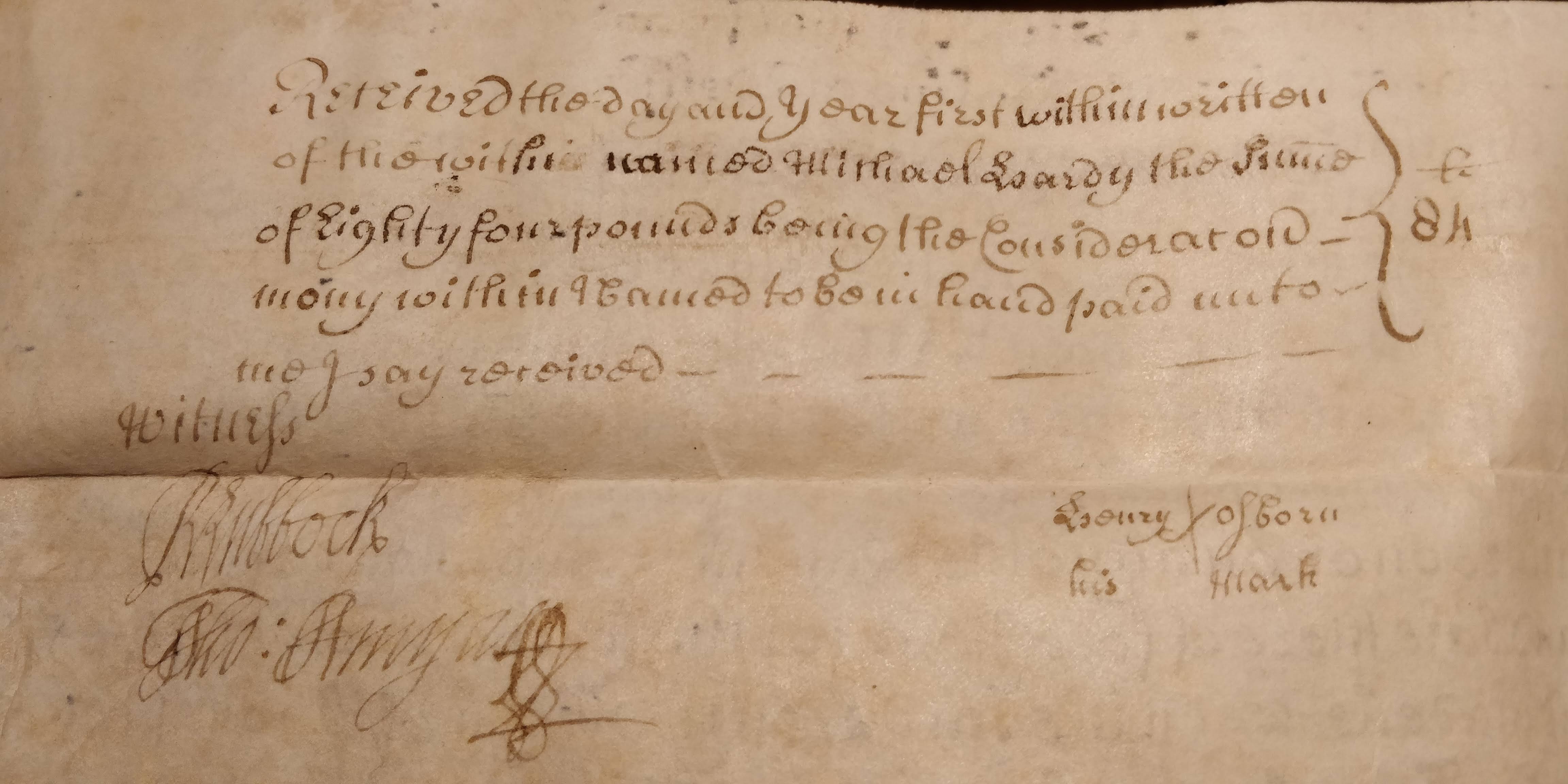
The signature of the second witness on this receipt is of Thomas Amyas – a family that features often in Deopham’s history.
January 21st – 22nd 1731: Lease and Release
Summary
This is a pair of documents recording a lease and release transaction transferring ownership of the mills and accompanying lands from Michael Hardy to William Rose. It describes the site as being “whereon a water mill late stood”, but includes “a windmill standing and being thereon”. The value of the sale was £40.
See here for an explanation of the Lease and Release process.
January 21st 1731: Lease

This Indenture made the Twenty first day of January In the Fifth Year of the Reign of our Sovereign Lord George the Second by the Grace of God of Great Britain, France and Ireland, King, Defender of the Faith and in the Year of our Lord One Thousand Seven hundred and Thirty one
Between
– Michael Hardy of Shropham in the County of Norfolk, Miller, of the one part and
– William Rose of Wymondham in the said County, Miller, of the other part,
Witnesseth that for and in Consideration of the Summe of Five Shillings of lawfull mony of this Nacion to the said Michael Hardy in hand well and truly paid by the said William Rose at or before the sealing and delivery of these presents, the receit whereof is hereby acknowledged He, the said Michael Hardy, hath Bargained and Sold and by these presents Doth Bargain and Sell unto the said William Rose
All that Messuage and Mill House with the Lands thereunto belonging situate, lying and being in Deopham in the said County, late in the possession and occupation of Henry Osborn and now in the possession and occupation of Matthew Daynes
And also All that Land thereunto belonging whereon a Water Mill late stood and all manner of Waters, Streams, Pools, Water Courses, Profits and Advantages whatsoever to the said Messuage, Water Mill and premises belonging with their and every of their appurtenances
And also one piece of Copyhold Land held of the Mannor of Deopham Hall in or nigh the Common Pasture of Deopham aforesaid called the Low Common nigh the said Water Mill and next the Water Course there on the part of the South and West Containing in length Sixty Foot and in breadth Sixty Foot
And also All that Windmill Standing and being thereon or on Any other Land thereunto near or next adjoining now in the use of the said Michael Hardy,
All which said premises are now in the Actual Possession of the said William Rose by Virtue of a Bargain and Sale thereof for a year for the Consideration of Five Shillings made by him the said Michael Hardy to the said William Rose by Indenture bearing Date the day next before the day of the date of these presents and made between the said Michael Hardy of the one part and the said William Rose of the other part and Sealed and Executed before the Execution of these Presents and by force of the Statute made for transferring Uses into Possession
And the Reversion and Reversions, Remainder and Remainders, Rents reserved Yearly and other rents, Issues and profits of the said Messuage, Mill, Lands, Tenements, Hereditaments and All and Singular other the premises hereby granted of released or mentioned or intended to be hereby granted or released with their and every of their Appurtenances.
To have and to hold so much and Such part of parts of the said Messuage, Mill, Lands, Tenements, Hereditaments and All and Singular other the Premises hereby bargained and sold or mentioned of intended so to be as are Freehold and not Copyhold and every part and parcell thereof with their and every of their appurtenances unto the said William Rose, his executors, Administrators and Assigns from the date hereof for during and unto the full End and Term of One whole Year from thence next Ensuing and fully to be Compleat and Ended
Yielding and paying therefore at the end of the said Term the rent of one pepper Corn only (if the same shall be lawfully demanded)
To the Intent and purpose that by Virtue of these presents and of the Statute made for the transferring Uses into possession, The said William Rose may be in the actual possession of all and Singular the said Premises hereby bargained and Sold with their and every of their Appurtenances and may thereby be the better Enabled to Accept of and take a Grant and Release of the Same Premises to him, his heirs and assigns
In Witness whereof the parties abovesaid have to these present Indentures interchangeably Set their hands and Seals the day and Year first above written: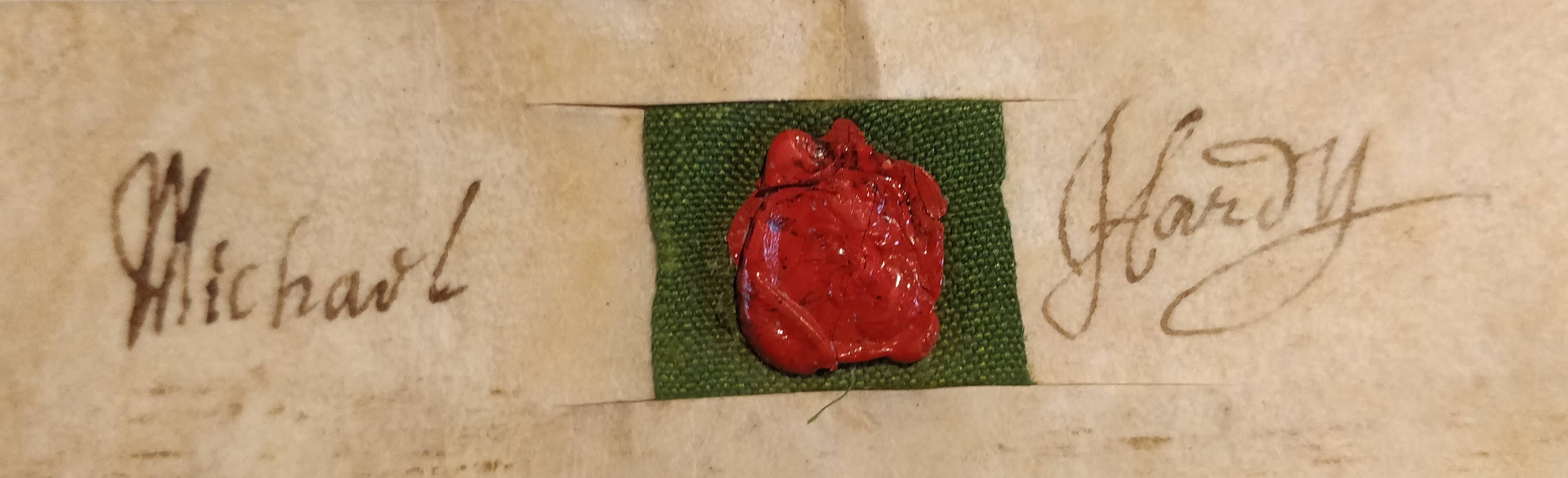
January 22nd 1731: Release
This Indenture made the Twenty Second day of January In the Fifth Year of the Reign of our Sovereign Lord George the Second by the Grace of God of Great Britain, France and Ireland, King, Defender of the Faith etc., And in the Year of our Lord One Thousand Seven Hundred and Thirty One
Between
– Michael Hardy of Shropham in the County of Norfolk, Miller,of the One part, and
– William Rose of Wymondham in the said County, Miller, of the other part,
Witnesseth that for and in Consideration of the Summe of Forty Pounds of Good and lawfull mony of this Great Britain to the said Michael Hardy in hand well and truly paid by the said William Rose at or before the sealing and delivery of these presents, the receit and payment whereof the said Michael Hardy Doth hereby acknowledge and thereof and of every part and parcell thereof doth hereby Acquit, Exonerate and Discharge the said William Rose, his Heirs, Executors and Administrators and Every of them by these Presents. The said William Hardy hath Granted, Bargained, Sold, remisedd, aliened amd Confirmed and by these presents Doth Grant, Bargain, Sell, remise, release, alien and confirm unto the said William Rose and to his Heirs
All that Messuage and Mill House with the Lands thereunto belonging situate, lying and being in Deopham in the said County, late in the possession and occupation of Henry Osborn and now in the possession and occupation of Matthew Daynes,
And also All that Land thereunto belonging whereon a Water Mill late Stood and all manner of Waters, Streams, Pools, Water Courses, Profits and Advantages whatsoever to the said Messuage, Watermill and premises belonging with their and every of their Appurtenances
And also one piece of Copyhold Land held of the Mannor of Deopham Hall in or nigh the Common Pasture of Deopham aforesaid called the Low Common nigh the said Water Mill and next the Water Course there on the part of the South and West Containing in Length Sixty Foot and in breadth Sixty Foot
And also All that Windmill Standing and being thereon or on Any other Land thereunto near or next adjoining now in the use of the said Michael Hardy,
And the Reversion and Reversions, Remainder and Remainders thereof with their and every of their appurtenances.
etc, etc
And Also that Mary the now Wife of the said Michael Hardy Shall and will within One Month next after the decease of the said Michael Hardy (in case she shall happen to Survive him) at her own proper Costs and Charges or at the Costs and Charges of the Executors or Administrators of the said Michael Hardy, by good and Sufficient Conveyances, Convey her Dower and all her Estate Rights Title & Interest of, in and to all and Singular the said granted and released premises unto the said William Rose, his Heirs and Assigns
And Also deliver or cause to be delivered within the said Month such Conveyances uncancelled unto the said William Rose, his Heirs and Assigns.
etc
In Witness whereof the parties abovesaid have to these present Indentures interchangeably Set their hands and Seals the day and Year first above written.
January 22nd 1731: Receipt for payment

The second witness signature is that of John Amyas, subsequently to appear in Deopham’s history.
Admission to the Court of the Manor of Deopham Hall
The admission of William Rose as the Copyhold tenant of these premises was recorded at the Court of the Manor of Deopham Hall held on February 15th 1731. The description was “one piece near or adjacent to the Common Pasture of Deopham called The Low Common by the Water Mill late of Richard Raven next the Watercourses there South & West, 60 feet in length and 60 feet in width”.
September 26th – 28th 1732 Lease, Release and Mortgage
Summary
See here for an explanation of the Lease and Release process.
It is interesting that this document refers to the “Windmill now standing”. The next document in which the windmill is mentioned (dated in 1734) refers to it in the past tense.
These indentures record the sale of the premises by William Rose to William Lane for a downpayment of £30 and a mortgage of £30 + 5% p.a. interest.
William Lane must consequently pay £31 10s (without any deductions for taxes etc) to William Rose by September 28th 1733 otherwise he will forfeit his rights to the property. In practice, this meant that as long as he continued to pay the interest of 5% per annum until the principal loan of £30 had been paid off, he would be OK.
September 26th 1732: Lease
This Indenture made the twenty sixth day of September in the Sixth Year of the Reign of our Sovereign Lord George the Second by the Grace of God of Great Britain, France and Ireland, King, Defender of the Faith etc, And in the Year of our Lord One thousand Seven Hundred and thirty two
Between
– William Rose of Deopham in the County of Norfolk, Miller, of the one part and
– William Lane of Hingham in the said County, Millwright, of the Other part;
Witnesseth that for and in consideration of the Summe of Five Shillings of Lawfull Mony of this Nacion to the said William Rose in hand well and truly paid by the said William Lane at or before the Sealing and delivery of these presents, the Receit whereof is hereby Acknowledged, He, the said William Rose,
Hath Bargained and Sold and by these presents doth Bargain and Sell unto the said William Lane
All that Messuage and Mill House with the Lands thereunto belonging Situate, lying and being in Deopham aforesaid late in the Use, Possession and Occupation of Henry Osborne and now in the Use, Possession and Occupation of Matthew Daynes
And also all that Land thereunto belonging whereon a Water Mill late stood and all Manner of Water, Streams, pools, Water Courses, Profits and Advantages whatsoever to the said Messuage, Water Mill and premises belonging with their and every of their Appurtenances
And also one piece of Copyhold Land held of the Manor of Deopham Hall in or nigh the Common Pasture of Deopham aforesaid, called the Low Common nigh the said Water Mill and next the Water Course there on the part of the South and West Containing in Length Sixty Foot and in breadth Sixty Foot
And also all that Windmill now Standing and being thereon or any other Land thereunto near or next adjoining now in the use of the said William Rose.
And also all Other the Messuages, Lands and Tenements of him the said William Rose in Deopham aforesaid,
And the Reversion and Reversions, Remainder and Remainders thereof with their and every of their Appurtenances
To have and to hold so much So much and Such part or parts of the said Messuage, Mill, Lands, Tenements & Hereditaments hereby Bargained and Sold or mentioned or Intended So to be (as are Freehold and not Copyhold) And All and Singular other the Premises and every part and parcell thereof with their and every of their Appurtenances unto the said William Rose, his Executors, Administrators and Assigns from the Day next before the Day of the Date of these presents for during and unto the full End and Term of one Whole Year from thence Next Ensuing and fully to be Compleat and Ended;
Yielding and paying therefore at the end of the said term the Rent of one pepper Corn only (If the Same Shall be lawfully Demanded) To the intent and purpose that by virtue of these presents and of the Statute made for lawfully transferring Uses into Possession, the said William Lane may be in the Actuall possession of All and Singular the said premises hereby Bargained and Sold with their and every of their Appurtenances and may thereby be the better Enabled to Accept of and take a Grant and Release of the same premises to him, his Heirs and Assigns.
In Witness whereof the Parties above said have to these present Indentures Interchangeably Set their Hands and Seals the day and year first above written.
September 27th 1732: Release
This Indenture made the twenty seventh day of September in the Sixth Year of the Reign of our Sovereign Lord George the Second by the Grace of God of Great Britain, France and Ireland, King, Defender of the Faith etc, and in the Year of our Lord One thousand Seven Hundred and thirty two
Between
– William Rose of Deopham in the County of Norfolk, Miller, of the one part and
– William Lane of Hingham in the said County, Millwright, of the Other part.
Witnesseth that for and in consideration of thirty pounds of lawfull Mony of this Nacion to the said William Rose in hand well and truly paid by the said William Lane at or before the Sealing and Delivery of these presents, the Receit and payment whereof the said William Rose doth hereby Acknowledge and thereof doth Acquit, Exonerate and Discharge the said William Lane his heirs, Executors and Administrators and every of them by these presents And also in consideration of the Summe of thirty pounds of like mony secured by mortgage of the premises hereafter mentioned to be paid to the said William Rose, his Executors, Administrators or Assigns in Manner therein mentioned, The said William Rose
Hath Granted, Bargained, Sold, Remised, Released, Aliened and Confirmed and by these presents doth Grant, Bargain, Sell, Remise, Release, Alien and Confirm unto the said William Lane and to his Heirs
All that Messuage and Mill House with the Lands thereunto belonging Situate, lying and being in Deopham aforesaid late in the Use, Possession and Occupation of Henry Osborne and now in the Use, Possession and Occupation of Matthew Daynes
And also all that Land thereunto belonging whereon a Water Mill late Stood and all Manner of Water, Streams, pooles, Water Courses, profits and Advantages whatsoever to the said Messuage, Water Mill and premises belonging with their and every of their Appurtenances
And also one piece of Copyhold Land held of the Manor of Deopham Hall in or nigh the Common Pasture of Deopham aforesaid, Called the Low Common nigh the said Water Mill and next the Water Course there on the part of the South and West Containing in Length Sixty Foot and in breadth Sixty Foot
And also All that Windmill now Standing and being thereon or any other Land thereunto near or next Adjoining now in the Use of the said William Rose. And also all Other the Messuages, Lands and Tenements of him the said William Rose in Deopham aforesaid
All which said premises are now in the Actuall possession of the said William Lane by virtue of a Bargain and Sale thereof for a year for the Consideration of Five Shillings made by him the said William Rose to the said William Lane by Indenture bearing date the day next before the day of the date of these presents and made between the said William Rose of the One part and the said William Lane of the Other part and Sealed and Executed before the Execution of these presents and by force of the Statute made for the transferring Uses into possession,
And the Reversion and Reversions, Remainder and Remainders, Rents reserved yearly and other Rents, Issues and profits of the said Messuage, Mill, Lands, Tenements, Hereditaments and All and Singular Other the premises hereby Granted or Released or mentioned or Intended to be hereby Granted or Released with their and every of their Appurtenances
etc, etc
The indenture continues with confirmation by William Rose that he has “Good Right, full power, lawfull and Absolute Authority to Convey” the premises, such as are Freehold. He also undertakes to let William Lane enjoy the premises “without any lawfull Let, Suit, Trouble, Molestation, Eviction or Interruption”. William Rose also indemnifies William Lane against any claims made in the future against the property being conveyed.
September 28th 1732: Mortgage
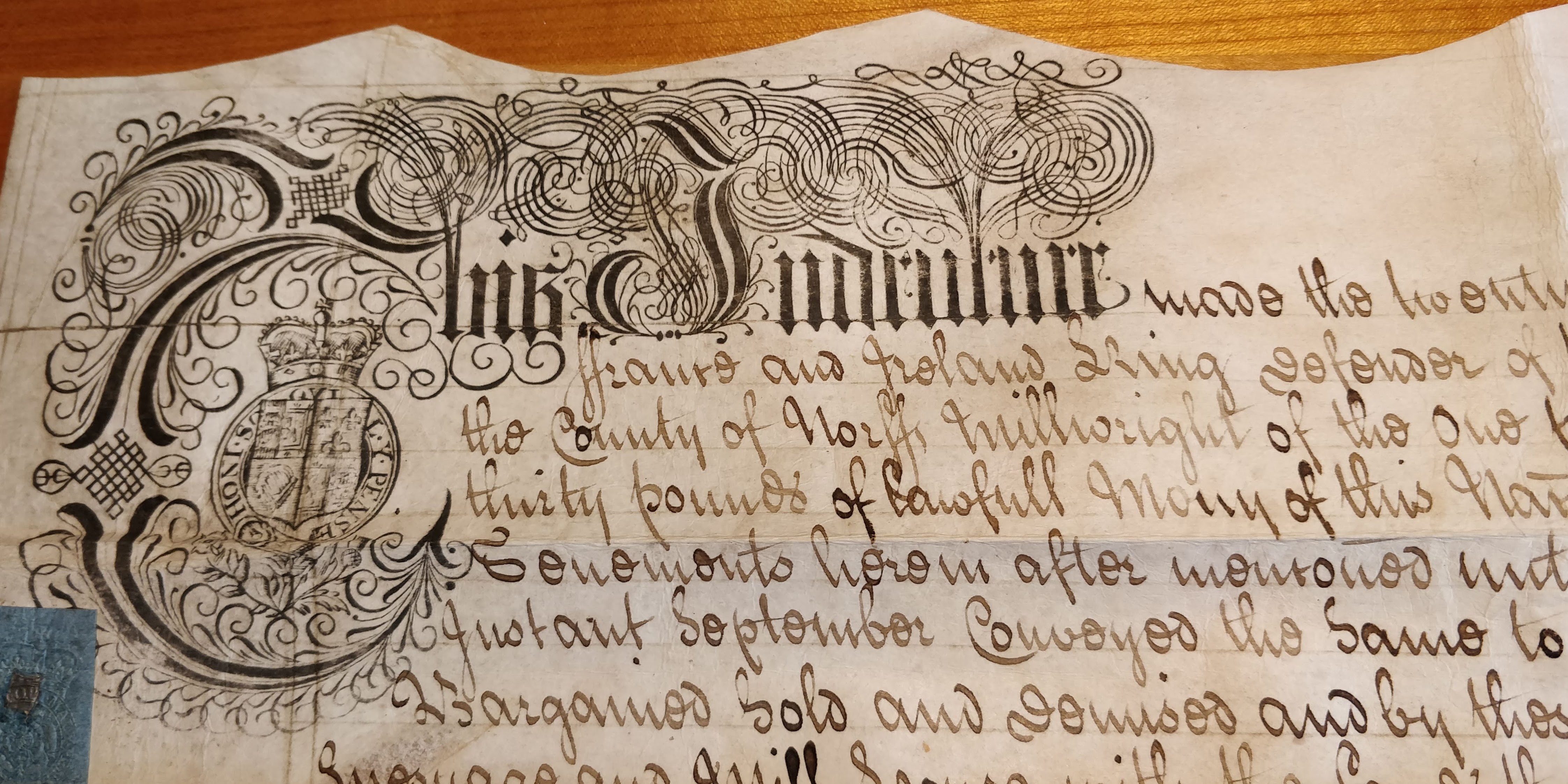
This Indenture made the twenty eighth day of September In the Sixth Year of the Reign of our Sovereign Lord George the Second by the Grace of God of Great Britain, France and Ireland; King, Defender of the Faith etc and In the Year of Our Lord One thousand Seven Hundred and thirty two
Between
-William Lane of Hingham in the County of Norfolk, Millwright, of the One part and
– William Rose of Deopham in the said County, Miller, of the other part
Witnesseth that for and in consideration of the summe of thirty pounds of lawfull mony of this Nacion being the Remainder of the Consideration Mony for which the said William Rose Sold the Messuage, Mills, Lands and Tenements herein after mentioned unto the said William Land and by Lease and Release bearing respectively Date the twenty sixth and twenty seventh Days of this Instant September, Conveyed the Same to the said William Lane and his Heirs and for diverse other good Causes and Considerations the said William Lane
Hath Granted, Bargained, Sold and Demised and by these presents
Doth Grant, Bargain, Sell and Demise unto the said William Rose, his Executors, Administrators and Assigns
All that Messuage and Mill House with the Lands thereunto belonging, Situate, lying and being in Deopham aforesaid, late in the Use, Possession and Occupation of Henry Osborne and now in the Use, Possession and Occupation of Matthew Daynes;
And also all that Land thereunto belonging whereon a Water Mill late stood and all Manner of Waters, Streams, pools, Water Courses, profits and Advantages whatsoever to the said Messuage, Water Mill and premises belonging with their and every of their appurtenances
And also one piece of Copyhold Land held of the Manor of Deopham Hall in or nigh the Common Pasture of Deopham aforesaid, called the Low Common nigh the said Water Mill and next the Water Course there by the part of the South and West Containeth in Length Sixty Foot and in breadth Sixty Foot
And also All that Windmill now Standing and being thereon or any other Lands thereunto near or next adjoining now in the Use of the said William Rose.
And the Reversion and Reversions, Remainder and Remainders, Yearly and other Rents, Issues and profits of All and Singular Other the said premises herein before mentioned and Intended to be hereby Granted and Demised and every part and every of their Appurtenances 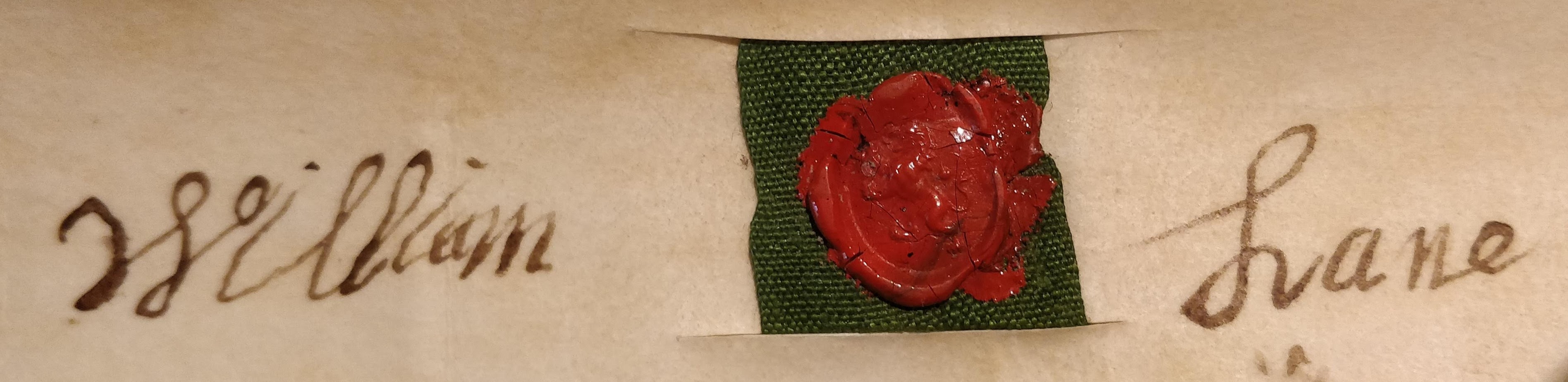
Admission to the Court of the Manor of Deopham Hall
The admission of William Lane as the Copyhold tenant of these premises was recorded at the Court of the Manor of Deopham Hall held on January 11th 1732/3. The description was “A piece of Copyhold land in or near the Common Pasture of Deopham called The Low Common by a Water Mill previously of Richard Raven, by the water course South & West. In length, 60 feet and width 60 feet”.
March 8th 1734: Hannah Thurrold advanced a mortgage
Summary
William Rose as mortgagee (the lender) and William Lane as occupier agreed to sell the mortgage to Hannah Thurrold. This takes the form of a sale to Hannah Thurrold which can be purchased when the loan is repaid. Hannah Thurrold paid £10 to William Rose being the outstanding balance on the loan he had advanced, and £30 to William Lane being the sum he had paid towards the premises.
This Indenture refers back to a time when the windmill was “then standing”, implying it is no longer standing.
Detail
This Indenture Tripartite made the Eighth day of March in the Eighth year of the Reign of our Sovereign Lord George the Second by the Grace of God of Great Britain, France and Ireland, King, Defender of the Faith, and in the year of our Lord One Thousand Seven Hundred and Thirty four
Between
– William Rose of Wramplingham in the County of Norfolk, Miller, of the first part
– William Lane of Deopham in the said County, Millwright, of the Second part and
– Hannah Thurrold of Hingham in the said County, Spinster, of the third part
Whereas by Indenture of Lease bearing date on or about the Twenty Eighth day of September which was in the year of our Lord One Thousand, Seven hundred and Thirty two and made or mentioned to be made between the said William Lane (by his additions therein mentioned) of the one part and the said William Rose (by his additions therein named) of the other part, The said William Lane for the consideration therein set forth did Grant, Bargain, Sell and Demise unto the said William Rose his Executors, Administrators and Assigns
All that Messuage and Mill House with the Lands thereunto belonging Situate, lying and being in Deopham aforesaid then late in the Use, Possession and Occupation of Henry Osborn and then in the Use, Possession and Occupation of Matthew Daynes
And also all that Land thereunto belonging whereon a Water Mill late stood and all Manner of Water, Streams, pools, Water Courses, profits and Advantages whatsoever to the said Messuage, Water Mill and premises belonging with their and every of their appurtenances
And also one piece of Copyhold Land held of the Mannor of Deopham Hall in or nigh the Common Pasture of Deopham aforesaid, Called the Low Common nigh the said Water Mill and next the Water Course there on the part of the South and West Containeth in Length Sixty Foot and in Breadth Sixty Foot
And also all that Wind Mill then standing and being thereon or any other Lands thereunto near or next Adjoining now in the use of the said William Rose.
etc etc
And whereas default was made in payment of the said Summe of Thirty One pounds and ten Shillings Contrary to the true Intent and meaning of the said proviso or condition whereby all and every the said Freehold premises became Forfeited to the said William Rose, his Executors, Administrators and Assigns which default of payment the said William Lane doth hereby Acknowledge
And whereas the said William Lane hath paid unto the said William Rose all principal and Interest due on the said Mortgage Except the Sume of Ten pounds
Now this Indenture Witnesseth that for and in consideration of the Sume of Forty pounds of Good and lawfull money of Great Britain in hand well and truly paid at of before the Sealing and delivery of these presents by the said Hannah Thurrold to the said William Lane and by his direction in manner following (that is to say)
– the sume of Ten pounds part thereof to the said William Rose in full Sattisfaction of all principall and Interest due to him upon the said mortgaged premises the Receit and payment of which said Sume of Ten pounds the said William Rose doth hereby Acknowledge and thereof and of every part and parcell thereof doth Acquit, Exonerate and Discharge the said Hannah Thurrold, her Executors and Administrators and every of them bv these presents
– And also for and in Consideration of the Sume of Thirty pounds of like Money by the said Hannah Thurrold to the said William Lane in hand … paid at or before the Sealing and delivery of these presents, the Receit whereof the said William Lane doth hereby Acknowledge and thereof and every part and parcell thereof doth Acquit, Exonerate and Discharge the said Hannah Thurrold, her Executors and Administrators and every of them bv these presents The said William Rose (By the direction and Appointment and at the Special Instance and Request of the said William Lane Testifyed by his being made a party to, and by his Signing and Sealing of these presents)
And also the said William Lane have and each of them hath Bargained, Sold, Assigned, Transferred and Set over by these presents
Do, and each of them, the said William Lane and William Rose,
Doth bargain, Sell, Assign, Transfer and Set over unto the said Hannah Thurrold, her Executors, Administrators and Assigns
All such and so much and such part and parts of the said Messuage, Mill, Lands, Tenements and Hereditaments herein before and in the said Rented Indenture mentioned and every part and parcell thereof, with their and every of their appurtenances as are Freehold
etc, etc
That if the said William Lane, his heirs, executors, Administrators or Assigns or any of them shall and so well and truly pay or Cause to be paid unto the said Hannah Thurrold, her Executors, Administrators or Assigns at or in the dwelling house of the said Hannah Thurrold in Hingham aforesaid the Sume of Fort two pounds of Lawfull Money of Great Britain in manner following (that is to say):
– the sume of Twenty Shillings part thereof on or upon the Eighth day of September next ensuing the day of the date hereof, and
– the sume of Forty one pounds residue thereof on or upon the eighth day of March which shall be in the year of our Lord one Thousand Seven Hundred and Thirty five without any Deduction or Abatement out of the Same or any part thereof for in respect of any Taxes, Charges or assessments already Taxed, Charged or Assessed or hereafter to be taxed charged or assessed by any Act or Acts of Parliament
etc, etc
And that in case default shall hapen to be made in payment of the said sume of Forty two pounds or any part thereof contrary to the … of the said provisoe herein before mentioned, That then from thenceforth the said Hannah Thurrold, her Executors, Administrators and Assigns shall and may from Time to Time and at all Times during the then residue of the said Term of one Thousand years peaceably and Quietly have, hold, Use, Occupy, Possess and Enjoy the said Messuage, Mill, Lands, Tenements, Hereditaments and premises herein before mentioned or intended to be hereby assigned with their and every of their appurtenances without any the lawfull Let, Suit, Trouble, Molestation, Interruption or Disturbance of the said William Rose or William Lane opr either of them then or either of their Heirs, Executors, Administrators or Assigns or of any other person or persons whatsoever.
October 29th 1739: Assignment of Mortgage by Hannah Thurrold
Summary
In 1734, Hannah Thurrold had advanced a mortgage of £40 to buy out William Rose and finance William Lane. One Robert Tuddenham had paid off the principal and interest, leaving Hannah Thurrold with a nominal entitlement to a peppercorn rent for the balance of 1,000 years. In return for a payment of 5 shillings, this Indenture assigned that entitlement from Hannah Thurrold to Samuel Gilman.
Detail

This Indenture Tripartite made the Twenty ninth Day of October In the Nineteenth Year of the Reign of our Sovereign Lord George the second By the Grace of God of Great Britain, France and Ireland, King, Defender of the Faith and so forth, And in the Year of our Lord One Thousand, Seven Hundred and Thirty Nine
Between
– Hannah Thurrold of Hingham in the County of Norfolk, Spinster, of the first part;
– William Lane of Deopham in the said County, Millwright, of the second part; and
– Samuel Gilman of Hingham aforesaid, Beerbrewer, of the third part:
Whereas by Indenture of Lease bearing date on or about the Twenty eight Day of September which was in the year of our Lord One Thousand, Seven Hundred and Thirty two and made or mentioned to be made between the said William Lane (By his additions therein mentioned) of the one part and William Rose (by his additions therein Named) of the other part, the said William Lane for the Consideration therein set forth
Did Grant, bargain, sell and demise unto the said William Rose, his executors, Administrators and Assigns
All that Messuage and Mill House with the Lands thereunto belonging situate, lying and being in Deopham aforesaid then late in the Use, Possession and Occupation of Henry Osborn and then in the Use, Possession and Occupation of Matthew Daynes,
And all that Land thereunto belonging whereon a Water Mill then late stood And all Manner of Water, Streams, Pools, Water Courses, Profits and Advantages whatsoever to the said Messuage, Water Mill and Premises belonging with their and every of their Appurtenances;
And also one piece of Copyhold Land held of the Manor of Deopham Hall in or nigh the Common Pasture of Deopham aforesaid, Called the Low Common nigh the said Water Mill and next the Water Course there on the part of the South and West Containeth in Length Sixty Feet and in Breadth Sixty Feet;
And also all that Wind Mill then standing and being thereon or any other Lands thereunto near or next adjoining then in the use of the said William Rose.
There is then a recitation of the terms of the 1734 tripartite agreement above.
And whereas Default was made in payment of the said Sum of forty two pounds contrary to the true Intent and Meaning of the said last mentioned provisoe or condition
And whereas the said William Lane hath by the payment of one Robert Tuddenham discharged all principall and Interest due on the said Mortgage … William Lane hath requested the said Hannah Thurrold to assign over the same unto the said Samuel Gilman, his executors, Administrators and Assigns
Now this Indenture Witnesseth that for the Consideration aforesaid and also in Consideration of the Sum of five Shillings in hand paid by the said Samuel Gilman to the said Hannah Thurrold at and before the sealing and Delivery of these presents, the Receit whereof is hereby acknowledged. She the said Hannah Thurrold by the Direction and at the Instance and Request of the said William Lane (testified by his being a party to and exemting these presents)
Hath bargained, sold, assigned, transferred and set over and by these presents at the like Instance and Request
Doth bargain, sell, assign, transferr and set over unto the said Samuel Gilman, his Executors, Administrators and Assigns all and Singular the said Messuage, Mill, Lands, Tenements, Hereditaments and Premises in the said recited Indenture mentioned
And the Reversion and Reversions, Remainder and Remainders thereof and all the Estate, Right, Title, Interest, Trust and Term of years to come and unexpired, Claim and Demand whatsoever (legal or Equitable) of her the said Hannah Thurrold of, in or to the same or any part thereof
To have and to hold the said Messuage, Mill, Lands, Tenements, Hereditaments and Premises herein before mentioned and intended to be hereby assigned and every part and parcel thereof with their and every of their Appurtenances unto the said Samuel Gilman, his Executors, Administrators and Assigns from henceforth for and during all the Rest, Residue and Remainder of the said Term of One Thousand Years and all and every other Term and Term of Years which She, the said Hannah Thurrold, is entitled unto in the said Premises
And it is hereby declared and agreed by and between All and every the said partys to these presents that the Remainder of the said Term of One Thousand Years is hereby assigned over unto the said Samuel Gilman, his Executors, Administrators and Assigns
In Trust only to prevent the said Term from being Merged or extinguished, and that the same may from Time to Time and at all Times be subservient unto and wait upon the freehold and Inheritance thereof vested in the said William Lane as aforesaid.
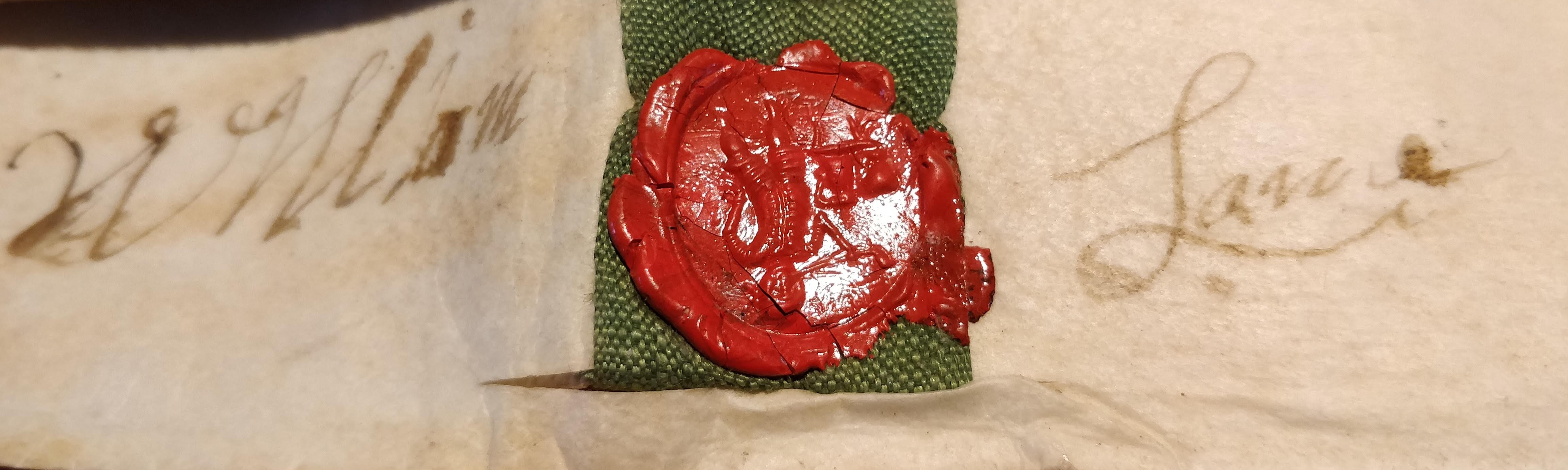
In witness whereof the said parties abovesaid have to these present Indentures interchangeably set their Hands and Seals the Day and Year first above written:
August 22nd 1757: Court of the Manor of Deopham Hall
At the Court of the Manor of Deopham Hall held on August 22nd 1757, it was recorded that Rose Lane was admitted to a piece of land near the Water Mill.
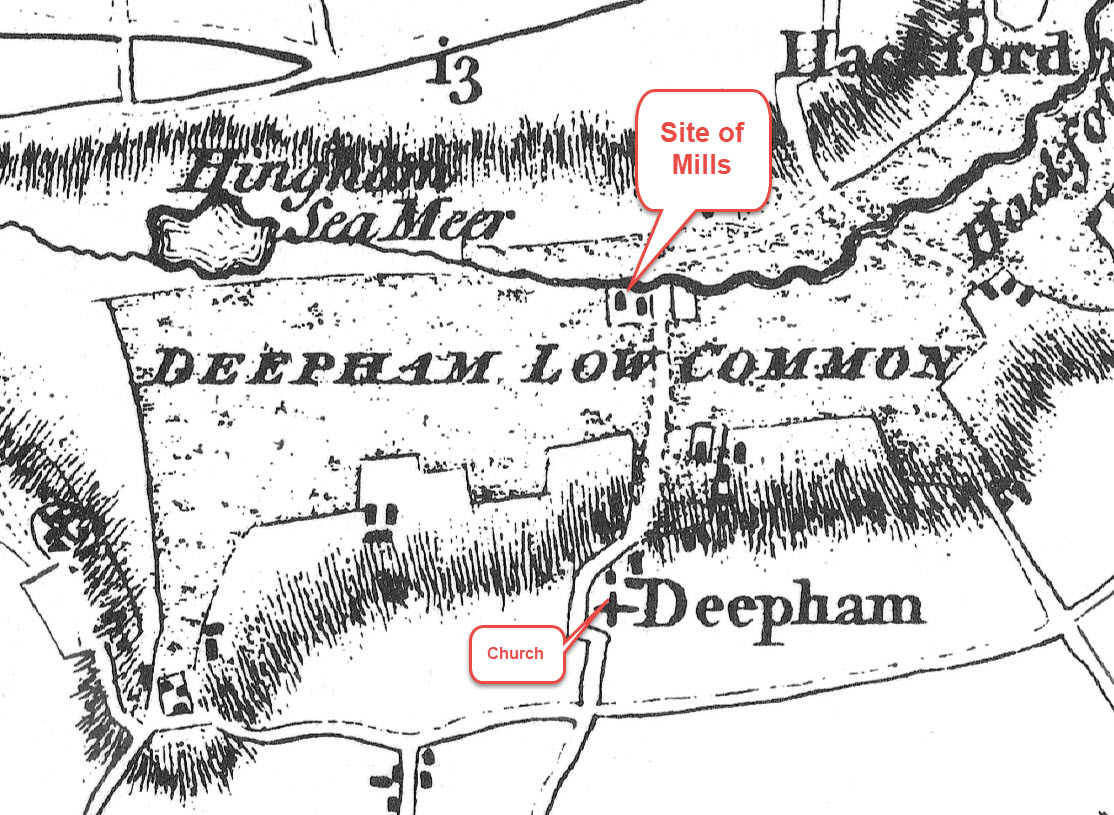
1797 Map
The following extract is taken from Faden’s Map of Norfolk which was first print in 1797:
December 13th – 14th 1798: Lease and Release
Summary
See here for an explanation of the Lease and Release process.
December 13th 1798: Lease

This Indenture made the Thirteenth Day of December in the year of our Lord One Thousand, Seven Hundred and Ninety Eight
Between
– John Cooper of Withingham in the County of Norfolk, Farmer, of the one part and
– John Lane of Deopham in the said County of Norfolk, Miller, of the other part
Witnesseth that for and in consideration of the Sum of Five Shillings of lawful British Money to him the said John Cooper in hand well and truly paid by the said John Laneat or before the Sealing and Delivery of these Presents, the Receipt whereof he, the said John Cooper, doth hereby acknowledge
And for divers other good Causes and Considerations thereunto especially moving, He the said John Cooper hath bargained and sold, And by these presents doth bargain and sell unto the said John Lane, his Executors and Administrators
All that Messuage and Millhouse with the Lands thereunto belonging, situate, lying and being in Deopham aforesaid, late in the Occupation of Henry Osborne and afterwards of Matthew Daynes and now of Taylor Phenix at the rent of six pounds & Seventeen Shillings
And also all that Land thereunto belonging whereon a Water Mill late stood and all Manner of Water Streams, Pools, Watercourses, Profits and Advantages whatsoever to the said Messuage and Premises belonging with their and every of their Appurtenances,
And the Reversion and Reersions, Remainder and Remainders thereof,
And all the Estate, Right, Title, Interest, Trust, Property, Claim and Demand whatever legal and equitable of him the said John Cooper in, out of or unto the same Premises of any parcel of the same
To have and to hold the said Messuage, Lands, Tenements and Hereditaments hereby bargained and sold with their and every of their Appurtenances unto the said John Lane, his Executors and Administrators from the Day next before the Day of the Date of these presents for, during and until the full end and Term of one whole Year from thence next ensuing and fully to be compleat and ended
Yielding and paying therefore unto the said John Cooper his heirs or Assigns the Rent of Farm of one Pepper Corn upon the last Day of the said Term if the same shall be lawfully demanded
To the Intent and purpose that by virtue of these presents and by force of the Statute made for transferring Use into possession, the said John Lane may be in the actual possession of all and every the said premises with their Appurtenances and may be thereby enabled to accept and take a Grant and Release of the Reversion and Inheritance thereof to him the said John Lane and his Heirs, to, for and upon such Uses, Intents and purpose, and in such manner and form as in and by one Indenture of Release of four parts already prepared and intended to bear the Date the Day next before the Day of the Date of these presents and to be made between
– the said John Cooper of the first part;
– Israel Lane and John Fisher and Sarah his wife of the second part;
– the said John Lane of the third part; and
– John Sutton of the Fourth part;
(by their several additions to be therein respectively named)
shall be limited, expressed and declared of and concerning the same.
In witness whereof the said parties to these presents have to the same interchangeably set their hands and seals the Day and year first above written:
December 14th 1798: Release

This Indenture of Four parts made the Fourteenth Day of December in the year of our Lord One Thousand Seven hundred and Ninety Eight
Between
– John Cooper of Witchingham in the County of Norfolk, Farmer, of the first part;
– Israel Lane of North Repps in the same County, Farmer, and John Fisher of Wymondham in the said County of Norfolk, Farmer, and Sarah his Wife (the said Israel Lane and Sarah Fisher being Two of the Three surviving children of William Lane hereafter named) of the second part;
– John Lane of Deopham in the said County of Norfolk, Miller, (the other of the Three surviving children of the said William Lane) of the third part, and
– John Sutton of Little Brand1 in the said County of Norfolk, Farmer, of the Fourth part.
Whereas the said William Lane, late of Hingham in the said County of Norfolk, Miller, deceased, by his last Will duly executed and bearing Date the Twenty Seventh Day of May One Thousand Seven Hundred and Fifty did (amongst other Things) give unto William Lane his Son, since deceased, all that his Messuage of Tenement and the Lands thereto belonging in Deopham aforesaid which he purchased of William Rose until his Youngest Child should attain the Age of Twenty one Years, And from and after his youngest child should attain such Age he gave the said premises unto the said Rose his Wife for her natural Life, And after his said youngest child should attain such Age and the Decease of his said Wife, he gave the said premises unto the said William Lane his son and the said John Cooper and the Survivor of them and the heirs of such Survivor, In Trust to be sold as soon as conveniently might be, And the money arising from such Sale he gave unto such of his Children as should be then living to be equally divided between them, As by the said Will now remaining in the Registry of the Archdeacon of Norfolk may appear.
And whereas the said William Lane the Testator died without altering or revoking his said Will and the said Rose his Widow is also lately deceased having survived the said William Lane the Son and the Youngest child of the said William Lane the Testator has attained the Age of Twenty one years
And whereas the said John Cooper hath with the consent of the said Israel Lane and John Fisher and Sarah his Wife testified by their signing hereof contracts with the said John Lane for the absolute Sale to him of the Messuage or Tenement and Hereditaments hereinafter mentioned and described and the Fee Simple and the Inheritance thereof free from Incumbrances for the Sum of One Hundred and Thirty pounds
And whereas the said John Lane having occasion to borrow the sum of One hundred pounds in order to compleat his said purchase has applied to and requested the said John Sutton to advance and lend him that Sum with which request the said John Sutton hath complied on having such Security made to him for Repayment thereof with Interest as hereinafter mentioned.
Now this Indenture witnesseth that in pursuance of the said Agreement and in consideration of the Sum of One Hundred pounds of lawful British money by the said John Sutton at the Request and by the Direction of the said John Lane (testified by his being a party to these presents and executing the same) to the said John Cooper in hand paid at or before the Sealing and delivery hereof.
And also in consideration of the further Sum of Thirty pounds of like Money in like manner paid by the said John Lane to the said John Cooper the Receit which said several Sums of One hundred pounds and Thirty pounds (making in total together the Sum of one hundred and Thirty pounds the full consideration for the absolute purchase of the hereditaments hereafter mentioned). He the said John Cooper doth hereby acknowledge and thereof and of and from the same and every part thereof doth acquit, release and for ever by those presents discharge the said John Lane and John Sutton and their respective heirs, Executors and Administrators. He the said John Cooper with the consent of the said Israel Land and John Fisher and Sarah his Wife testified as aforesaid
Hath granted, bargained, sold, aliened, released and confirmed and by these presents
Doth grant, bargain, sell, alien, release and confirm unto the said John Lane (in his actual possession now being by Virtue of a Bargains and Sale for a year to him hereof made by the said John Cooper in consideration of Five Shillings by Indenture bearing Date the Day next before the Day of the Date of these presents and duly executed before the Signing hereof and by Force of the Statue made for transferring of Uses into possession and to his heirs
All that Messuage and Millhouse with the Lands thereunto belonging, situate, lying and being in Deopham aforesaid, late in the Occupation of Henry Osborne and afterwards of Matthew Daynes and now of Taylor Phenix at the rent of Six pounds & Seventeen Shillings
And also all that Land thereunto belonging whereon a Water Mill late stood and all Manner of Water Streams, Pooles, Watercourses, Profits and Advantages whatsoever to the said Messuage and Premises belonging with their and every of their Appurtenances
Which Premises were purchased (with a small parcel of Land Copyhold of Deopham Hall Manor and which did not pass by the said recited Will to the said John Cooper) by the said William Lane, the Testator of William Rose and the same by Indentures of Lease and Release dated respectively the Twenty Sixth and Twenty Seventh Days of September, One thousand Seven hundred and thirty two were conveyed by the said William Rose to the said William Lane, the testator, and his heirs
And also all other the Messuages, Lands, Tenements and Hereditaments whatever of him the said John Cooper in Deopham aforesaid which were devised to him as aforesaid by the said William Lane
And the Reversion and Reversions, Remainder and Remainders of the said premises, And all the Estate, Right, Title, Interest, Inheritance, Trust, Property, Claim and Demand whatever as well in Equity as at Law of him the said John Cooper of, in or out of the same premises or any part thereof
etc, etc
it is expressly declared and agreed by and between the said parties to these presents and the true intent and meaning of them and of these presents is That if the said John Lane, his heirs, Executors, Administrators or Assigns shall and so well and truly pay or cause to be paid unto the said John Sutton his Executors, Administrators or Assigns at his now dwelling house in Little Brand aforesaid the full and just Sum of one hundred pounds of lawful British Money with lawful Interest for the same on the fourteenth Day of June next ensuing the Date hereof without any deduction whatever for taxes of any sort or for, or in Respect of any other matter or Cause whatever…
In witness whereof the said parties to these presents have to the same interchangeably set their Hands and Seals the Day and Year first above written:
April 2nd 1800: Court of the Manor Deopham Hall
See: Court of the Manor of Deopham Hall April 1800
The land is described in the Court Roll for the meeting of April 2nd 1800 as:-
“A piece of Copyhold Land in or next the Common Pasture called the Low Common near the Water Mill late of Richard Raven next the Watercourses there South & West, length 60 ft, breadth 60 ft.”
At this Court, John Lane, the eldest son of William and Rose Lane, was admitted to this land; William Lane had been admitted to this Copyhold land in 1732 following its surrender by William Rose.
October 4th 1800: Transfer of Mortgage to John Smith
Summary
The mortgage on the freehold land was assigned from John Sutton and John Lane to John Smith.
Detail
This Indenture Tripartite made the fourth day of October in the year of our Lord one thousand and eight hundred
Between
– John Sutton of Little Brand in the County of Norfolk, Farmer, of the first part;
– John Lane of Deepham in the said County, Miller, of the second part; and
– John Smith of Bixley in the same County, Farmer, of the third part.
Whereas by Indentures of Lease and Release bearing date respectively the twelfth and thirteenth Days of December one Thousand seven hundred and ninety eight, the Release of four parts, and made between
– John Cooper of Witchingham in the County of Norfolk, Farmer, of the first part;
– Israel Lane of Northrepps in the same County, Farmer, and John Fisher of Wymondham in the said County, Farmer, and Sarah his Wife (the said Israel Lane and Sarah Fisher being two of the three surviving Children of William Lane thereafter named) of the second part;
– the said John Lane (the other of the three surviving Children of the said William Lane) of the third part and
– the said John Sutton of the fourth part,
All that Messuage and Millhouse with the Lands thereunto belonging, situate, lying and being in Deepham aforesaid, then late in the Occupation of Henry Osborne and afterwards of Matthew Daynes and then of Taylor Phenix at the Rent of
six pounds and seventeen Shillings
And also all that Land thereunto belonging whereon a Water Mill then late stood and all Manner of Water, Streams, Pooles, Watercourses, Profits and Advantages whatsoever to the said Messuage and Premises belonging with their and every of their Appurtenances were granted and conveyed unto the said John Lane, his heirs and Assigns
etc, etc
… the indenture then recites the earlier indentures and mortgage documents.
Now this Indenture witnesseth that for and in consideration of the said sum of one hundred pounds of good and lawful money of Great Britain to the said John Sutton in hand well and truly paid by the said John Smith at or before the Sealing and Delivery of these presents (at the Request and by the direction and appointment of the said John Lane testified by his being a party to and executing of these presents) the Receipt of which said Sum the said John Sutton doth hereby confess and acknowledge and thereof and therefore and of and from every part thereof doth acquit, release and discharge the said John Smith, his Executors, Administrators and Assigns for ever ………
etc, etc
In witness whereof the said parties to these presents have hereunto set their Hands and Seals the day and year first above written –
July 28th 1804: Transfer of Mortgage to William Lane
Summary
The mortgage advanced by John Smith and John Lane was transferred to William Lane.
Detail
This Indenture made the twenty eighth day of July in the year of our Lord One Thousand Eight Hundred and Four
Between
– John Smith of Bixley in the County of Norfolk, Farmer, of the first part;
– John Lane of Hingham in the said County, Yeoman, of the second part and
– William Lane of Hingham aforesaid of the third part
Whereas by Indentures of Lease and Release bearing date respectively the twelfth and thirteenth of December one Thousand seven hundred and ninety eight, the Release of four parts, and made between
– John Cooper of Witchingham in the County of Norfolk, Farmer, of the first part;
– Israel Lane of Northrepps in the same County, Farmer, and John Fisher of Wymondham in the said County, Farmer, and Sarah his Wife (the said Israel Lane and Sarah Fisher being two of the three surviving Children of William Lane thereinafter named) of the second part;
– the said John Lane (the other of the three surviving Children of the said last named William Lane) of the third part and
– John Sutton of Little Brand in the County aforesaid, Farmer, of the fourth part
All that Messuage and Millhouse with the Lands thereunto belonging, situate, lying and being in Deopham in the County aforesaid, late in the Occupation of Henry Osborne and afterwards of Matthew Daynes and then of Taylor Phenix at the rent of Six pounds and Seventeen Shillings
And also all that Land thereunto belonging whereon a Water Mill then late stood and all Manner of Water, Streams, Pools, Watercourses, Profits and Advantages whatsoever to the said Messuage and Premises belonging with their and every of their Appurtenances were granted and conveyed unto the said John Lane, his heirs and Assigns
To the Use of the said John Sutton, his Executors,m Administrators and Assigns for the Term of Five hundred years without impeachment of waste Remainder
To the use of the said John Lane, his Heirs and Assigns
And in the said Indenture of Release is contained a proviso for making void the said term of 500 years on payment by the said John Lane to the said John Sutton of the Sum of One hundred pounds with Interest for the same on the day and at the place thereby appointed
And whereas by an indenture bearing date the fourth day of October one thousand eight hundred made between
– the said John Sutton of the first part;
– the said John Lane of the second part and
– the said John Smith of the third part
After reciting as hereinbefore is writed
and further Reciting that default was made in payment of the said sum of one hundred pounds to the said John Sutton on the Day in the said writed Indenture of Release appointed whereby the Estate of the said John Sutton in the said Premises became absolute for all the said Term of Five hundred years,
and further Reciting that what was then due to the said John Sutton the Sum of One hundred pounds only and that the said John Smith at the request of the said John Lane had agreed to pay the same
It is witnessed that in consideration of One hundred pounds to the said John Sutton paid by the said John Smith at the request of the said John Lane and of the Sum of five shillings to the said John Lane by the said John Smith the said John Sutton at the request of the said John Lane Did bargain, sell, assign, transfer and set over and the said John Lane did grant, satisfy and confirm unto the said John Smith, his Executors, Administrators and Assigns
All and singular the said Messuage, Millhouse, Lands, Hereditaments and Premises comprised in the said in part writed Indenture of Lease and Release thereby limited to the said John Sutton, his Executors and Administrators for the said Term of Five hundred Years with their Appurtenances
To hold the said Messuage, Millhouse, Lands and other the Hereditaments and Premises thereby assigned with their Appurtenances unto the said John Smith, his Executors, Administrators and Assigns for all the remainder of the said Term of Five hundred years without Impeachment of waste and discharged from the said last mentioned Proviso of Redemption, But subject to Redemption if the said John Lane should pay to the said John Smith the Sum of One hundred pounds with Interest at five pounds per Centum on the fourth day of April then next;
And whereas the said Sum of One hundred pounds still remains due to the said John Smith but all the Interest thereon hath been paid to the date hereof
And whereas the said William Lane (party hereto) hath at the request of the said John Lane agreed to pay off the said John Smith on having the Security hereinafter contained.
Now this Indenture Witnesseth that in consideration of the Sum of One Hundred Pounds of lawful British Money to the said John Smith paid by the said William Lane (party hereto) before the execution hereof at the request of the said John Lane (testified by his being a party to, and executing, these presents) the Receipt of which said Sum the said John Smith doth hereby acknowledge and therefrom doth release the said William Lane (party hereto) his Executors, Administrators and Assigns and in consideration of the Sum of Five shillings of like Money to the said John Lane in like manner paid by the said William Lane (party hereto) the Receipt whereof is hereby acknowledged;
Also the said John Smith (at the request of the said John Lane testified as aforesaid)
Hath bargained, sold, assigned, transferred, and set over And the said John Lane hath granted, ratified and confirmed by these presents to the said John Smith (at such request as aforesaid testified as aforesaid)
Doth bargain, sell, assign, transfer and set over and the said John Lane Doth grant, ratify and confirm unto the said William Lane (party hereto) his Executors, Administrators and Assigns
All and Singular the said Messuage, Millhouse, Lands, Hereditaments and Premises comprised in the said in part writed Indentures of Lease and Release and term of Five hundred years with their Appurtenances
And all the Estate Right and Interest of the said John Smith and John Lane of, in and to the said Premises and every part thereof.
etc, etc
And also that in case default shall be made in payment of the said Sum of One hundred pounds and Interest or any part thereof unto the said William Lane (party hereto) his Executors, Administrators or Assigns at the time hereinbefore appointed for the payment thereof, then and from thenceforth, it shall be lawful for the said William Lane (party hereto), his Executors, Administrators or Assigns quietly to enter into, hold and enjoy the said hereditaments and premises hereby granted.
etc, etc
In witness whereof the said parties to these presents have hereunto set and put their hands and seals the day and year first above written:
April 26th 1806: Transfer of Mortgage to John Smith
Summary
The mortgage was assigned from William Lane and John Lane to John Smith. Interest was to be paid on July 26th each year. Upon repayment of the £100 and all interest, ownership of the premises would be transferred back to John Lane.
Detail
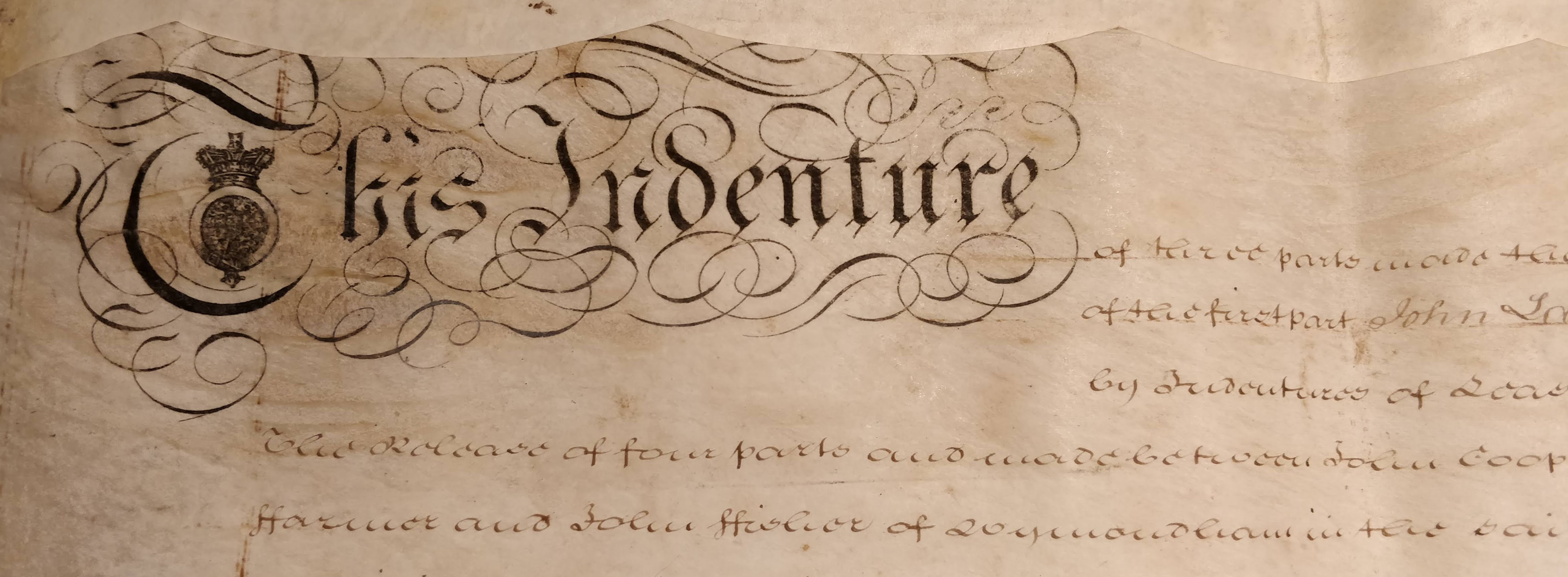
This Indenture of three parts made the twenty sixth day of April, One thousand and eight hundred and six
Between
– William Lane of Hingham in the County of Norfolk, Miller, of the first part;
– John Lane of Hingham aforesaid, yeoman, of the second part, and
– John Smith of Hethersett on the said County, Farmer, of the third part
Whereas by Indentures of Lease and Release bearing date respectively the twelfth and thirteenth days of December one Thousand seven hundred and ninety eight, the Release of four parts, and made
between
– John Cooper of Witchingham in the said County of Norfolk, Farmer, of the first part;
– Israel Lane of Northrepps in the same County, Farmer, and John Fisher of Wymondham in the said County, Farmer, and Sarah his Wife (the said Israel Lane and Sarah Fisher being two of the three surviving Children of William Lane thereinafter named) of the second part;
– the said John Lane (the other of the three surviving Children of the said last named William Lane) of the third part and
– John Sutton of Little Brand in the County aforesaid, Farmer, of the fourth part
All that Messuage and Millhouse with the Lands thereunto belonging, situate, lying and being in Deopham in the County aforesaid, then late in the Occupation of Henry Osborne and afterwards of Matthew Daynes and then of Taylor Phenix at the rent of six pounds and Seventeen Shillings
And also all that Land thereunto belonging whereon a Water Mill then late stood and all Manner of Water, Streams, Pools, Watercourses, Profits and Advantages whatsoever to the said Messuage and Premises belonging with their and every of their Appurtenances were granted and conveyed unto the said John Lane, his heirs and Assigns To the Use of the said John Sutton, his Executors, Administrators and Assigns for the term of five hundred years without impeachment of waste Remainder to the use of the said John Lane, his heirs and Assigns, And in the said Indenture of Release is contained a proviso for making void the said term of five hundred years on payment by the said John Lane ti the said John Sutton of the sum of One Hundred pounds with Interest for the same on the day and at the place appointed for that purpose ….
etc etc
Now this Indenture Witnesseth that in consideration of the Sum of One hundred pounds of lawful British Money to the said William Lane in hand paid by the said John Smith at or before the sealing and delivery of these presents (at the request and by the Appointment of the said John Lane testified by his executing these presents) the receipt of which said Sum of one hundred pounds he the said William Lane doth hereby acknowledge and therefrom doth release and discharge the said John Smith, his Executors, Administrators and Assigns and also the said John Lane, his Heirs, Executors, Administrators and Assigns for ever by these presents and also in Consideration of the sum of five Shillings of like Money to the said John Lane in like manner paid by the said John Smith, the receipt whereof is hereby also acknowledged.
He the said William Lane (at the request and by the direction of the said John Lane testified as aforesaid)
Hath bargained, sold, assigned, transferred and set over and the said John Lane hath granted, bargained, sold, ratified and confirmed and by these presents the said William Lane (at the request and by such direction as aforesaid testified as aforesaid)
Doth bargain, sell, assign, transfer and set over and the said John Lane doth grant, bargain, sell, ratify and confirm unto the said John Smith, his Executors, Administrators and assigns
All and Singular the said Messuage, Millhouse, Lands, Hereditaments and all and singular the Premises comprised in the said in part recited Indentures of Lease and Release and term of five hundred years with their Appurtenances, as the same are now in the occupation of Andrew Lane, his Assigns or undertenants.
And all the Estate, Right, Title and Interest of them the said William Land and John Lane or either of them of, in and to the same premises and every part and parcel thereof with their Appurtenances,
To have and to hold the said Messuage, Mill House and all other the Hereditaments herein and hereby granted and assigned or intended so to be with their Appurtenances unto the said John Smith, his Executors, Administrators and Assigns henceforth for and during all the residue and remainder of the said term of five hundred years therein yet to come and unexpired without impeachment of waste discharged from the proviso contained in the said last recited Indenture, but subject to the proviso hereinafter mentioned, that is to say:
Provided always and upon condition nevertheless that if the said John Lane, his Heirs, Executors, Administrators or Assigns shall pay of cause to be paid unto the said John Smith his Executors, Administrators or Assigns the sum of one hundred pounds of lawful British money together with lawful Interest for the same on the Twenty sixth day of July now next ensuing,
Then and in such case he the said John Smith his Executors, Administrators or Assigns shall and will upon the request and at the charges of the said John LAne his Heirs, Executors, Administrators or Assigns reassign and transfer the said Hereditaments and premises with their Appurtenances and all the Estate and term of years therein unexpired of him the said John Smith his Executors, Administrators or Assigns of, in and to the same Hereditaments and premises unto the said John Lane, his Heirs, Executors, Administrators or Assigns or to whom he or they shall appoint ….
There then follow clauses stating that in the event of default, John Smith will acquire full enjoyment of the premises.
In Witness whereof the said parties to these presents have hereunto set and put their hands and seals the day and year first above written: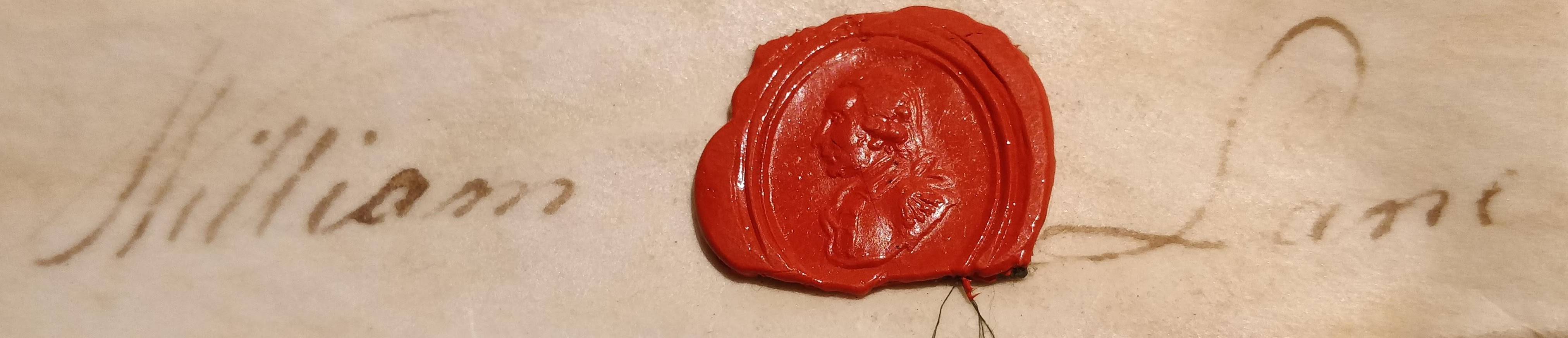
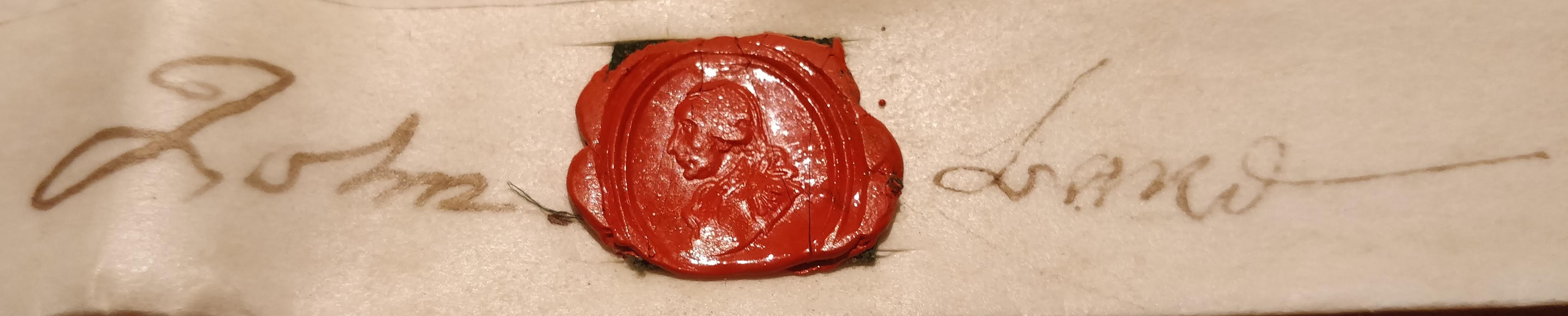
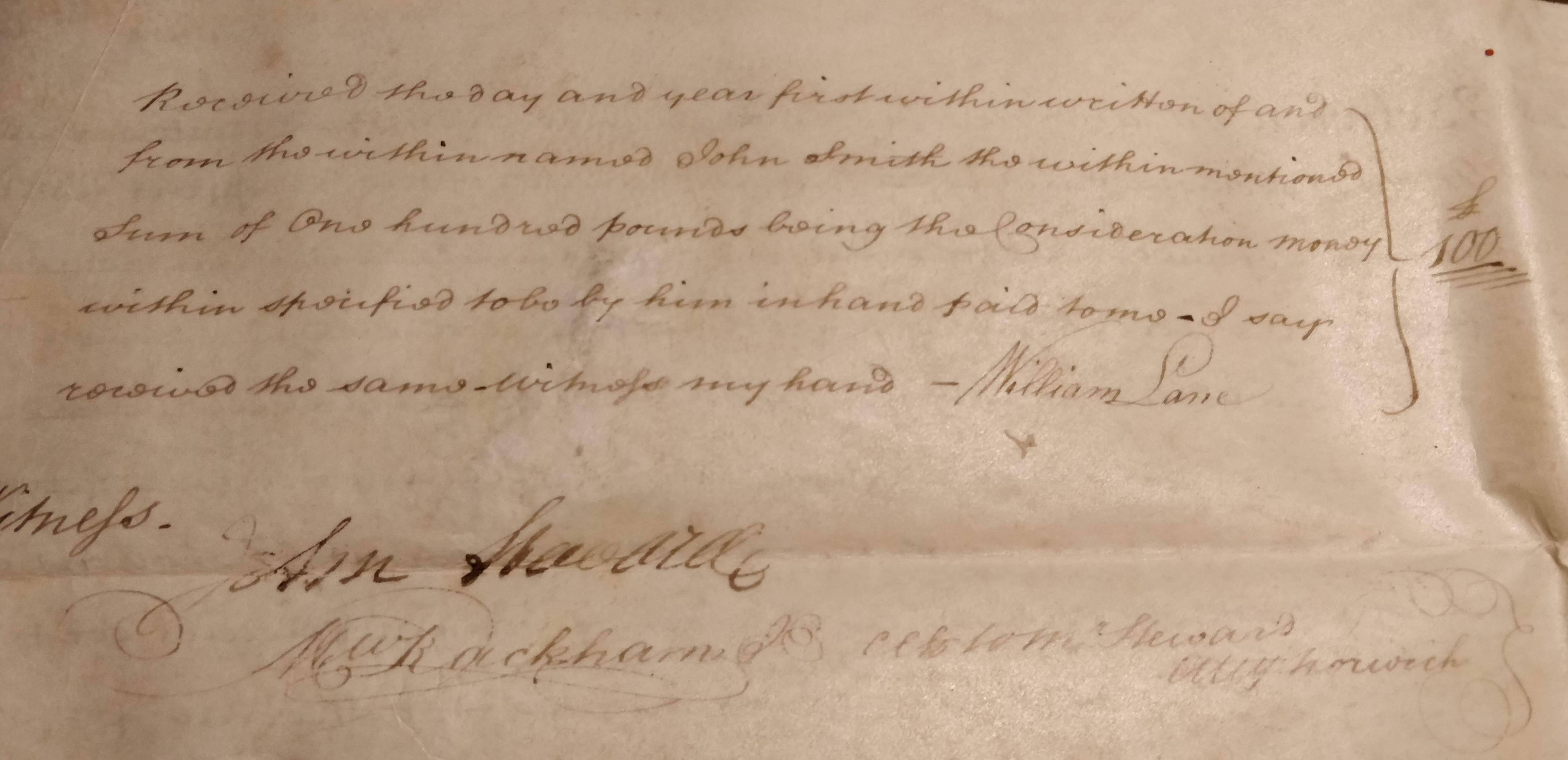
Receipt
This receipt on the reverse of the Indenture recorded that William Lane had received the advance of £100 from John Smith.
December 5th-6th 1808: Lease and Release to Aaron Lane
Summary
See here for an explanation of the Lease and Release process.
John Lane sold the premises to Aaron Lane.
There is no mention of the windmill, nor of the copyhold land.
December 5th 1808: Lease
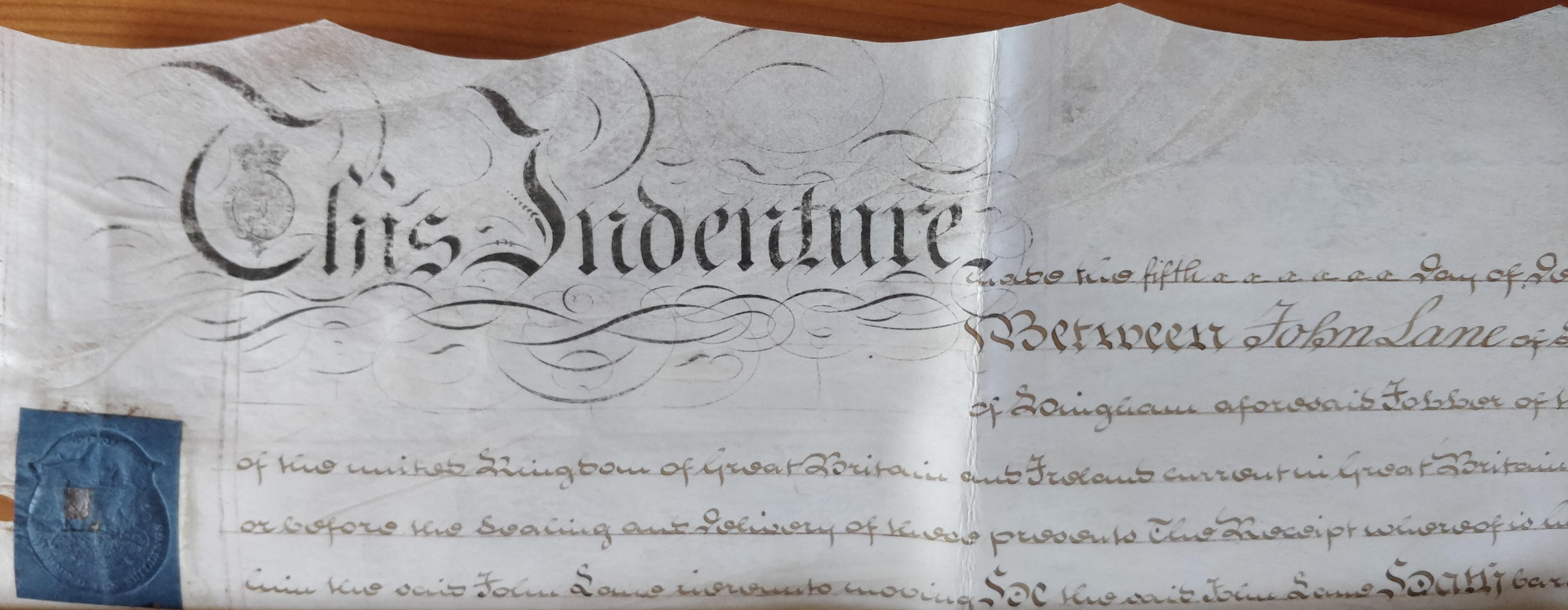
This Indenture made the fifth Day of December in the year of our Lord One Thousand eight hundred and eight
Between John Lane of Hingham in the County of Norfolk, Miller, of the one part and Aaron Lane of Hingham aforesaid, Jobber2, of the other part
Witnesseth that in Consideration of five shillings of lawful money of the United Kingdom of Great Britain and Ireland current in Great Britain to the said John Lane in hand well and truly paid by the said Aaron Lane at or before the sealing and Delivery of these presents, The Receipt whereof is hereby acknowledged at and for other good Causes and valuable Considerations him the said John Lane hereunto moving
He the said John Lane hath bargained and sold and by these presents
Doth bargain and sell unto the said Aaron Lane, his Executors, Administrators and Assigns
All that Messuage and Millhouse of him the said John Lane with the Land thereunto belonging, situate, lying and being in Deopham aforesaid formerly in the Occupation of Henry Osborne, since that of Matthew Downes [sic] afterwards of Taylor Phenix and now or late of Andrew Lane;
And also all that Land thereto belonging whereon a Watermill formerly stood and all Landes, Outhouses, Waterstreams, Pools, Watercourses, Rights, Liberties, Privileges, Advantages and Appurtenances whatsoever to the said Messuage, Millhouse and Lands and premises belonging or in any wise appertaining,
And the Reversion and Reversions, Remainder and Remainders thereof
To have and to hold the said Messuage, Millhouse, Lands, Hereditaments and all and singular other the premises herein before bargained and sold or intended so to be and every part and parcel thereof with their and every of their appurtenances unto the said Aaron Lane, his Executors, Administrators and Assigns from the Day next before the Day of the Date of these presents for and during and unto the full End Term of one whole year thence next ensuing and fully to be compleat and ended
Yielding and Paying therefore unto the said John Lane his Heirs or Assigns the yearly Rent of one pepper Corn at the expiration of the said Term if the same shall be lawfully demanded, To the Intent and purpose that by virtue of these presents and the Statute made for transferring uses into possession, the said Aaron Lane may be in the actual possession of the same premises and may thereby be enabled to accept and take a Grant and Release of the Freehold Reversion and Inheritance of the same Premises and of every part and parcel thereof to the said Aaron Lane, his Heirs and Assigns
To the Sole only and absolute use and Behoof of the said Aaron Lane, his Heirs and Assigns in and by another Indenture of four parts already prepared and intended to be dated the Day next after the Day of the Date of these presents and made between:-
– the said John Lane of the first part,
– John Smith of Hethersett in the said County, Farmer, of the second part;
– the said Aaron Lane of the third part; and
– William Littleproud of Attleborough in the said County, Farmer, of the fourth part.
In witness whereof the said parties to these presents have hereunto set and put their Hands and Seals the Day and Year first above written: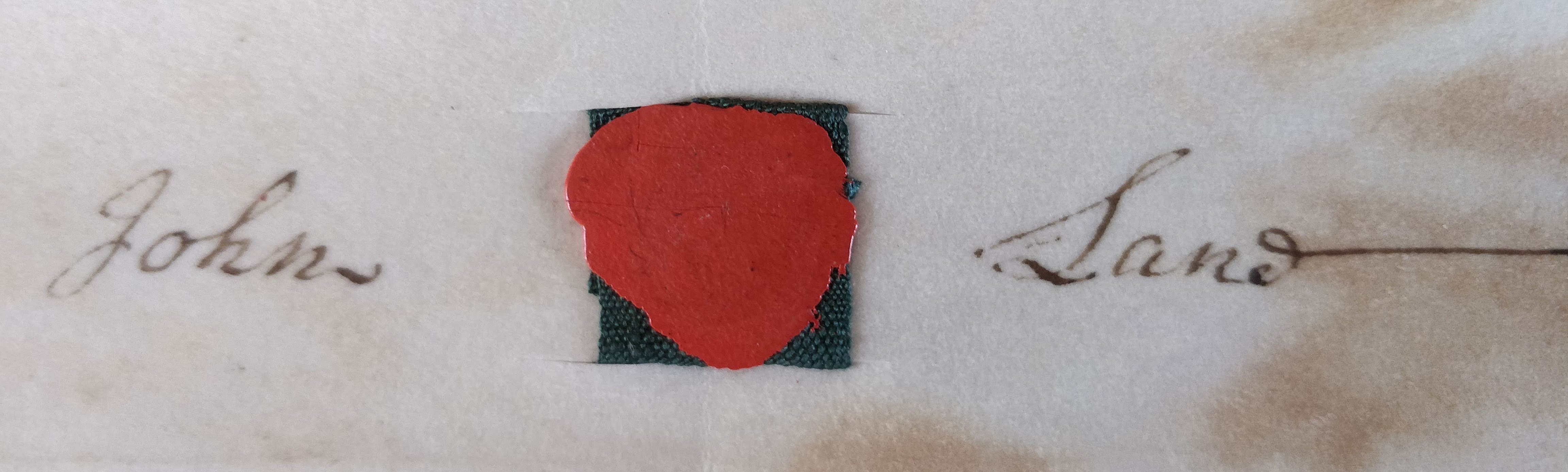
December 6th 1808: Release
This Indenture made the sixth day Day of December in the year of our Lord One Thousand eight hundred and eight
Between
– John Lane of Hingham in the County of Norfolk, Miller, of the first part,
– John Smith of Hethersett in the said County, Farmer, of the second part;
– Aaron Lane of Hingham aforesaid, Jobber of the third part; and
– William Littleproud of Attleborough in the said County, Farmer, of the fourth part.
Whereas by Indentures of Lease and Release respectively the Thirteenth and Fourteenth of December One Thousand Seven hundred and Ninety eight, The Release being of four parts and made
– John Cooper therein described of the first part;
– Israel Land and John Fisher and Sarah his Wife therein also respectively described of the second part;
– the said John Lane of the third part and
– John Sutton therein also described of the fourth part
All that Messuage and Millhouse with the Land thereunto belonging, situate, lying and being in Deopham in the County aforesaid then late in the Occupation of Henry Osborne, and afterwards of Matthew Daynes and then of Taylor Phenix at the Rent of Six pounds and seventeen shillings;
And also all that Land thereto belonging whereupon a Watermill there late stood and all manner of Water Streams, Pools, Watercourses, Profits and Advantages whatsoever to the said Messuage and premises belonging with their and every of their Appurtenances were granted and conveyed unto the said John Lane, his Heirs and Assigns To the use of the said John Sutton, his Executors, Administrators and Assigns for the Term of five Hundred years without Impeachment of Waste Remainder
etc etc repeating all previous Indentures
Now this Indenture Witnesseth that
– in Consideration of the Sum of One Hundred pounds hereinafter mentioned to be paid by the said Aaron Lane to the said John Smith and
– in Consideration of the Sum of Seventy pounds of lawful British Money to the said John Lane well and truly in hand paid by the said Aaron Lane at of before the Sealing and Delivering of these presents, The Receipt whereof the said John Lane doth hereby confess and acknowledge thereof and of and from the same and every part thereof both acquit, release and discharge the said Aaron Lane, his Heirs, Executors and Administrators for ever by these presents.
He, the said John Lane, hath granted, bargained, sold, aliened, released and confirmed and by these presents doth grant, bargain, sell, alien, release and confirm unto the said Aaron Lane (in his actual possession now being by virtue of a bargain and Sale to him thereof made the the said John Lane for five Shillings Consideration Money by Indenture bearing Date the Day next before the Day of the Date of these presents for one whole year commencing from the Day next before the day of the Date of the same Indenture of bargain and Sale and by force of the Statute made for the transferring uses into possession), and to his Heirs and Assigns:
All that Messuage and Millhouse of him the said John Lane with the Land thereunto belonging, situate, lying and being in Deopham aforesaid formerly in the Occupation of the said Henry Osborne, since that of the said Matthew Downes [sic] and afterwards of the said Taylor Phenix and now or late of Andrew Lane;
And also all that Land thereto belonging whereon a Watermill formerly stood and all Landes, Outhouses, Water streams, Pools, Watercourses, Rights, Liberties, Privileges, Advantages and Appurtenances whatsoever to the said Messuage, Millhouse and Lands and premises belonging or in any wise appertaining;
And the Reversion and Reversions, Remainder and Remainders thereof …
etc, etc
In witness whereof the said parties to these presents have hereunto set and put their Hands and Seals the Day and Year first above written: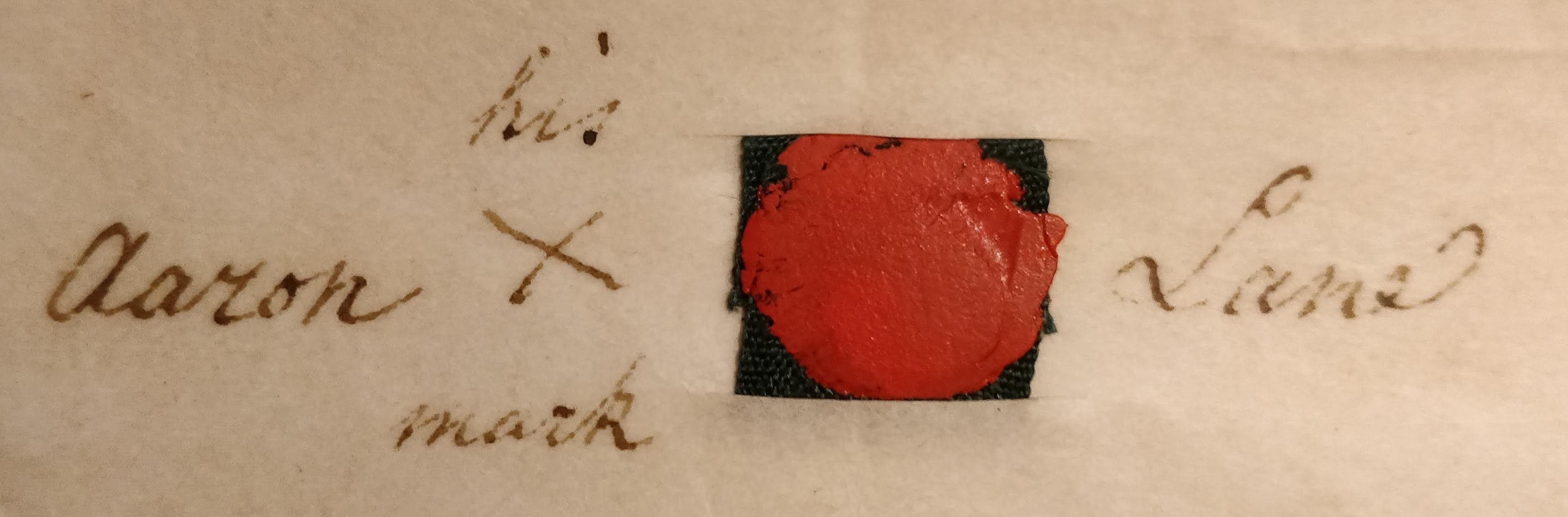
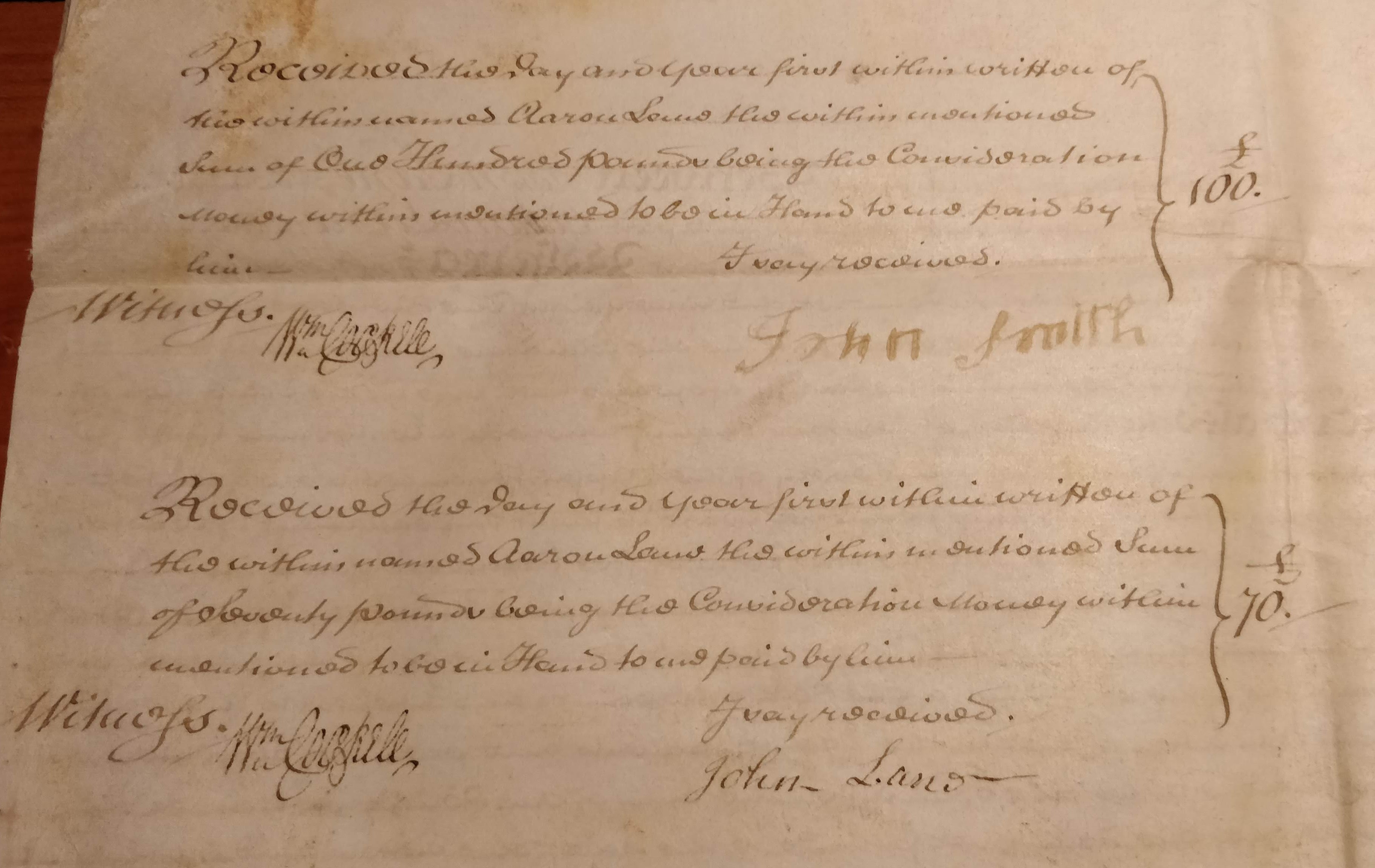
Receipts for payment
The following two receipts are written on the reverse side of this indenture:-
1812 – Pre-Inclosure Statement of Claims
At the start of the Inclosure process, following the 1812 Act of Parliament, all landowners submitted to the Commissioners a statement of what they considered to be their rights over property and customary claims on the commons. The full document is available here.
Aaron Lane, in his submission numbered 38 in this document, claimed …
… a right to flood six acres of land, part of the commons of Deopham, for the use of a water mill formerly standing upon the said premises …
The property is listed as a “Double Cottage, Yard, Orchard and Land” occupied by James Shickle and James Muir. The yard and orchard are shown as freehold, but no measurements of area are given.
1813 – earliest plan
Freehold

With thanks to Michael Allen for allowing sight of this map.
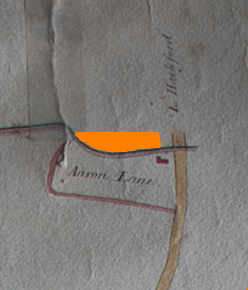
Copyhold
Since the Copyhold land is described as having the watercourse to the south and west, its most likely location would be as shown in orange below. No contemporary plans have been located showing this plot.
The 1814 Inclosures

We assign, set out and allot unto Aaron Lane the two pieces of Land next hereinafter described, namely:-
First, one piece of land marked on the map hereto annexed No 15 containing three roods and nineteen perches with a Messuage called the Mill House and other Buildings standing thereon bounded by the Parish of Hackford North, by the Upper Hackford Road East and by land allotted to John Lord Wodehouse South and West;
Second, one other piece of land marked on the Map hereto annexed No 3 containing one acre two roods and eighteen perches with a newly erected Messuage standing thereon bounded by Land allotted to William Jolly North, by land allotted to Richard Jolly in part East, by land allotted to John Lane in part South and on the remaining part of the East by the Wymondham Road or Palloway on the remaining part of the South and by the Parish of Hingham West.
And we direct the said Aaron Lane to make and keep in Repair the Fences in his second Allotment against the Allotment to Richard Jolly and against the Public Road.
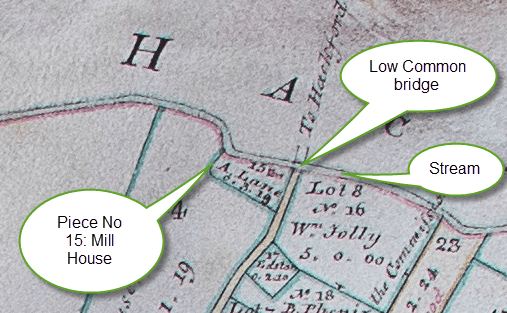
Map extract reproduced with permission from Deopham Church
April 7th 1814: Court of the Manor of Deopham Hall
The Court held in 1814 following the Inclosures process refers to “A piece of land lying in or next the Common Pasture called Low Common near the Water Mill late of Richard Raven next the Watercourses there South & West containing in length 60 feet & breadth 60 feet” belonging to John Lane who inherited it in 1800 as the eldest son of William Lane. This description used in the 1814 Court is identical to that used in the 1638 Court of the Manor of the Dean and Chapter of Canterbury as well as the 1731 Court of the Manor of Deopham Hall.
1815 Survey of Deopham
The 1815 Survey of Deopham recorded the plot at Low Common alongside the stream, numbered 136, as being “The Mill House, Orchard & Pightle”, occupied by James Shickle and owned by Aaron Lane:

November 4th 1837: Disposal of Aaron Lane’s assets
Summary
This Indenture relates to the disposal of Aaron Lane’s assets to James Gapp of Hingham.
Pieces numbered 2 and 3 during the Inclosures process (located towards the Stalland) are referenced in this Indenture, but not piece no 15 – the former Mill which was relinquished by Aaron Lane.
Following an earlier mortgage on the Mill, William Littleproud had acquired a right to a peppercorn rent over this land: following the death of Aaron Lane his executors wished to print this asset under their control.
Detail
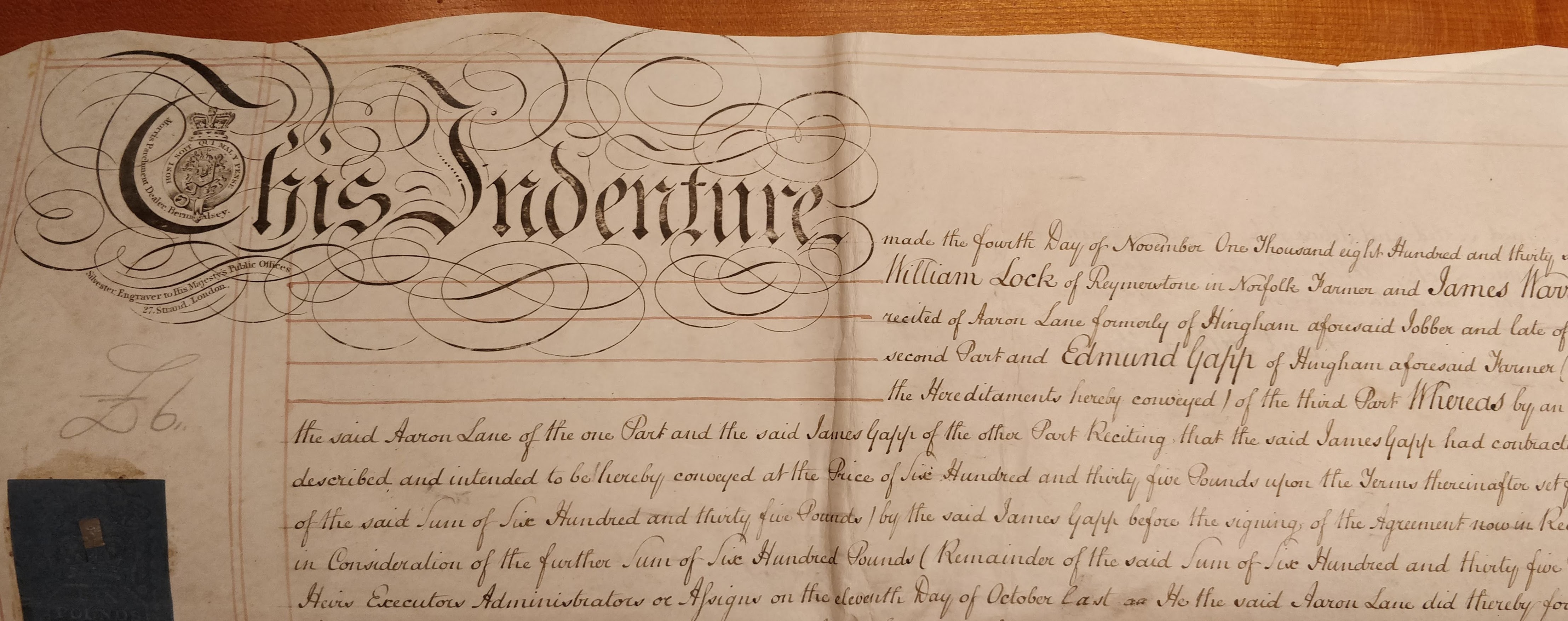
This Indenture made the fourth Day of November One thousand eight Hundred and thirty seven
Between
– Samuel Lock, late of Shipdham in Norfolk, but now of Barton Bendish in Norfolk, Farmer; William Lock of Reymerstone in Norfolk, Farmer, and James Warren in Hingham in Norfolk, Carpenter (Executors and Trustees for Sale named in the last Will in Writing (hereinafter recited of Aaron Lane, formerly of Hingham aforesaid, Jobber, and late of Deopham in Norfolk, Farmer, deceased) of the first part;
– James Gapp of Hingham aforesaid, Farmer, of the second part, and
– Edmund Gapp of Hingham aforesaid, Farmer (a Trustee to prevent the present of any future Wife of the said James Gapp from being entitled to Dower out of the Hereditaments hereby conveyed) of the third part;
Whereas by an Agreement in Writing made the thirteenth Day of October One Thousand eight Hundred and thirty six between the said Aaron Lane of the on Part and the said James Gapp of the other part, Reciting that the said James Gapp had contracted with the said Aaron Lane for the absolute Purchase of the Messuages, Lands and Hereditaments hereinafter described and intended to be (hereby) conveyed at the price of Six Hundred and thirty five Pounds upon the Terms thereinafter set forth.
It is witnessed that in Consideration of the Sum of Thirty five Pounds of lawful British Money (Part of the said Sum of Six Hundred and thirty five Pounds) by the said James Gapp before the signing of the Agreement now in Recital paid to the said Aaron Lane whose Receipt thereof is thereby acknowledged and thereon endorsed;
And in Consideration of the further Sum of Six Hundred Pounds (Remainder of the said Sum of Six Hundred and thirty five Pounds) to be paid to the said Aaron Lane, his Executors or Administrators by the said James Gapp, his Heirs, Executors, Administrators or Assigns on the eleventh Day of October last
Although this Indenture references explicitly the pieces numbered 2 & 3 by the Inclosures Commissioners, no mention is made of piece no 15 – the former Millhouse. It would appear therefore that between 1815 and 1837 Aaron Lane must have sold the Millhouse land.
November 4th 1837
The Indenture states that the Mill House, or “the Rights of Common appendant or appurtenant thereto” at Low Common had been exchanged by the Inclosure Commissioners for a larger plot of land near the Stalland – plot no 3.
This Indenture made the fourth Day of November One Thousand eight Hundred and thirty seven
Between
– William Littleproud of Attleburgh [sic] in Norfolk, Farmer, of the first part
– Samuel Lock of Shipdham in Norfolk but now of Barton Bendish in Norfolk, Farmer, William Lock of Reymerstone in Norfolk, Farmer and James Warren of Hingham in Norfolk Carpenter (Executors of the last Will of Aaron Lane, formerly of Hingham aforesaid, Jobber, and late of Deopham in Norfolk, Farmer, deceased) of the second part;
– James Gapp of Hingham aforesaid, Farmer of the third Part and
– Daniel Alexander the Younger of Hingham aforesaid, Gentleman, of the fourth part
Whereas by certain Indentures of Lease and Release dated respectively the thirteenth and fourteenth Days of December One Thousand seven Hundred and ninety eight, the Release being made between:
– John Cooper of Witchingham in Norfolk of the first part;
– Israel Lane of Northrepps in the same County and John Fisher of Windham [sic] in Norfolk, Farmer, and Sarah his Wife of the second part;
– John Lane of Deopham in Norfolk, Miller, of the third Part and
– John Sutton of Little Brand in Norfolk, Farmer, of the fourth Part
All that Messuage and Mill House with the Lands thereunto belonging situate and lying in Deopham aforesaid, then in Occupation of Taylor Phenix;
And also all that Land thereunto belonging whereon a Water Mill then of had then lately stood with the Water Streams, Pools, Watercourses and Advantages whatsoever to the said Premises belonging were conveyed (with other Hereditaments) to the said John Sutton for the term of five Hundred Years to be computed from the Day next before the Day of the Date of the Presents now in recital and Subject to the said Term.
etc, etc
As a “left over” from an earlier mortgage, there was an entitlement to a peppercorn rent for a decreasing balance of 500 years; this is repeated in this indenture, the passage of which entitlement can be summarised as follows:-
| Date | Made over to |
|---|---|
| December 14th 1798 | John Sutton |
| October 4th 1800 | John Smith |
| July 28th 1804 | William Lane |
| April 26th 1806 | John Smith of Hethersett |
| December 6th 1808 | William Littleproud |
Following the Indentures recital of the history of the balance of the 500 years, it carries on to formalise the transfer of William Littleproud’s entitlement to Daniel Alexander:-
And whereas by certain other Indentures of Lease and Release dated respectively the fifth and sixth Days of December One Thousand eight Hundred and eight the Release being made between
– the said John Lane of the first part,
– the said John Smith of Hethersett of the second part;
– the said Aaron Lane of the third part and
– the said William Littleproud pf the fourth Part:
the Freehold and Inheritance of and in the aforesaid Hereditaments were conveyed by the said John Lane to the sole and absolute Use o f the said Aaron Lane and his HEirs and the Remainder then to come of the said Term of five Hundred Years in the same Hereditaments was assigned by the said John Smith of Hethersett unto the said William Littleproud
To hold to the said William Littleproud In Trust for the said Aaron Lane, his Heirs and Assigns to go along with the freehold and Inheritance of the same Hereditaments to protect the same from all mesne Incumbrances3
And whereas the Commissioners appointed by an Act of Parliament passed in the fifty second year of the Reign of King George the third for inclosing Lands in Deopham aforesaid did by their Award bearing Date the sixteenth Day of February One Thousand eight Hundred and fourteen and Inrolled with the Clerk of the Peace for the County of Norfolk allott unto the said Aaron Lane (amongst other Hereditaments) A piece of Land marked on the Map annexed to the said Award Number three containing One Acre, two Roods eighteen Perches with a newly erected Messuage standing thereon … was so made to the said Aaron Lane for, or in lieu, or in Respect of the said Messuage, Mill House and Hereditaments first hereinbefore described and the Rights of Common appendant or appurtenant thereto …
Now this Indenture witnesseth that in Consideration of the Premises and of ten shillings of lawful British Money to him the said William Littleproud paid by the said Daniel Alexander immediately before the Execution of these Presents, the Receipt whereof is hereby acknowledged, He the said William Littleproud Doth (at the request of the said James Gapp, and by the Direction of the said Samuel Lock, William Lock and James Warren testified as aforesaid) bargain, sell, assign and transfer unto the said Daniel Alexander, his Executors, Administrators and Assigns, All the aforesaid piece of Land containing One Acre, two roods, eighteen Perches with the said Messuage and Other Buildings standing thereon, And all Ways, Watercourses, Paths, Passages, Rights, Easements, Liberties, Privileges, Advantages and Appurtenances to the said Hereditaments and Premises hereby assigned or any Part thereof in any wise belonging
And all the Estate, Right, Title, Interest, Term of Years now to come and unexpired Claim and Demand whatsoever, both at Law and in Equity of the said William Littleproud.
etc
In witness whereof the said parties to these presents have hereto set and put their Hands and Seals the Day and Year first above written:
1843 Tithe Apportionment
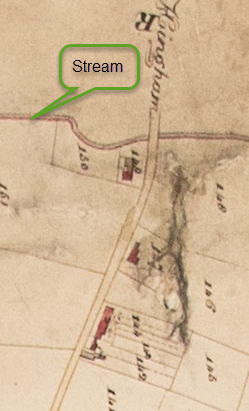
The text accompanying the 1843 Tithe map indicated the following; there is no mention of the milling heritage.
| Owner | Occupier | Map reference | Description | Cultivation | Roods-Perches | Payable to Appropriators |
|---|---|---|---|---|---|---|
| James Watson | Henry London | 149 | House, yards, etc | Pasture | 1 rood 7 perches | 1s 5d |
| 150 | Homestall | Arable | 2 roods 30 perches | 4s 3d |

Tithe map and legend: All rights reserved by Norfolk Record Office who hold the original; their ref is NRO DN/TA 743
June 30th 1847: Mortgage on Copyhold Land redeemed
At the Court of the Manor of Deopham Hall held on November 23rd 1847, a mortgage of £1400 + interest advanced to Andrew Lane, Miller, by William Stannard Cockell, was declared to have been redeemed.
What appears to be the granting of the same mortgage is also referenced in the Court Roll for the Manor of Deopham of the Dean and Chapter of Canterbury held on November 24th 1825.
1881/2 Ordnance Survey Map
At this time there was still a “blip” adjacent to the river:

2024
Three properties occupy the land subject to the above documents:-
Pine Tree House

Holmsleigh
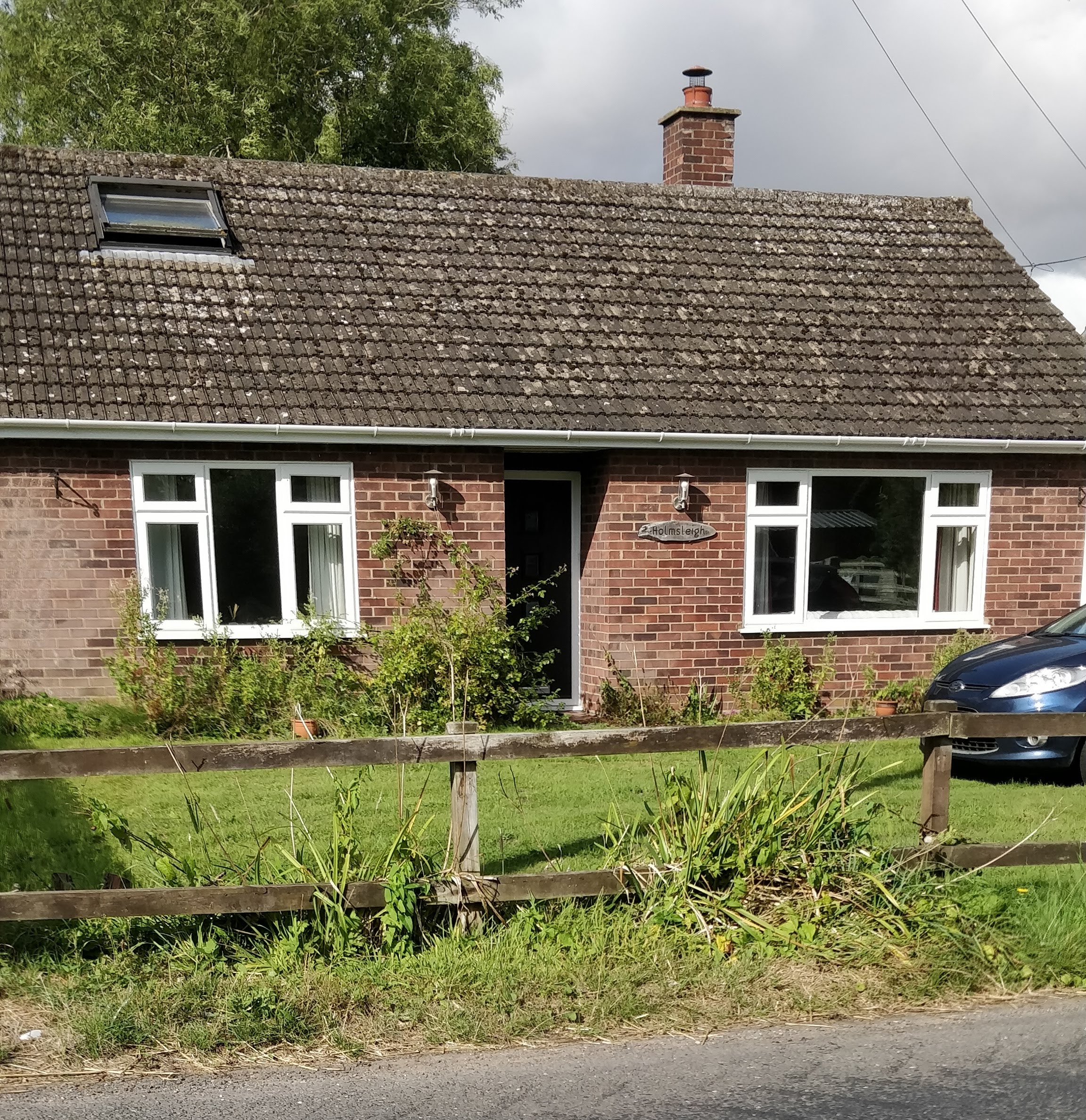
Riverside

Photos: G. Sankey, Sept 2024
Footnotes
- Little Brand is now known as Brandon Parva. ↩︎
- Jobber: A jobber could at this time have been either a wholesaler buying large quantities of a product and selling them on in retail quantities, or someone who was paid by the job. It is not clear which meaning applies to Aaron Lane. ↩︎
- A Mesne Incumbrance is a liability attached to property which can decrease its value. ↩︎
Navigation
| Date | Change |
|---|---|
| 2/2/26 | 1724 Court |
| 27/1/26 | 1719 Court |
| 24/1/26 | 1718 Court |
| 20/9/25 | 1812 Inclosure claim |
| 16/8/25 | 1636 Court reference |
| 10/8/25 | Faden’s Map 1797 |
| 4/8/25 | 1638 Court of the Manor of Deopham of the Dean & Chapter of Canterbury |
| 14/7/25 | Links to 1731 Court of the Manor of Deopham Hall |
| 27/9/24 | Published |
In Memoriam Endocarditis
Requiescat pace
 Deopham History