- The Society for the Protection of Ancient Buildings, SPAB
- Report by SPAB on Deopham Church 1882
- SPAB letter to Ewan Christian March 20th 1882
- Ewan Christian’s response March 24th 1882
- William Morris – May 10th 1882
- Letter from Mr Christian to the SPAB Feb 14th 1883
- Letter from Mr Turner to Mr. Christian, Feb 16th 1883
- Addressing the objections
- John Stevenson to SPAB May 12th 1884
- SPAB withdraw – March 29th 1892
- Footnotes
- Navigation
The Society for the Protection of Ancient Buildings, SPAB
William Morris founded the Society for the Protection of Ancient Buildings in 1877 to halt what he saw as the destruction of medieval buildings, particularly a trend to destroy authentic medieval artifacts in order to replace them with copies that would increase the “gothicness” of a building.
The founding objectives stated in 1877 by William Morris are quoted here.
There is a copy of sections from the SPAB annual report of 1882 here which contains their objections to the work at Deopham and the Chairman’s address which sets out the SPAB’s objectives in greater detail.
Report by SPAB on Deopham Church 1882
The report is not dated. On October 31st 1881 the secretary wrote to the Rev. Hibbert Wanklyn asking him to delay work until SPAB had paid a visit. The vicar responded in a letter received by the SPAB on November 2nd that work would start as soon as possible and that “any member of your committee is perfectly at liberty to come down to inspect the Church”. The SPAB secretary’s letter of February 13th 1882 is well informed about the screens implying that the survey below had taken place by this date.
The report is laced with much irony!
Deopham Parish Church, Norfolk
To the Restoration Committee of SPAB
Gentlemen,
The Chancel of this very Stately Church has been completely destroyed within the last few years, under the name of Restoration. And the Parson1 now proposes with the aid of Mr Ewen [sic] Christian to destroy the whole of the present magnificent nave roof, to replace it by a copy, and to make the stone-work, tracery of windows etc as good as new. The Parson expects that Mr Christian’s well-known taste will enable him to make many improvements on the original design, while the acknowledged superiority of 19th Cent. carvers and other workmen will turn out a very superior class of work to anything that the benighted artisans of the 15th Cent. could do. He hopes that the SPAB will assist him with a grant of money towards this laudable enterprise.
The remaining position of this Church, the whole of which is of the 15th Century, consists of Nave and Aisles, with South Porch, and very grand Western Tower, enriched outside with very rich and elaborate carving. The whole of the external stone-work is in excellent condition, except that the Clerestory walls have been strained, and slightly pushed out by the failure of the Nave roof.
This roof is of low pitch, and has tie-beam and King post with curved braces descending on to hammer beams; the whole, including a deep cornice, is very richly moulded.
Many years of neglect to the lead covering have caused considerable injury to the roof, into which at many points the rain pours freely.
It would be difficult, but we believe quite possible, to strengthen the Principals at the back with iron plates after stripping off, bay by bay, the lead and boarding: an iron shoe should be introduced at the feet of each Principal, and a wrought iron rod stretched across, and tightly screwed up, from shoe to shoe, in pairs one lying against each side of the tie-beam.
In this way we believe that the Nave roof could be made perfectly safe.
The roof of the south aisle is new, and a very poor one.2
The N. Aisle roof is quite plain, of Oak, a lean-to with unmoulded principals and rafters. The cornice only is moulded.
This too has suffered from rain getting in, and needs careful repair.
Both this roof, and that of the Nave, needs complete recovering with inch Oak battens, and newly cast lead, to be laid with oak 2″ rolls.
There are some extremely interesting screens, which are in site, though the Parson asserts that they were moved from the Chancel.
The Chancel extended originally one Bay into the Nave, and here there were Screens, extending the whole width of the Church, with a rood-loft at the top – the Stairs to which are in the S. wall of the S. Aisle. Of these 3 screens only a part, on the north side, remains: this eastern bay, screened off thus from each of the Aisles, formed a little Chapel, the side screens of which, each with a door in it, remain. The Parson hopes to pull these down, and knock them up into a Screen for the Chancel Arch – a double falsification, as first, these are side screens, and secondly, there never was a screen in the Chancel Arch, the Chancel Screen being fixed one bay Westwards.
We need hardly say that Mr Christian thoroughly coincides with the Parson in this Admirable Suggestion.
The Colouring on the remaining parts of the Screens is exceeding delicate and beautiful: the colour is on both sides of the Screens.
In many places patches of the old pavement still exist, of 4½” tiles, once encaustic3, but now warn down to the red ground.
In the S. Aisle Chapel the raised Altar-pace4 remains, with many of its tiles.
The paving throughout is patched in various ways with brick and stone, and in some places where it has sunk needs repair.
The whole level is considerably below that of the ground outside, and consequently the Church is damp. A dry open drain should be made all round the Church, outside.
We are, gentlemen,
Yours faithfully,
J. Henry Middleton
& George Wardle
Mr Wardle has added the following note:
We may note as a sign of the spirit in which the Church has been treated that a new Stone pulpit stands very near a hole in the roof or gutter, through which water must have been soaking for many years: the foot of the principal, the cornice & the wall part being all black with rot in that place.
Excerpt courtesy of the SPAB (Society for the Protection of Ancient Buildings), all rights reserved. Transcription © G. Sankey.
SPAB letter to Ewan Christian March 20th 1882
Based on the report above, the following letter was sent to the church architect Mr Ewan Christian:
Dear Sir,
re Deopham Church
A deputation of the Society for the Protection of Ancient Buildings have recently visited and examined Deopham Church, Norfolk. The Committee of the Society wish to offer some suggestions as to the manner of dealing with the building.
The Committee are of opinion that with care and a good deal of trouble it will be possible to repair and strengthen the roofs of the Nave and North Aisle without removing them from their place. It appears to them that the Nave roof should be stripped of its lead & boarding, and the decayed wood-work strengthened by iron straps and bolts at the weak places.
Iron shoes should be fixed at the feet of each principal, and a wrought iron rod (with shackle junction in the middle, so that it can be tightly screwed up) stretched across from shoe to shoe, in pairs, one lying against each side of the tie-beam.
Each bay should then be re-covered with new Oak boarding and cast lead, before the next bay is stripped.
The stone-work outside is ion the whole in a good state; it needs but little repair and the surface should be as little interfered with as possible.
The parts of screens which remain round two Aisle Chapels are extremely interesting, and are certainly in situ, in spite of the tradition that they were moved from the Chancel Arch.
They should on no account be moved, or meddled with in any way.
It seemed to the Committee to be most desirable that the Altar-pace in the S. Aisle and remains of the old tile-pavement at various places in the floor should be preserved untouched, and the whole pavement disturbed as little as possible, though in a few places it has sunk and needs repair.
The lead work of the glazing where necessary should be repaired without entirely reglazing the windows.
The church seems to require drains laid outside & the earth lowered to below the level of the floor.
The Committee of this Society venture to hope that the reparations which will not interfere with the due character of the building will recommend themselves to your approval.
Signed on behalf of the Committee
Yours truly
Thomas Wise
Sec.
Excerpt courtesy of the SPAB (Society for the Protection of Ancient Buildings), all rights reserved. Transcription © G. Sankey
Ewan Christian’s response March 24th 1882
The following letter from the church architect Mr Ewan Christian is addressed to Thomas Wise Esq.
8A, Whitehall Place
London S.W.
March 24th 1882
Dear Sir,
re Deopham Church
I am obliged by your letter of the 20th inst, and in reply beg to say:
1st That as regards the roofs, while appreciating the suggestions offered as to the method of repair, I think I have had sufficient experience in such cases to be able to determine what is best to be done, when by stripping off the lead the condition of the timbers can be exactly ascertained. Until that is done, it would be premature on the part of any person to offer a decided opinion as to the possibility of maintaining the ancient structure. I should of course take only a bay at a time.
I cannot however refrain from observing that the method of strengthening and securing the old timbers suggested by your Committee can hardly be deemed consistent with the principles of sound Carpentry, nor is it such as would ever have been adopted by the great roof constructors of Mediaeval times. Where however in an old roof iron is needed, I should not hesitate to use it, provided it could be done in accordance with sound construction.
As regards the lead: considering that for 30 years at least, I have persistently carried out the process of recasting instead of exchanging I am not likely now to change the procedure, though I grieve to say the race of Plumbers who can do such work properly is rapidly becoming extinct. I have never wittingly, except in very small quantities when recasting was impracticable, parted with old Church lead in exchange for new, which is more than can be said by most Church Architects of our day.
2nd It is certain that no sound stonework will in any way be touched under my direction. It is not likely to be done in this case, but if your Society would strenuously resist the destruction of the stonework of ancient windows, their stanchions and saddle bars, often times in perfect condition, under the plea of putting in stained glass5, you would be doing a really useful work for which I for one should heartily thank you. I have seen beautifully wrought and quite perfect iron bars 3 & 4 centuries old ruthlessly torn out and cast aside to make way for the mean and miserably thin and inferior metal used by modern stained glass workmen. and a serious wrong has been done thereby. I have given the most stringent orders that no bars shall ever be moved in cases of my own, but do not remember to have seen any suggestions of your Society on this point. You are doubtless aware that some of the ancient ironwork in windows is most beautifully wrought, and it is certain that no such metal will will ever be seen again unless the process of manufacture be entirely changed. This is a matter of real importance, that of ordinary leadlights is of very inferior interest, but genuine old lead glazing that can be retained will, I hope, never be destroyed by me.
3rd I note what you have said about the interior, but so far as I know nothing is likely to be touched, for there is no money.
I am dear Sir
Yours faithfully,
Ewan Christian
Excerpt courtesy of the SPAB (Society for the Protection of Ancient Buildings), all rights reserved. Transcription © G. Sankey
Messrs Middleton & Ward of SPAB responded in May 1882 to Mr Christian explaining that they had understood that the entire reconstruction of the roof had been intended and tell him:
Your assurance that nothing is yet decided is very welcome & the Committee trusts that in your final examination the idea of reconstruction may be wholly abandoned.
They continue that Mr Christian may not be aware of the vicar’s “notions” about renewal of the floor and the “alteration of the screens”.
The letter concludes with a broadside:
I may add that the Committee of SPAB regard with great regret the manner in which the Chancel has already been treated. No respect for the old work appears to have been shown, and the whole structure is practically quite new. They are especially desirous that the rest of the Church may be treated in a more reverent and conservative spirit.
William Morris – May 10th 1882
There was some concern at the SPAB that they might have been too abrupt in their communications with Mr. Ewan Christian the church architect. When William Morris was asked for his opinion, he responded that he did not see that the correspondence should be altered, throwing in the classic quote that Mr. Ewan “is a great criminal”.
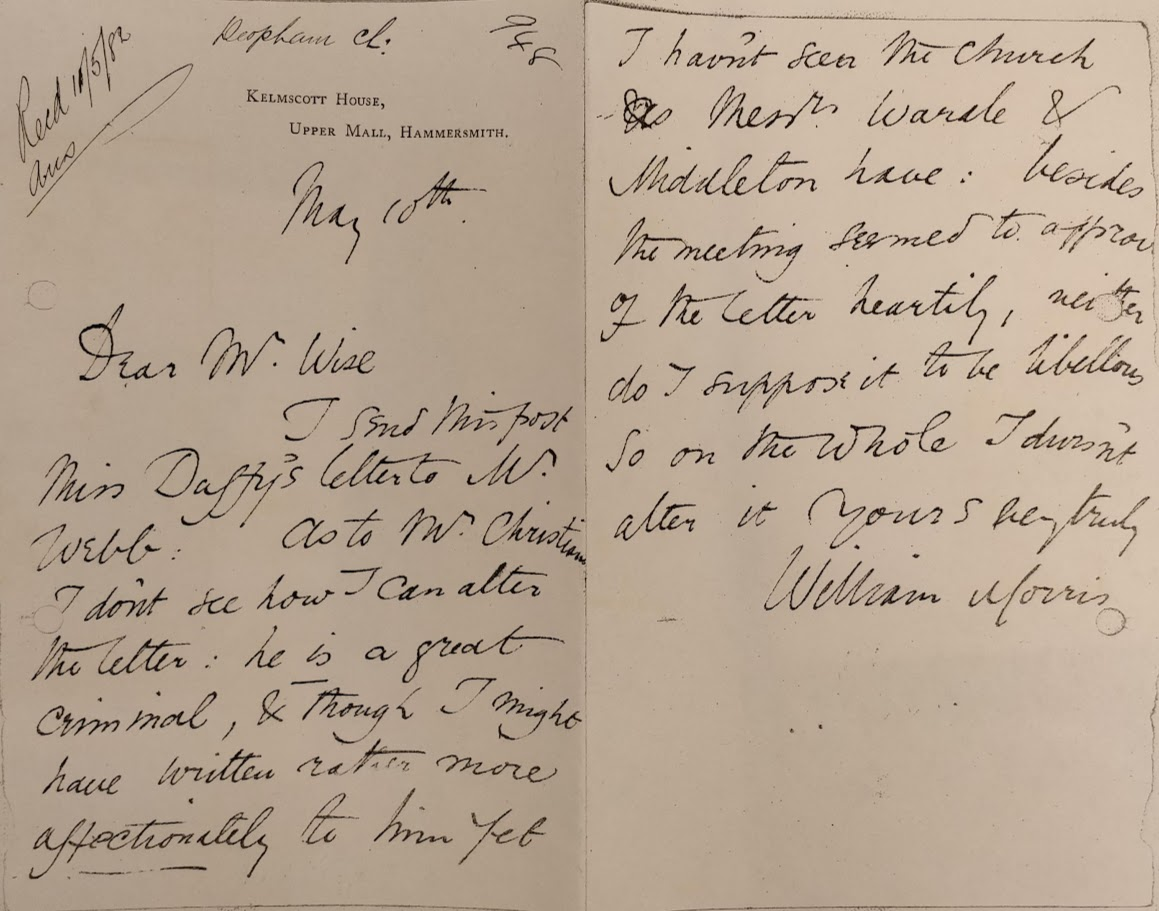
Image courtesy of the SPAB (Society for the Protection of Ancient Buildings), all rights reserved.
William Morris’s antagonism was towards all architects involved in restoration projects, not just Ewan Christian. Sir Gilbert Scott was a key target of his criticism. It would seem though that by the time of this letter he was fighting a battle that was no longer current. Once the architects had become more professional in their approach after the formation of the RiBA in 1834, many of Morris’s arguments were defused.
The Church of England and its amateur approach to the management of its legacy of medieval buildings was also a target for Morris’s criticism, aggravated by his socialist principles which saw the privileged Church of England as an anachronism. On the other hand, he did very well out of contracts for stained glass for the very organisation he opposed.
Letter from Mr Christian to the SPAB Feb 14th 1883
The following letter was sent by the architect Mr Ewan Christian to Thomas Wise at the SPAB on February 14th 1883. Events have shown that the comments both about the screens and the floors turned out to be untrue. Whether Mr. Christian knew that at the time of writing this letter is less certain. The comment concerning the floor is difficult to reconcile with Mr Christian’s estimate of 1864 which included “The refitting of the interior with new seating of fir on new wood floors – renewing the paved floors etc”. The Rev. Wanklyn‘s fundraising circular of 1881 included a sum of £500 for “flooring and seats”.
Whitehall Place
London S.W.
14 Feby 1883
Dear Sir,
Deopham Church
I have no intention whatever of removing the screens forming the Chapels in this Church and at present have no instructions to touch any portion of the floor area. I think your Committee would have been somewhat astonished had they seen the condition of the Nave roof beams I was asked to support with iron: rotten at each end, rotten in the middle and with scarcely a fragment of sound wood all through hopelessly past mending by any living carpenter!
I am Dear Sir
Yours faithfully
Ewan Christian
Excerpt courtesy of the SPAB (Society for the Protection of Ancient Buildings), all rights reserved.
Letter from Mr Turner to Mr. Christian, Feb 16th 1883
On February 16th 1883 Mr. Thackeray Turner wrote to Mr. Christian in reply to his letter of the “14th inst” saying that “it gave the Committee great pleasure to find that the report respecting the screens was incorrect”.
Clearly someone had been economical with the truth since the screens were in fact removed. Mr. Christian’s plan of the reordered interior shows no sign of the screens which the SPAB delegation had recorded around the north-east chapel.

Addressing the objections
Whoever primed the EDP author of the article on December 28th 1882 was at pains to make clear that the project had done its best at that stage to preserve as much ancient material as possible:
Nearly all the old mouldings and carved-work were pronounced fit to go up again, and were carefully sawn from the otherwise rotten timbers and screwed or bolted to the new ones. Every place that required it was most beautifully mended with old oak. The lead has been re-cast and put on again at the rate of seven pounds to the square foot.
John Stevenson to SPAB May 12th 1884
This letter was sent from John Stevenson to Thackeray Turner at the SPAB.
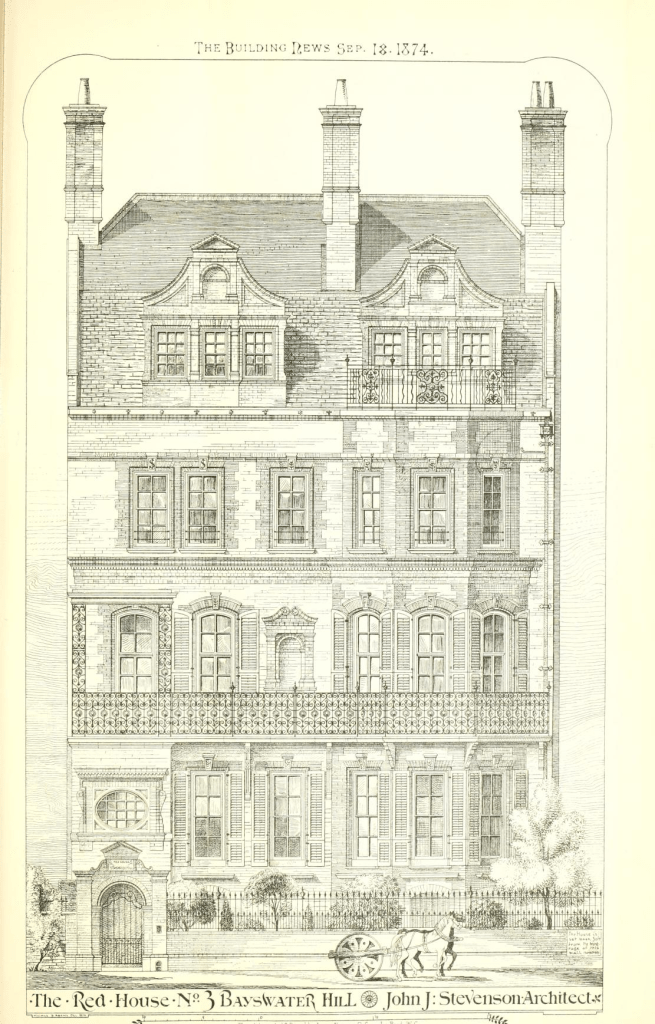
John Stevenson was an architect and designer, an advocate of the Queen Anne style of building.
He had named his house “The Red House” (see letter heading below) in deference to William Morris’s home of the same name.
This image of The Red House is from the Building News of Sept 18th 1874.
Thackeray Turner was an architect who until 1883 had been working with Gilbert Scott. In 1883 he became a salaried member of the SPAB. Mr Turner comments that he has told the author of the letter that this “is a hopeless case”. This must have meant a hopeless case for the SPAB to have any hope of influencing the restoration. In any case, the work on the nave and aisles had been completed before this letter was written, leaving only the tower repairs outstanding.
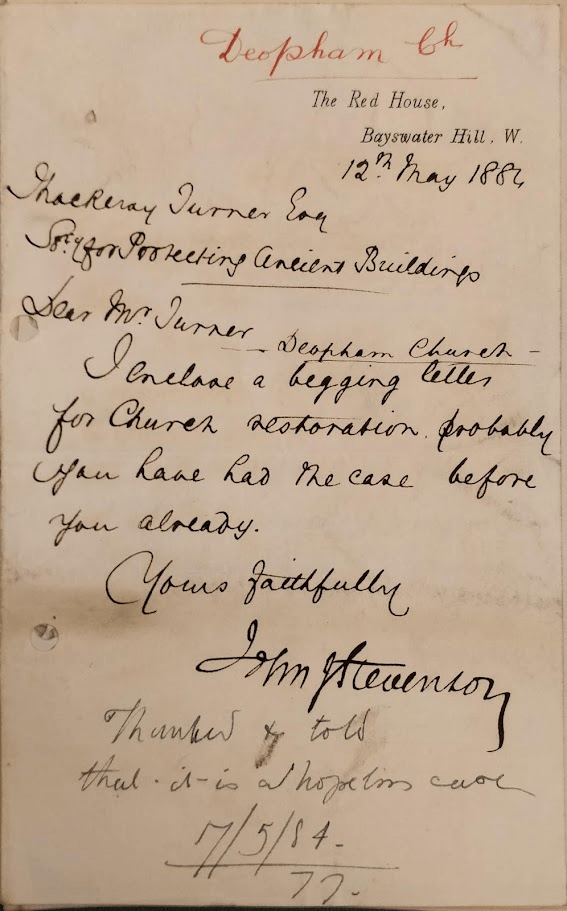
Image courtesy of the SPAB (Society for the Protection of Ancient Buildings), all rights reserved.
SPAB withdraw – March 29th 1892
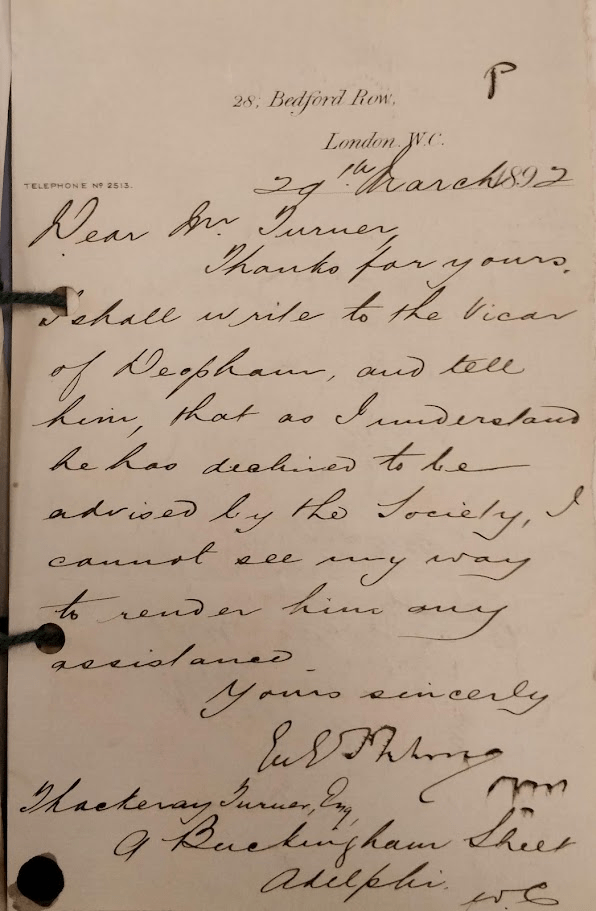
Image courtesy of the SPAB (Society for the Protection of Ancient Buildings), all rights reserved.
Footnotes
- The “parson” at this time was the Rev. Hibbert Wanklyn. ↩︎
- This is another thinly veiled criticism of Ewan Christian who had supervised the south aisle repairs. Further details on the south aisle project of 1867 are accessible here. ↩︎
- Encaustic tiles are ceramic tiles in which the pattern or figure on the surface is not a product of the glaze but of different colours of clay (Wikipedia). ↩︎
- Altar-pace: the steps or platform on which an altar stands in a church. ↩︎
- This comment by Ewan Christian asking William Morris’s SPAB to campaign against the removal of ancient glazing in order to replace it with stained glass is made with a huge dose of irony. William Morris had done very well out of supplying and fitting stained glass for church restorations. ↩︎
Navigation
| Date | Change |
|---|---|
| 21/2/24 | Published |
 Deopham History