Vicar of Deopham 1850 – 1861
Contents
Biography
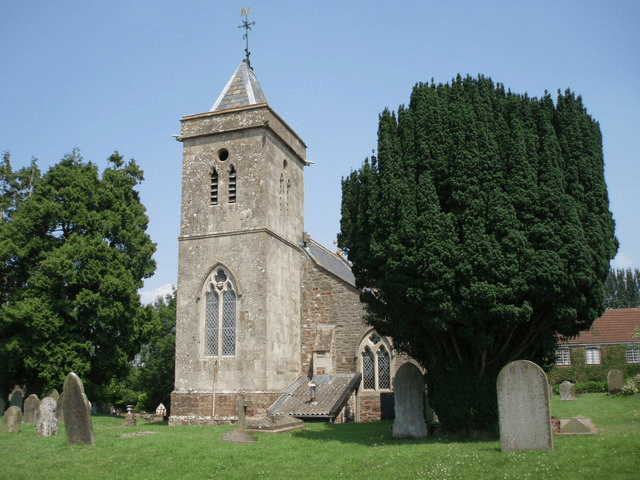
Chelwood – Baptism
George Henry Turner, son of John and Caroline, was baptised by his father on April 13th 1821 in the now redundant church of St. Leonard at Chelwood, Somerset. His father is shown as being a priest. The 1851 census recorded Turner as being in Deopham with a birthplace of Corston, Somerset – some 5 miles from Chelwood.

© Ancestry
Ashbrittle
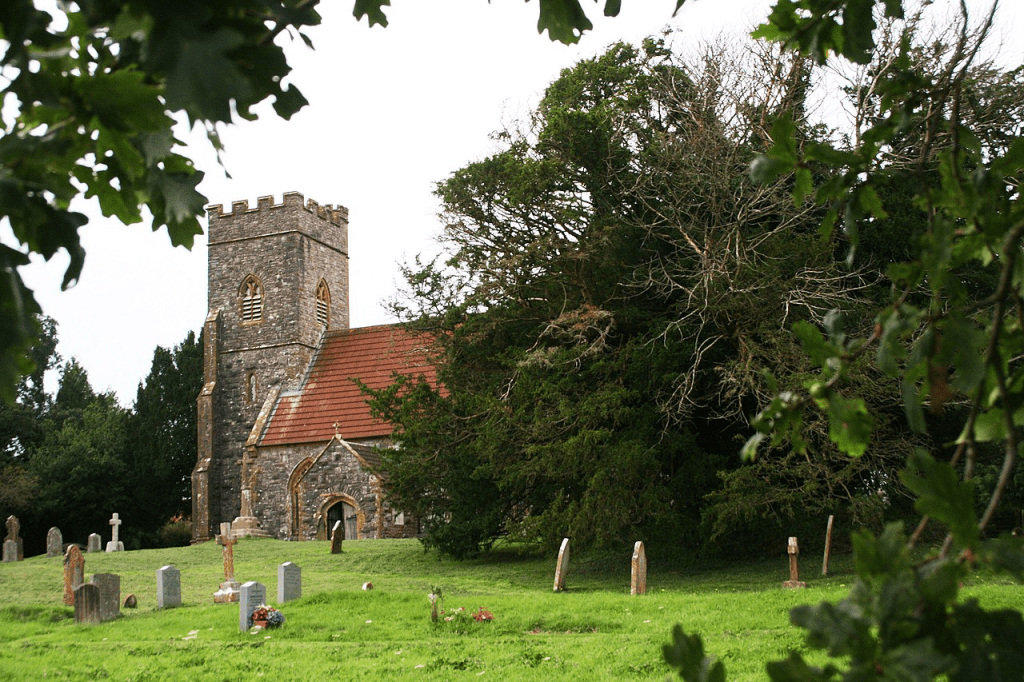
At the time of the 1841 census, George Turner was still living with his parents who by then had moved to Ashbrittle in Somerset (the churchyard contains a yew tree that is at least 3,000 years old).

© Ancestry
Education
George Turner was educated at Balliol College Oxford where he attained his B.A. in 1843 and his M.A. in 1847; he was ordained deacon in 1845 by the Bishop of Salisbury at Wells Cathedral, and priest in 1846 by the bishop of Salisbury.1
Holborn
The Churchman’s Companion of 1851 said that Rev. George Turner had previously been the curate of St. Andrew’s, Holborn before coming to Deopham.
Deopham
The Norfolk News of August 17th 1850 says that Rev. George Henry Turner M.A. was instituted to the Vicarage of Deopham on July 29th 1850. He first appears in the Register of Burials on November 1st, 1850.
This was a particularly important appointment for the village since for a long time the village had not had a resident vicar (the last one was likely to have been the Rev. William Cullyer at the end of the 17th century). By the time of the Rev. George Turner’s appointment, the Pluralities Acts passed in 18382 and 18503 had outlawed clergy from holding the living for multiple parishes (pluralism) and also from being resident outside the parish from which they drew their income. Turner’s predecessor (the Rev. Richard Adams) was both non-resident and the holder of parishes in plurality. The Rev. Richard Adams had financed a number (at least eight) of curates to act on his behalf in Deopham – these are listed in the table of Incumbents and Curates here.
One of the problems resulting from there not having been a resident vicar in the village for many years was that there was no vicarage. At the time of the 1851 census, carried out on April 8th, the Rev. George Turner was living at “Green” – in a household of ten persons made up of himself and his wife, a son and daughter, his father, both in-laws and two servants. Clearly at this stage the new vicarage had not been completed. There is more information on the financing, construction and subsequent enlargement of the vicarage here.
White’s 1854 directory confirms that Rev. George Turner was the incumbent at that time.
The following advertisement appeared in the Norfolk Chronicle dated Saturday, December 8th 1860 shortly before his departure from Deopham:-
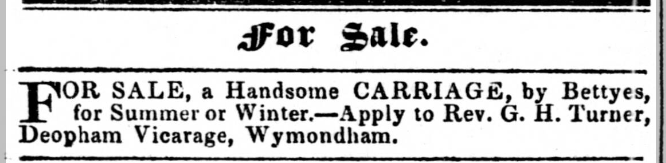
Preparing to Move out of Deopham
In 1860, the Rev. George Turner started to make arrangements to swap his job in Deopham with that of the Rev. Hibbert Wanklyn who was based at Eton College. The reason for either of them wanting to change is not recorded.
The Dean & Chapter of Canterbury’s Letter book includes copies of correspondence written by their Daniel Finch. Unfortunately it is one-sided: the letters that they received have to be guessed at!

The following letter was written on November 15th 1860 to the Rev. G.H. Turner at Deopham saying:
I have written this day to Mr. Wanklyn for his testimonials previous to the Chapter deciding to assent to the proposed exchange of livings.
I have addressed my Letter Eton Coll. – the address you gave me 2nd Nov.
The Dean & Chapter received the Rev. Wanklyn’s testimonials as referred to above, and wrote to the Rev. Wanklyn at Eton College on November 29th 1860 as follows:
I herewith return your Institution to Fleet Marston, Admission to Parish Orders and Certificate of Subscription.
The Testimonials I retain for the present at least as the Chapter cannot at present decide on the application made to them.
It will however be considered and decided upon next week of the week following.
The Dean & Chapter wrote to the Rev. Wanklyn at Eton College, Windsor, as follows on December 19th 1860:
The matter of the exchange of the Living of Deopham was brought before the Chapter at their Audit but the Chapter thought it right that some inquiries should be made before their decision thereon should be pronounced.
I can only say that as soon as anything is determined, it shall be communicated to you,
A couple of days later, on December 21st 1860, the following letter was sent to the Rev. Wanklyn, again at Eton College, Windsor, confirming his appointment:
I have received instruction from the Dean & Chapter to prepare a Presentation of yourself to the Vicarage of Deopham as soon as the Cession of Mr. Turner is certified to me with the date on which the Vicarage became vacant.
This is required in the Form of application to the Ecclesiastical Commissioners for a certificate of the value by which the Stamp is regulated.
I presume you have but one Christian Name (Hibbert). Will you let me know your Degree.
Another letter was sent on the same day to Rev. G.H. Turner at Deopham:
I have now got instructions from the Chapter to make out Mr. Wanklyn’s Presentation to Deopham as soon as your having vacated the living is certified to me.
I have written to Mr. Wanklyn to the like effect.
It appears that the Rev. Turner was in no hurry to move on, with the following being written from Canterbury to the Rev. Wanklyn on February 26th 1861:
I shall hope to receive in a day or two a Certificate from Mr. Turner of his resignation of Deopham having been accepted. No time shall be lost in preparing your Presentation.
There is a note dated March 19th 1861 recording that the Presentation to Deopham had been sent to the Rev. H. Wanklyn at Deopham Vicarage, stating that the fees of £8 12s 8d should be “paid to C.A. at convenience”.
This correspondence was reproduced courtesy of the Chapter of Canterbury; their ref CCA-DCc/LB/OLB/11.
Move South
After Deopham, Crockford’s Clerical Directory recorded that he took up an appointment at Fleet Marston near Aylesbury, a tiny village with a population of 23, and a church attendance of 8 at the time of the 1851 Religious Survey.
The record of the Court of the Manor of Deopham of the Dean & Chapter of Canterbury held on October 20th 1866 summarised his travels as “formerly of Deopham, late of Ilford, Essex then of Bayswater in Middlesex”. At this Court, it was recorded that he had sold an eight acre field in Deopham for £400. Likewise, the Court of the Manor of Shadwells otherwise Cockerells of June 27th 1867 gave the same description of his movements, recording that at that time his wife was Elizabeth. At that Court, it is recorded that he sold another field of 8 acres, adjacent to that mentioned above.
The 1868 edition of Crockford’s Clerical Directory did not include an entry for George Turner, implying that at that time he did not hold a clerical post.
The 1871 census recorded that George Turner, his wife Sarah and eight children (8 of which are recorded as being born in Deopham) were living at No. 15, Burlington Road, Paddington, London. His profession was recorded as “Clergyman”. The 1872 edition of Crockford’s Clerical Directory did not include an entry for George Turner, implying that at that time he still did not hold a clerical post.
The 1881 census recorded his residence as being in a house called “Woodlands” (not the vicarage) in Woodham Walter, Essex, having remarried. His 23 year old daughter Jessie Maude (described as having been born in Deopham) was living with them. His occupation is stated as being “Vicar of Tolleshunt Major” which is some 8 miles from his home.
Volume 4 of the Alumni Oxoniensis4 recorded:

The period spent in Deopham is conspicuously absent, in fact the whole period from 1847 when he gained his M.A. until 1872 when (according to the above cutting) he started at Branksea Island is completely missing. A number of newspapers reported that he actually started there in January 1873. His resignation in 1874 is confirmed in the press. The presence of a daughter born in Deopham living with him in Woodham Walter whilst being vicar of Tolleshunt Major anchors him to this extract of lives of Oxford graduates.
Death and burial
The Rev. Henry Turner died on July 9th 1884 whilst still vicar of Tolleshunt Major, Essex. He was buried in Kensal Green Cemetery in the Royal Borough of Kensington and Chelsea, Greater London.
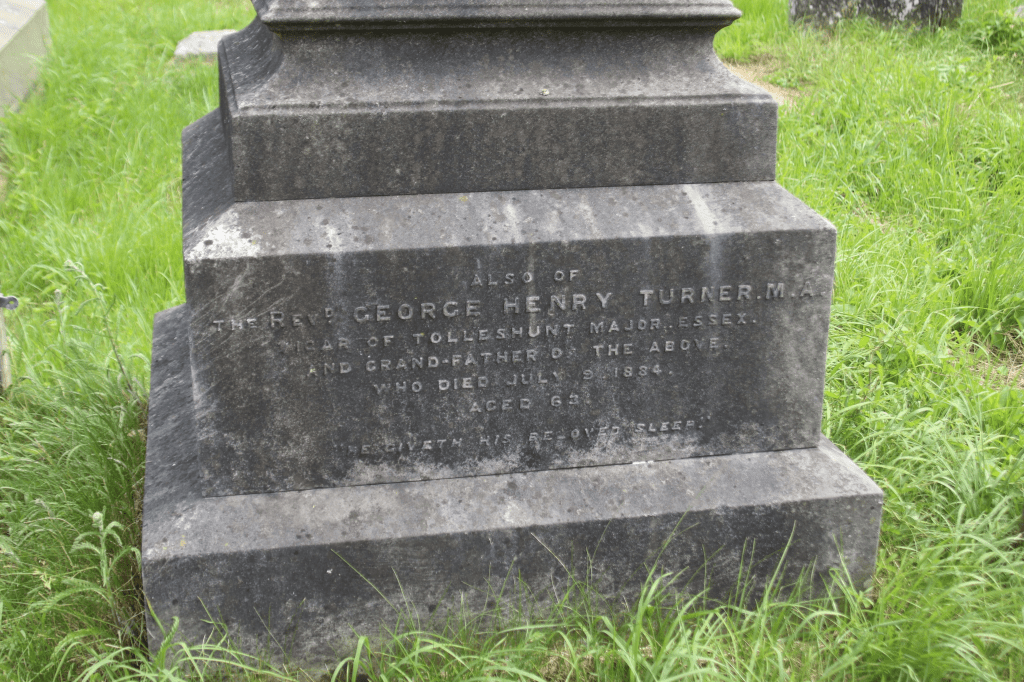
© Findagrave
Legacy
The opening in 1851 of the first village school (thereby completing the project started by the Rev. Henry Spencer), the building of a vicarage and some renovations of the church were the Rev. George Turner’s legacy to the village. The extent of his contribution to both has been overestimated since his successor the Rev. Hibbert Wanklyn was left with much work to do on both, as well as a lot of work on the vicarage that Turner had started.
Footnotes
- Information from Crockford’s Clerical Directory for 1865, pg 634:

Further details on his ordination are recorded here.
↩︎ - Although this Act had limited many of the practices that were being criticised (particularly outside the Church of England), it still contained a large number of escape clauses making it somewhat ineffectual.
https://www.legislation.gov.uk/ukpga/Vict/1-2/106/contents
↩︎ - Spiritual Persons not to hold Benefices in Plurality except under certain Circumstances.
That, notwithstanding any Provision in the said recited Act contained, it shall not be lawful, after the passing of this Act, for any Spiritual Person to take and hold together any Two Benefices, except in the Case of Two Benefices the Churches of which are within Three Miles of one another by the nearest Road, and the annual Value of one of which does not exceed One hundred Pounds.
https://www.legislation.gov.uk/ukpga/Vict/13-14/98/enacted
↩︎ - Alumni Oxoniensis (1715-1886) volume 4.djvu/243, page 1449
↩︎
Navigation
| Date | Change |
|---|---|
| 22/5/25 | Correspondence concerning exchange of livings with Rev. H. Wanklyn |
| 3/1/25 | Note on Court of Shadwells otherwise Cockerells of June 27th 1867 |
| 17/4/24 | 1866 Manor Court record; comments on Branksea Island |
| 6/4/24 | 1860 carriage advertisement |
| 24/1/24 | Pluralities and non-residence |
| 5-6/11/23 | 1871 Census & Crockford’s |
| 25/10/23 | Baptism + 1841 census |
| 23/10/23 | 1851 Census |
| 27/8/23 | Comment about Burials Register |
| 29/11/22 | Published |
 Deopham History