Contents
The Sale Process
Proposed sale to Mr. F. T. W. Hurrell
It was recorded that the sale of the farm was first raised on August 18th 1950 during an inspection by Lord Tovey. Messrs. Smith, Gore & Co. stated that they were “considering recommending the Commissioners to sell this property”.
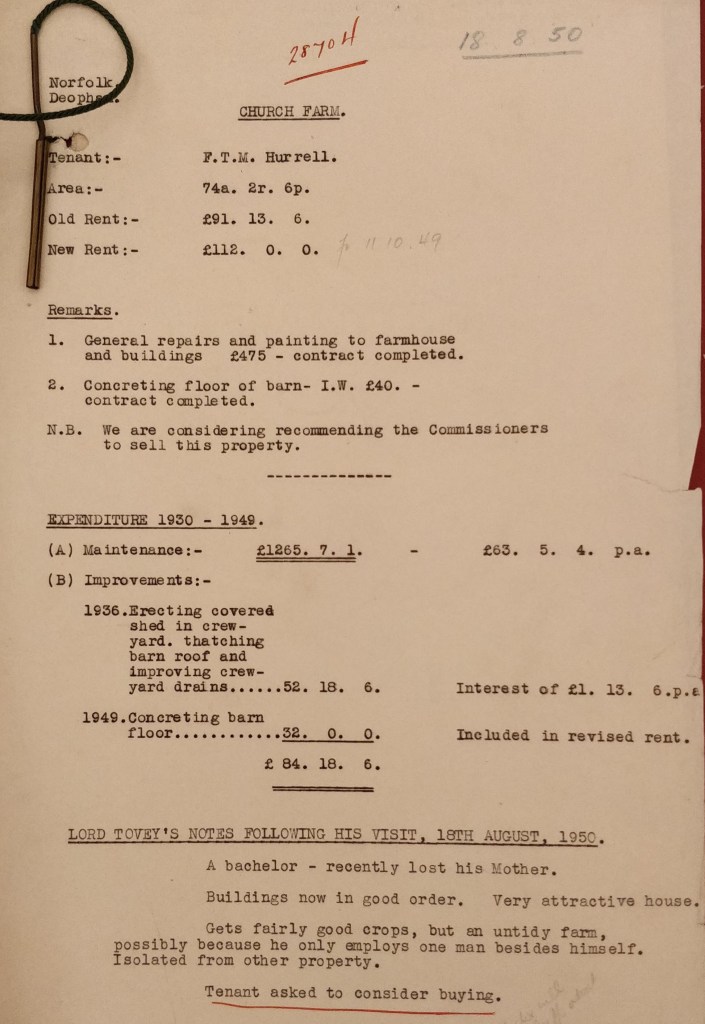
Image courtesy of Lambeth Palace Library, file 28704
A formal request was then presented by Messrs. Smith, Gore & Co. to the Church Commissioners on June 6th 1951 that the farm should be sold to Mr F. T. M. Hurrell:

Image courtesy of Lambeth Palace Library, file 28704
The property is described in the attached annexe as

The attached plan referred to above is shown below, although unfortunately the image is not too clear:
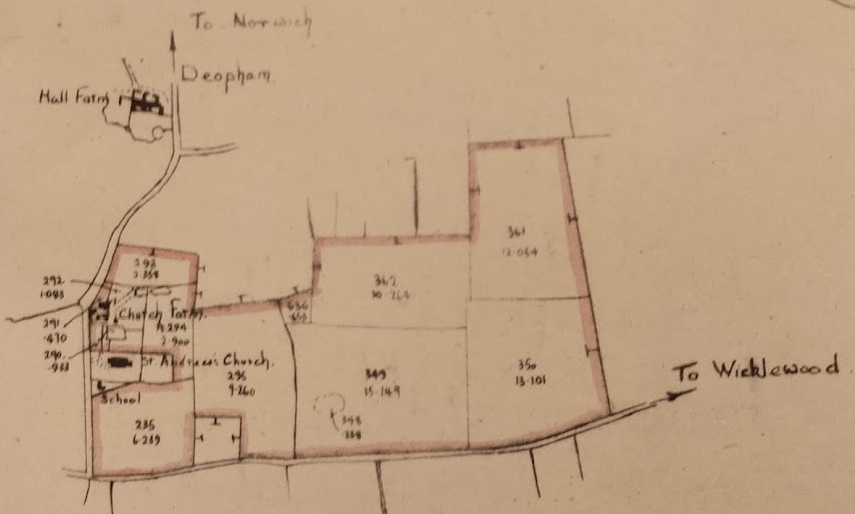
The outline from the above map has therefore been transferred to the 1906 OS Map LXXIII:

Reproduced with the permission of the National Library of Scotland
The land shown as included in the sale is as follows:
| Piece no on the above map | Acreage |
|---|---|
| 235 | 6.239 |
| 290 | 0.933 |
| 291 | 0.470 |
| 292 | 1.083 |
| 293 | 2.358 |
| 294 | 2.900 (3.400 less the extended churchyard) |
| 295 | 9.260 |
| 348 | 0.338 |
| 349 | 15.149 |
| 350 | 13.101 |
| 361 | 12.054 |
| 362 | 10.264 |
| 363 | 0.653 |
| Total | 74.802 |
Minerals
A memo dated October 8th 1951 from a Senior Legal Assistant for the Official Solicitor stated:-
In their Minute dated 6th June 1951, the Commissioners approved this sale upon the terms advised by Messrs. Smith, Gore & Co., in which the minerals are to be reserved. The Mineral [sic] Department reported that there are no mineral leases and the Purchaser considers that no minerals of any value can exist and hopes that the Commissioners will not insist on the reservation.
In a letter dated 4th October the Purchaser’s Solicitors said that their Client will proceed with or without the minerals but that they would pay a sum not exceeding 10 guineas towards the cost of an Investigation and Report by the Commissioners’ Mineral Agent. It is hoped that you will confirm that there are no minerals worth reserving and that the Mineral reservation in the Conveyance can therefore be deleted.
There are some handwritten notes on this document where Mr. Hall asks Mr. Warren for confirmation concerning the minerals, commenting that “We appear to be getting a good price for the farm (£3,400)”. Mr. Warren confirmed that “the minerals can be included in the sale, and need not be reserved”.
A few days later, on October 11th 1951, Mr. Hall the “Principal Officer” confirmed to the Legal Department that “the Church Commissioners will not insist on the reservation of minerals as stipulated in Messrs. Smith, Gore & Co’s report of the 24th May last and these may therefore be included in the sale”. This document still refers to the purchaser as being Mr. Hurrell.
Sale to Mr G. Peacock
For some reason, Mr. Hurrell withdrew from this transaction and a short time later in 1951 Mr. Geoffrey Liddelow Peacock purchased the farm:


Image courtesy of Lambeth Palace Library, file 28704
Navigation
| Date | Change |
|---|---|
| 16/4/25 | Link to source document of October 8th 1951 |
| 31/3/25 | Published |
 Deopham History