Contents
Origins of the Name
University of Nottingham
Deopham:
‘Deep homestead/village’.
The name may be referring to a deep place in a nearby lake, Sea Mere.
Elements and their meanings
- dēope (Anglian) A deep place, especially in water.
- hām (Old English) A village, a village community, a manor, an estate, a homestead.
- hamm (Old English) Land hemmed in by water or marsh (perhaps also by high ground); a river-meadow; cultivated plot on the edge of woodland or moor.1
Blomefield
Blomefield wrote: [Depham] “is so called from
– deop, deep, and
– ham, a village,
that is, the deep or miry village“.2
In John Bunyan’s book Pilgrim’s Progress, the adjective “miry” is used in a very derogatory sense to refer to the “Slough of Despond”:
Now I saw in my Dream, that just as they had ended this Talk, they drew nigh to a very Miry Slough that was in the midst of the Plain, and they being heedless, did both fall suddenly into the Bog. The name of the Slough was Despond. Here therefore they wallowed for a Time, being grievously bedaubed with Dirt; and Christian, because of the Burthen that was on his Back, began to sink in the Mire.3
It is likely that John Bunyan derived this terminology from Psalm 40:2. Bunyan has a further biblical quote4 with which Blomefield would have been familiar, and may have been in his mind when using this word “mire”:
“The dog is turned to his own vomit again; and the sow that was washed to her wallowing in the mire” (2 Peter 2:22). As an ordained priest, Francis Blomefield would have been well aware of these uncomplimentary word associations, although why he had a problem with Deopham is not yet apparent.
Bernard Kranenburg
Several years ago Bernard Kranenburg contacted Phil Long drawing attention to the possible link between two Dutch villages with Norfolk’s Deopham and Hackford:
Deop means indeed deep, but also a kind of lowland (Dutch: diepte). According to old Anglish namerules Deopham therefore means “the ham (region) near the lowland”. In Twente (N.E. Netherlands) there is a village called Diepenheim, or in local tongue “Deephem” or just “Deep”. More to the south there is an old manor called Hackfort: the ford (wading place in river) near a hack (clearing in wood). This manor dates from about 400 AD.
The whole of N.E. Netherland is historic Anglish land. Since Norfolk seems to be old Anglian land, it might be possible that people from Diepenheim and Hackfort have migrated to the area of Deopham and Hackford in Norfolk. It is quite common that migrants call their new settlement after their old homeland.
Various spellings
1086 Domesday Book:

c. 1200 – Grant in Alms:
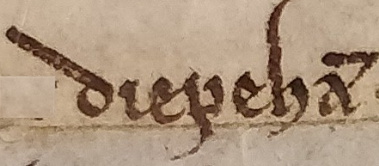
1227 – An assessment of the vicarage of Deopham:

late 13th century – Quitclaim:
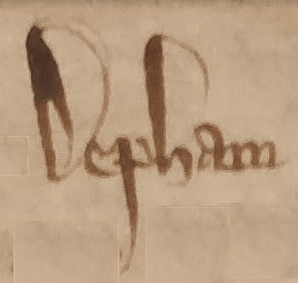
1309 – Court Roll of the Manor of Deopham of the Dean & Chapter of Canterbury:
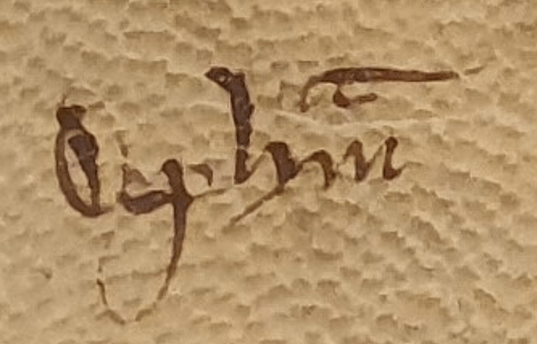
1538 – Lease:
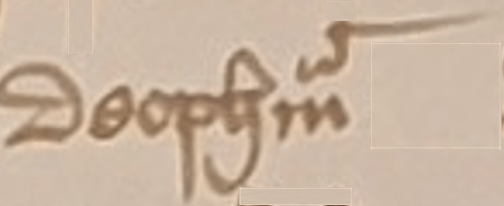
1626 – Court of the Manor of Shadwells otherwise Cockerells:
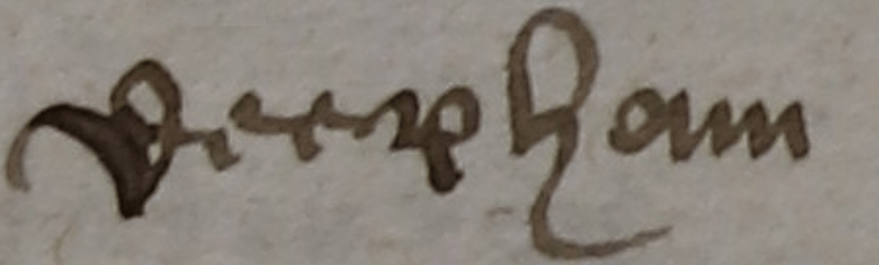
1629 – Map of Morley created for Martin Sedley by Thomas Waterman5:

1641 – Court of the Manor of Deopham of the Dean & Chapter of Canterbury:
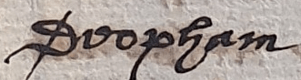
1643 – Court of the Manor of Deopham of the Dean & Chapter of Canterbury:
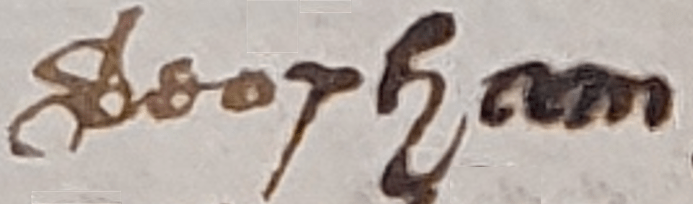
1656 – Court of the Manor of Shadwells otherwise Cockerells

1675 – Court of the Manor of Deopham of the Dean & Chapter of Canterbury:

1805 – Blomefield

1837 – Court of the Manor of Shadwells otherwise Cockerells of Morley:

Sometimes a little withdrawn:

2024 – Parish sign:

Footnotes
- http://kepn.nottingham.ac.uk/map/place/Norfolk/Deopham retrieved 24/7/25. ↩︎
- Blomefield – An essay towards a topographical history of the county of Norfolk, Volume 2, page 490. See here for the full text relating to Deopham. ↩︎
- John Bunyan, Pilgrim’s Progress, W. Johnston, 1764, pg 9. ↩︎
- Ibid pg 82. ↩︎
- All rights reserved by Norfolk Record Office who hold the original;
their ref is NRO PD 3/108 ↩︎
| Date | Change |
|---|---|
| 3/9/25 | Published |
 Deopham History