Also spelt Blomvyle, Blomvyles, Blomeviles, Blomville
Contents
History
The history written by Francis Blomfield included a paragraph on the subject of Blomevile’s Manor. This has been referenced in compiling the following sequence of events.
It has been recorded that Hubert de Rye was richly rewarded by William the Conqueror after the invasion of Britain for the life-saving favours he had previously given to the Conqueror in France. This reward was held as land, which passed to his son, Hubert.
Upon Hubert’s death, his assets passed to his son Henry de Rye.
One third of the Manor held by Henry was given to William de Blundevile (or Blomevile). Henry also passed on to this William one third of the right to appoint the parish priests of Deopham (this privilege was known as the advowson). William de Blundevile lived in Newton Flotman.
Blomefield recorded that William’s son, Richard de Blomevile, gave his one-third share of the advowson to the monks of Canterbury in 1226: he also stated that this gift was confirmed by Thomas de Blomevile, who appears to have been Richard’s uncle. Amazingly, the document by which Richard de Blomevile gave up his right to the advowson is still extant in the archives at Canterbury Cathedral:
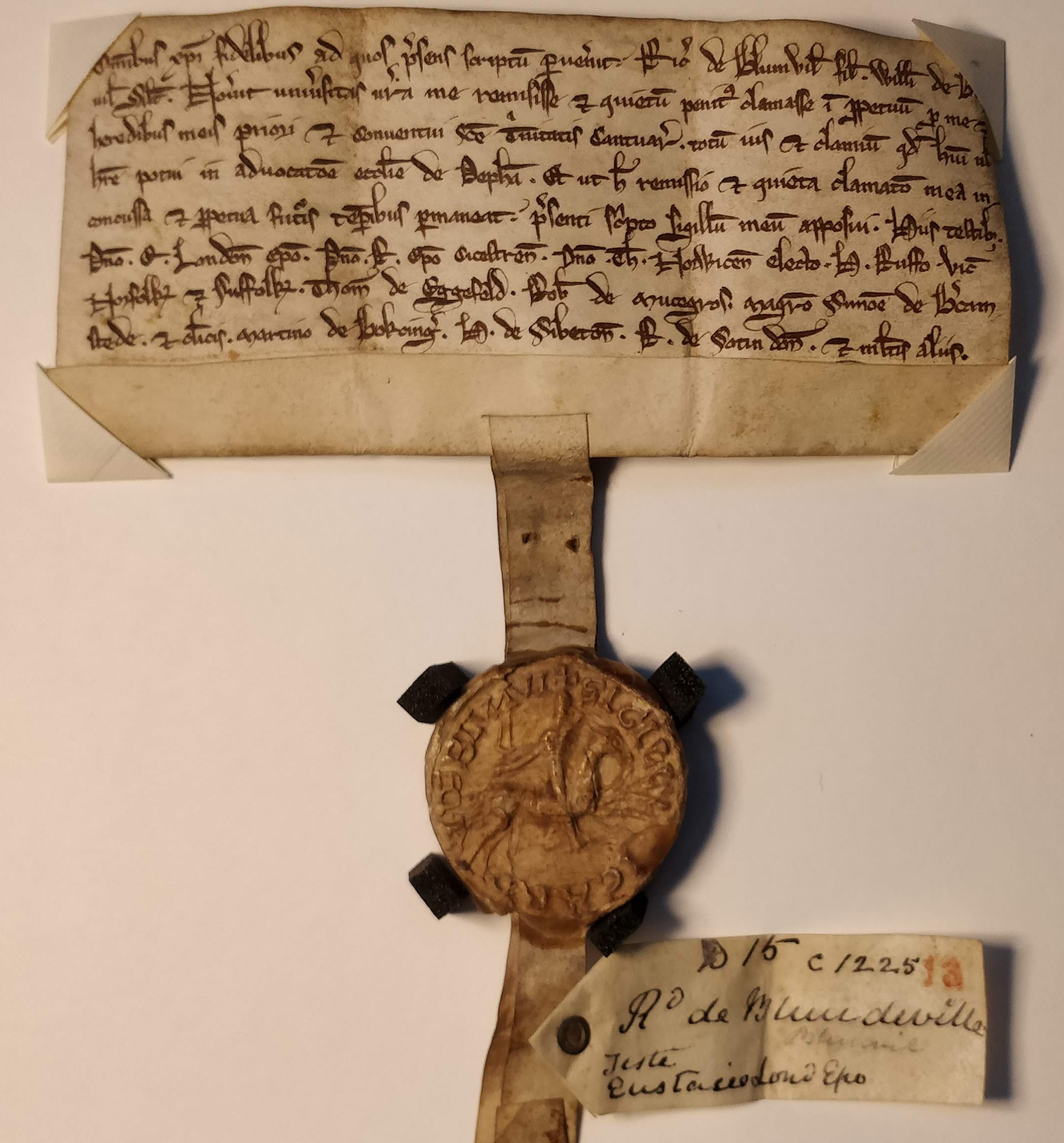
Reproduced courtesy of the Chapter of Canterbury; their ref CCA-DCC-Chant/D/15
The declaration carries the seal of Blaumville:
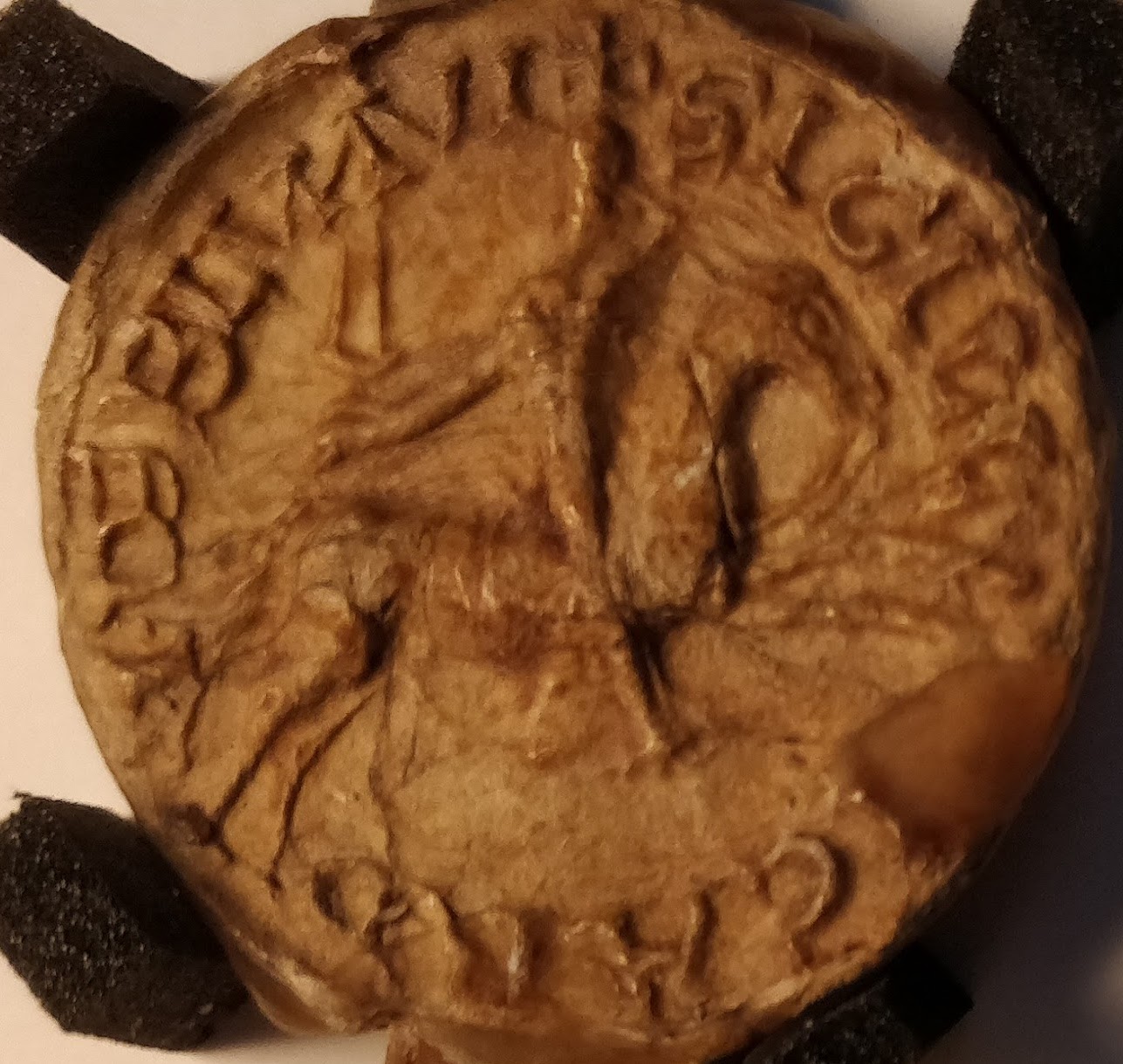
Reproduced courtesy of the Chapter of Canterbury; their ref CCA-DCC-Chant/D/15
At this time, c. 1226, part of the Manor belonged to the Wachesham family. From them, this part passed to the de Creping family.
In 1249, John de Blomevile possessed the Blomevile share, and in 1260 William de Blomevile was lord of that part.
Hugh de Creping then conveyed his half-fee to William de Blomevile, and from then on the whole estate took the name Blomevile’s Manor.
Blomefield, in his history, listed the succession of the Manor’s ownership as follows:-
- In 1282, William de Blundevile held the manor from Gerard de Wachesham, who in turn held from Giles Plais.
- By 1302, Roger Cosyn held the manor, probably as guardian or trustee for the heirs of William de Blomevile.
- In 1320, William de Blomevile settled the manor on his wife Margaret, probably as part of a marriage settlement.
- By 1345, Ralph Bokyng held the manor in right of his wife, as her dower (the portion of the husband’s estate to which a widow was entitled for her lifetime). The manor formed part of the inheritance of William Blomevile.
- In 1401, Richard Blomevile held the manor.
- In 1489, Richard Blundevile was Lord of the Manor. He died around 1503.
The manor was then sold, subject to an existing life interest, to Roger Woodhouse, Esquire. In 1572, Henry Richers, Esquire, was lord during the lifetime of his wife. She apparently died around 1578, after which Roger Woodhouse became lord.
From that time onward the manor remained in the Woodhouse family, and at the time Blomefield was writing his history (1739), Sir John Woodhouse, Baronet, was the Lord of the Manor.
Successor in Manor of Deopham Hall
A letter from Mr. Gilman dated October 6th 1796, written during the initial stages of the inclosure discussions, made the direct link between the Manor of Blomevile and the Manor of Deopham Hall
Navigation
| Date | Change |
|---|---|
| 24/6/26 | Published |

